At Peach, we continue to invest in cutting-edge technologies that push the boundaries of loan servicing. One example of this is our focus on generative AI-powered servicing enhancements to improve agent productivity and the borrower experience. Because we’ve built our servicing tech in-house and in an API-first manner—and because our platform fully integrates loan management, servicing, collections and compliance—Peach is uniquely positioned to help lenders quickly realize the benefits of generative AI.
Our newest AI-powered innovation is Case Notes Summarization, a capability designed to reduce the time agents spend reviewing case histories in the Peach CRM. By employing generative AI to systematically and succinctly summarize a case’s full history of notes, we’re now able to meaningfully streamline agents’ case management workflows. In this post, we’ll take a closer look at how Case Notes Summarization works as well as the technology behind it.
The business objective: Increasing agent productivity
The core business objective of Case Notes Summarization is simple: To increase the productivity of agents by reducing their time spent reviewing case histories.
This is an especially important pain point in the context of collections, where it’s typical for multiple agents to work a single case and where cases may contain dozens or even hundreds of notes. Historically, agents have always reviewed each note to piece together a clear and accurate chronological picture of the case history and associated loans. This is a time-consuming and tedious process that’s susceptible to human error.
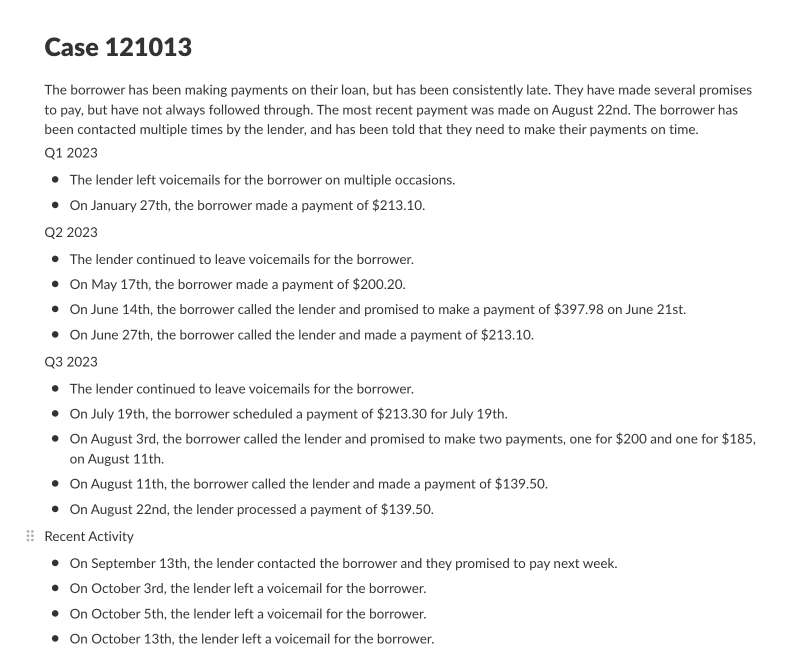
However, this challenge fits squarely within the wheelhouse of generative AI. Which is why we’ve invested in a tool that will, with the click of a button, generate a concise summary of all notes attached to a given case.
WATCH CASE NOTES SUMMARIZATION IN ACTION
With this tool, agents gain quick access to a concise yet comprehensive overview of the case history. This empowers them to quickly comprehend the current loan status and see the chronological sequence of any relevant events associated with the case. As a result, agents can take the necessary actions more quickly and with greater context. Agents can in turn handle more cases in a given time period.
While the primary benefit of Case Notes Summarization is increased agent productivity, there’s an additional positive impact on the borrower experience. Any reduction in the time borrowers spend waiting on an agent is a net positive, as are improvements in agents’ understanding of case histories. By quickly gleaning the essential points of the case, agents can engage with borrowers more thoughtfully, reinforcing trust and providing more personalized solutions.
Translating business objectives into machine learning goals
To assess the effectiveness of Case Notes Summarization, we needed a consistent testing framework. We determined that the utility of Case Notes Summarization could be understood through a proxy metric: the normalized number of queries made to our case note endpoint. As Case Notes Summarization gains traction within servicing teams, agents consult the case notes themselves less often, leading to a reduction in queries to the case note endpoint. This change is a positive indicator of increased efficiency in the handling of cases, of a smoother workflow that reduces the bottleneck in information retrieval, and of more time being redirected toward proactive customer engagement.
Concurrently, for offline evaluation, we employ the standard ROUGE-L metric for measuring the preciseness of our summary-generation algorithm.
Machine learning tools and methods
A crucial part of the engineering process in developing this feature was selecting the appropriate tools. Our collaboration with Google's Vertex AI proved fruitful, giving us a diverse set of offerings to explore. We decided to leverage a blend of self-hosted open-source models and other advanced models available on Vertex AI, ensuring the best fit for our requirements.
To refine our models, we conducted a series of detailed experiments, exploring methodologies such as fine-tuning, distillation and prompt engineering. We also leveraged techniques like chain-of-thought and self-consistency sampling for prompts, coupled with frequent tests using various large language model (LLM) parameters and temperatures.
Our experiments were carefully monitored and recorded, enabling us to meticulously manage and version all experimental models. This systematic tracking allowed us to effectively compare experimental iterations and determine optimal models.
A/B testing, monitoring and improvisations
At Peach, we value consistent performance monitoring and enhancements. And so we’ve ensured steady tracking of system performance, swiftly detecting and handling anomalies. A/B testing is also pivotal to our approach, especially when it comes to testing various models and prompt variations. The data insights obtained in this process enable us to make necessary adjustments and improvements.
Integrating LLMs into our production environment presented unique challenges, particularly in managing the variability in output format inherent to natural language processing. To tackle this challenge, we invested heavily in precise prompt engineering, meticulously crafting our queries to guide the LLMs toward generating more predictable and structured responses. Concurrently, we fortified our downstream processing code, enhancing its ability to handle a range of input variations.
Where we go from here
Our journey in developing our Case Notes Summarization tool reinforced our conviction around the vast potential of LLMs in solving real-world challenges for lenders.
We’re still near the start of our generative IT journey, and we already have an extensive roadmap in place. We will continue to navigate the rapidly advancing AI landscape to identify the platform enhancements that offer the highest return for our clients. As ever, we are committed to delivering unmatched efficiency and value in disruptive ways, continually orienting the lending technology industry toward the areas of greatest opportunity. Stay tuned for more updates as our roadmap comes to fruition.
If you'd like to learn more about how our AI-powered servicing tools can increase your operational efficiency, please reach out.
lender’s priority list. But that doesn’t mean compliance is straightforward, even for lenders with the most earnest intentions. Often, legacy infrastructure is the culprit, making it difficult for lenders to take the actions clearly outlined in the law. Even regulations that haven’t changed for some time—like the—still present significant challenges for many lenders.
The SCRA grants active-duty service members the ability to request certain protections during the period of their deployment, enabling them to devote their energy to serving the country. These protections include a reduction in interest rate to a maximum of six percent on any pre-service loans. While the SCRA in its current version has been law since 2003, the number of recent enforcement actions indicates just how difficult it is for many lenders to comply with the SCRA’s interest rate protections.
Blunt tools in the absence of a scalpel
For example, in October of 2022 the Department of Justice (DOJ) announced that the financial leasing arm of GM agreed to pay over $3.5 million to resolve allegations in relation to
Peach’s approach to SCRA
At Peach, we brought real-life lending experience to the design of our platform. So from day one, we recognized the importance of being able to make retroactive changes to loans. (There are numerous applications beyond SCRA, including our Supported Portfolio Migration.) In the case of SCRA, Peach has long enabled lenders to retroactively change interest rates and waive past fees—as separate, manual actions.
Peach’s approach to SCRA
This was functional, but the ideal way to implement SCRA is to make these changes simultaneously. We now support this capability by leveraging the power of Peach's Loan Replay™ engine, which can make changes to the ledger at any time, and then recalculate a loan’s history in light of those changes. The new combined functionality is as user-friendly for your agents as processing a payment.
Peach’s approach to SCRA
Specifically, the new SCRA feature allows your agents to perform the following adjustments simultaneously on a loan of an active-duty service member:
- Lower interest rates to 6% (and lower the recurring payment during the active-duty period to account for the interest rate reduction)
- Waive fees, if necessary
- Enact these changes retroactively, if necessary, and replay the loan history with the rate and fee adjustments
- Preview the intended changes
“We launched our first product on Peach in six weeks. Eighteen months later.”
John Smith, CMO
Our SCRA functionality is available via API as well as through our white-label agent tool. The white-label agent interface can be seen here:
Peach’s approach to SCRA
Our SCRA functionality is available via API as well as through our white-label agent tool. The white-label agent interface can be seen here:
For those working directly with the API, this can be as simple as sending the following request body to the SCRA endpoint:
You’ll receive a response with either the actual post-SCRA adjusted payment plan or a preview of it. Below is a comparison of a payment plan prior to the SCRA adjustment, and the expected payments after the SCRA adjustment. The SCRA period is in effect for the first two months, and thus you will see the interest rates lowered to 6% in the response body (and the recurring amount due lowered by the amount of the interest rate reduction for the two relevant months). The origination fee has also been canceled.
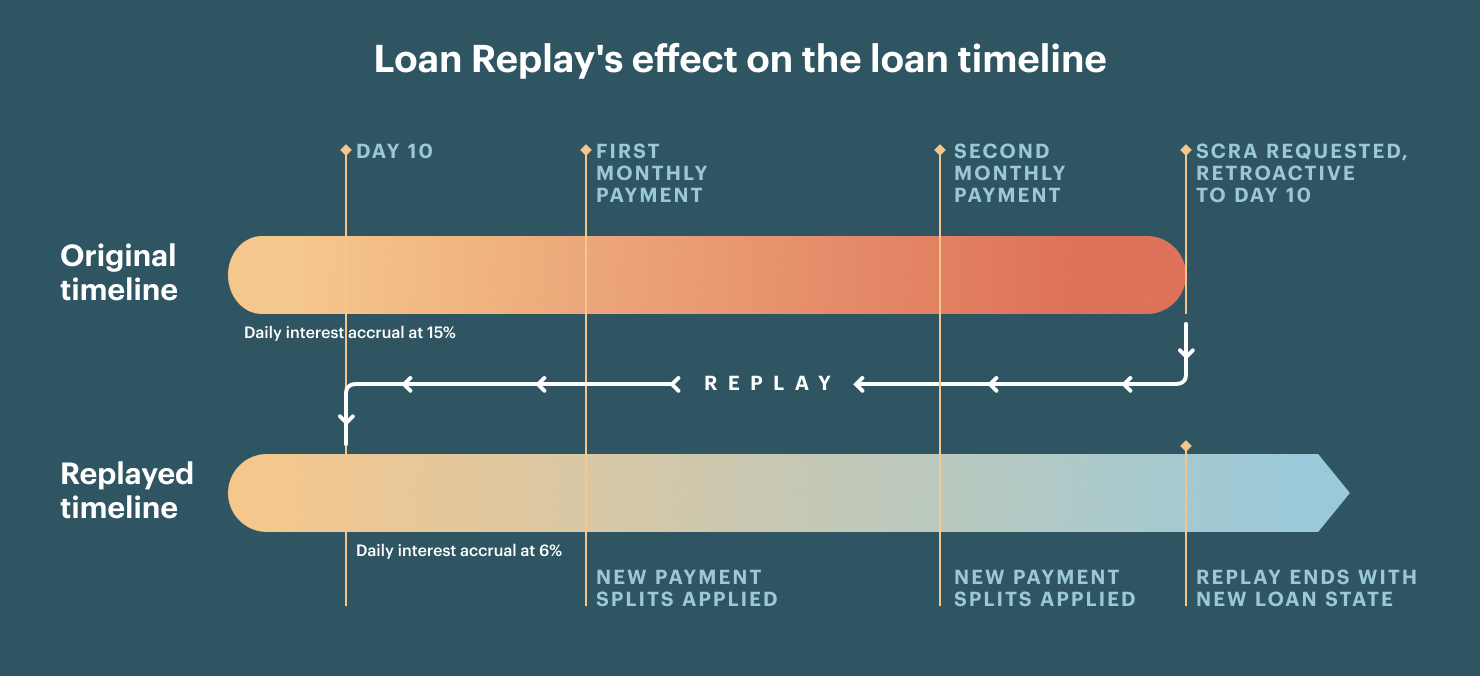
The breadth of loan data needing to be adjusted means that rewriting loan histories requires the right design and abstractions, and having a built-in layer of abstraction to handle retroactive changes is the only feasible approach. Because of our team’s combined experience in the real world of lending, we know that the need to edit past loan events is inevitable. So we’ve designed a system that makes these changes as painless and automated as possible.