Beyond the binary choice of build or buy, a compelling third option exists: integration. This approach enables lenders to capture benefits of both buy and build approaches, and reduces the risk of disadvantages of either option over time. Integration offers lenders the choice of bringing or building their own internal solutions that are proprietary or unique to market, and integrating those solutions with a purchased platform like Peach.
Peach is an event-driven, highly configurable, API-first platform which makes integration possible across a range of capabilities from its comprehensive and resilient ledger, to borrower communications to agent servicing tools. Lenders can access off the shelf solutions through Peach’s servicing suite, making it possible to rapidly deploy to market while building internal tools over time. It’s a blend of buy and build made possible through integration with the portions of the Peach platform that the lender wants to supplement their own tech stack, reserve internal resources for proprietary internal projects, and optimize time to market product releases.
Let’s break down the considerations for an integration approach such as one with Peach.
Advantages of Integration:
- Resource effectiveness: It can be more cost-effective than a full custom build and potentially more flexible than a monolithic off-the-shelf solution.
- Focused customization: Customize configuration, not code. Prioritize internal resources to customize lender-owned systems, while leveraging Peach’s API-first, highly configurable variables to achieve market fit.
- Flexibility and scalability: Migrate existing portfolios or launch new ones in our flexible infrastructure that supports multiple product types. Our cloud-native platform scales up or down as needs change.
- Speed to market: Implement new product configurations quickly in time with business launch to market requirements. Use existing systems, integrate new ones, or transition between while getting the best of internal resources coupled with external expertise.
- Access to Specialized Expertise: Integration allows lenders to tap into the specialized capabilities of other companies. Peach continues to improve the platform to offer lenders the modern solutions and tools needed to remain current in the market.
Considerations for Integration:
- Make sure systems connect smoothly: Successful integration depends on good, readily available connections (APIs, etc.) enabling access to data for many use-cases. Using an API-first approach allows for easier updates and additions without causing disruptions.
- Get the right experts involved: Integrating different systems can be complex and requires technical knowledge. Combining the internal team's expertise with the integration platform's experts ensures a successful outcome.
- Keep data flowing correctly: It's essential that data moves easily between systems. The integration platform should provide clear visibility into lender data and any related events.
- Choose a partner who understands the business: Working with a partner who knows the challenges of loan management and servicing will lead to better, long-term results. They can create tailored solutions, saving lenders time and money.
Conclusion: Choosing the Right Path
In today's dynamic lending environment, the conventional 'build versus buy' decision could be answered with “both” through the strategic advantage of integration. This approach empowers lenders to leverage the speed and cost-effectiveness of off-the-shelf solutions while maintaining the focused customization and control of bespoke development. Integration, particularly with a platform like Peach, allows for the optimal allocation of internal resources towards core, differentiating systems, while harnessing external expertise and API-driven flexibility for loan management and servicing.
Peach provides an event-driven, highly configurable, and API-first platform that connects with existing systems, enabling rapid market entry while maintaining data integrity and ensuring scalability. By partnering with Peach, lenders gain access to specialized domain expertise and a platform designed for a high degree of configurability, effectively mitigating the limitations of both pure 'buy' and 'build' strategies. This allows lenders to create a tailored technology ecosystem that is both agile and robust, adapting to evolving business needs and technological advancements, and ultimately driving sustained competitive advantage.
With Peach, it’s not a binary decision to build or buy, we offer the best of both options through integration.Contact us today to setup a discovery meeting.
lender’s priority list. But that doesn’t mean compliance is straightforward, even for lenders with the most earnest intentions. Often, legacy infrastructure is the culprit, making it difficult for lenders to take the actions clearly outlined in the law. Even regulations that haven’t changed for some time—like the—still present significant challenges for many lenders.
The SCRA grants active-duty service members the ability to request certain protections during the period of their deployment, enabling them to devote their energy to serving the country. These protections include a reduction in interest rate to a maximum of six percent on any pre-service loans. While the SCRA in its current version has been law since 2003, the number of recent enforcement actions indicates just how difficult it is for many lenders to comply with the SCRA’s interest rate protections.
Blunt tools in the absence of a scalpel
For example, in October of 2022 the Department of Justice (DOJ) announced that the financial leasing arm of GM agreed to pay over $3.5 million to resolve allegations in relation to
Peach’s approach to SCRA
At Peach, we brought real-life lending experience to the design of our platform. So from day one, we recognized the importance of being able to make retroactive changes to loans. (There are numerous applications beyond SCRA, including our Supported Portfolio Migration.) In the case of SCRA, Peach has long enabled lenders to retroactively change interest rates and waive past fees—as separate, manual actions.
Peach’s approach to SCRA
This was functional, but the ideal way to implement SCRA is to make these changes simultaneously. We now support this capability by leveraging the power of Peach's Loan Replay™ engine, which can make changes to the ledger at any time, and then recalculate a loan’s history in light of those changes. The new combined functionality is as user-friendly for your agents as processing a payment.
Peach’s approach to SCRA
Specifically, the new SCRA feature allows your agents to perform the following adjustments simultaneously on a loan of an active-duty service member:
- Lower interest rates to 6% (and lower the recurring payment during the active-duty period to account for the interest rate reduction)
- Waive fees, if necessary
- Enact these changes retroactively, if necessary, and replay the loan history with the rate and fee adjustments
- Preview the intended changes
“We launched our first product on Peach in six weeks. Eighteen months later.”
John Smith, CMO
Our SCRA functionality is available via API as well as through our white-label agent tool. The white-label agent interface can be seen here:
Peach’s approach to SCRA
Our SCRA functionality is available via API as well as through our white-label agent tool. The white-label agent interface can be seen here:
For those working directly with the API, this can be as simple as sending the following request body to the SCRA endpoint:
You’ll receive a response with either the actual post-SCRA adjusted payment plan or a preview of it. Below is a comparison of a payment plan prior to the SCRA adjustment, and the expected payments after the SCRA adjustment. The SCRA period is in effect for the first two months, and thus you will see the interest rates lowered to 6% in the response body (and the recurring amount due lowered by the amount of the interest rate reduction for the two relevant months). The origination fee has also been canceled.
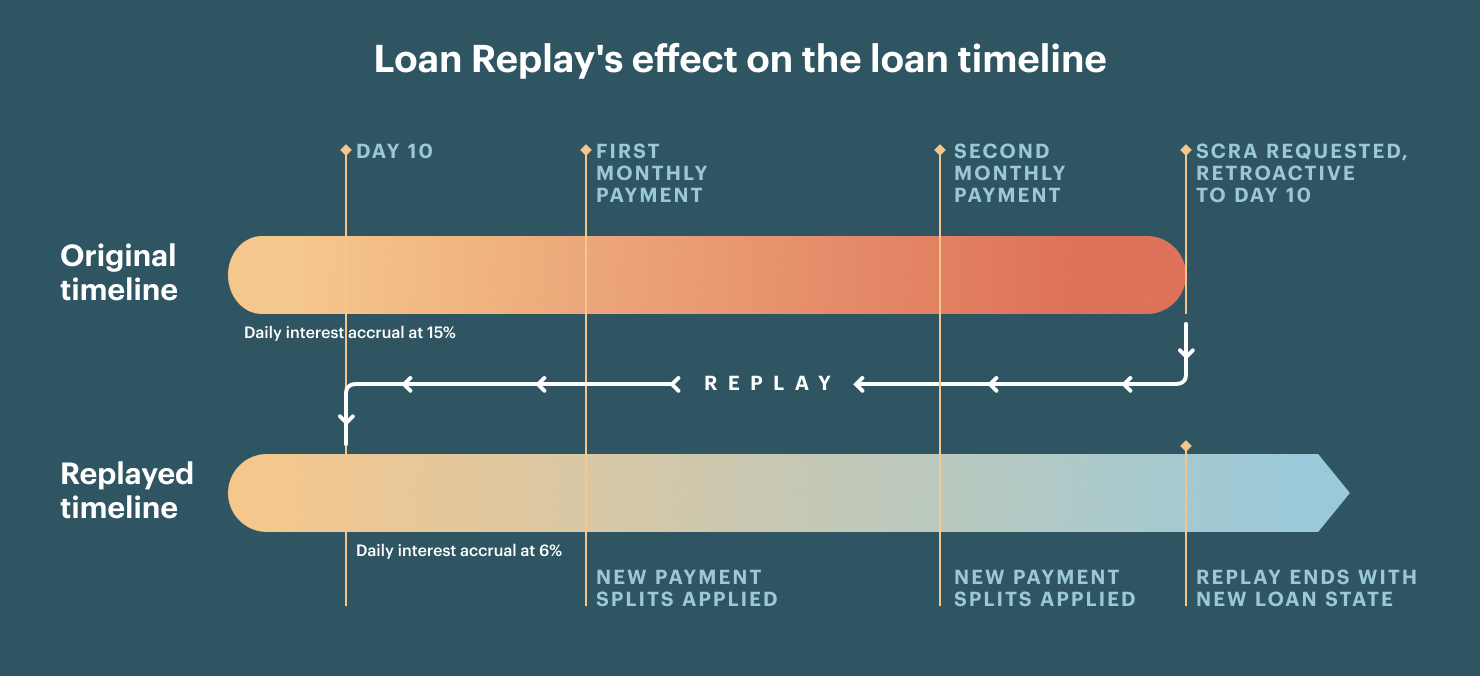
The breadth of loan data needing to be adjusted means that rewriting loan histories requires the right design and abstractions, and having a built-in layer of abstraction to handle retroactive changes is the only feasible approach. Because of our team’s combined experience in the real world of lending, we know that the need to edit past loan events is inevitable. So we’ve designed a system that makes these changes as painless and automated as possible.