A Metro 2 credit reporting file reports what your servicing system knows about each loan. The system underneath models product structure, fees, interest, and loan modifications. A file can only be accurate if that system represents the loan honestly, so the decision that shapes the file happens the day you pick the platform, long before an export ever runs.
Credit Reporting Is a Servicing Function
The first of the month comes around, and the credit file starts building on your screen.
You watch it pull together from the same account records your team touched all month. The Metro 2 file, the standardized monthly report lenders send to the credit bureaus, isn't composed fresh when you hit send. Your servicing platform generates it from records that already exist.
That matters more than it looks.
Loan servicing is the ongoing management of a loan after it's created. Account administration, payments, borrower communications, delinquency work, collections. All of it lives in the same system the credit file reads from when the cycle runs.
So the file inherits whatever those records say. Faithfully. Including anything they got wrong.

Credit reporting sits in the post-origination period, the stretch after disbursement, identity checks, and underwriting are done. Peach doesn't originate loans or decide who qualifies. By the time the file assembles, all of that is settled, and what goes out is a read of what your system already believes about each account.
This is where the mental model usually breaks. The export step feels like the place correctness happens, like the file is being written there. It isn't. The send reads prior state. It doesn't create accuracy.
The file can't know anything your account records don't already carry.
Which means the honesty of what reaches the bureaus was decided weeks ago, in the ledger and the account events your team was posting all along. You can't fix it at export time.
You already own the only place it can be fixed.
What It Costs When the File Is Wrong
The compliance lead spends the week after a bad file went out doing one thing. Tracing it.
Borrower by borrower, pulling each account that got reported wrong, working out who was hit and how far it reaches. The error is already gone from your hands. It landed on real people's credit, and now the only job left is measuring the damage.
Here's what makes that week heavy. When a borrower's score takes a hit from wrong data, the borrower feels it first, but the responsibility points back at you. You furnished the data. That makes the harm your exposure too, and it can turn into liability for violations.
So hold the bar at every month, with correct data, all of it. A most-months record doesn't clear it.
Sit with that, because the standard runs differently here. A report that's right eleven months out of twelve isn't ninety-two percent right. It's a wrong file for every borrower it missed that one month. Averaging doesn't apply. There's no partial credit for a good streak.
That's the part that catches teams who already report. You built the pipe once. The first files cleared. It feels like background plumbing now, something that runs itself.
It doesn't. Each cycle is a fresh claim that the data is accurate. Building the connection once didn't discharge the duty. It started it.
Treat this as a directional read of the stakes, not a quantified or settled legal count. But the shape holds. Correctness can't be the thing you aim at each month. It has to be the state the system already sits in before you send.
That's the bar worth setting. Not a clean file, but a file that was never going to be dirty.
Where the Numbers in the File Come From
A borrower says the balance you reported last month is wrong. Now you're the one who has to prove it either way. So you open the ledger and start chasing the number.
Here's what you find first. The balance in that file wasn't a photo taken at month-end. It was a direct read of the ledger and the payment records, the same records the system kept every day the loan was open.
The ledger is just the running account of every dollar that moved on the loan. What was charged, what was paid, what was reversed. Payment processing feeds it, meaning the movement and status of each borrower payment through bank, card, or an outside processor lands in that record as it happens.
So the file can only be as honest as those records. Reporting accuracy is record accuracy.
There's no separate truth the export reaches for at the end of the month.
Now the corrected entry. When something was fixed mid-month, you don't see the old number erased. In Peach's ledger, the original entry is kept and marked no-longer-in-effect, and the correction sits beside it. Preserved and invalidated, not overwritten.

That's a claim about how Peach built its ledger, not about how every loan management system handles a correction. Plenty overwrite.
But this is why the reported figure holds up. You can show the borrower the current number and the trail that produced it. The entry that was wrong, the moment it changed, the entry that replaced it.
A number you can walk backward is a number you can defend.
When the Past Changes After You Have Already Reported It
A servicing agent enters a fee waiver this morning. The waiver legally took effect two months ago.
Now there's a fork. Patch today's balance to net out the fee and move on. Or apply the change at the date it actually belongs to.
The patch feels done. It isn't.
Two reported months already went out with the fee still sitting on the loan. Adjusting today's number leaves those months frozen and wrong. You'd correct the present and let the past stand.
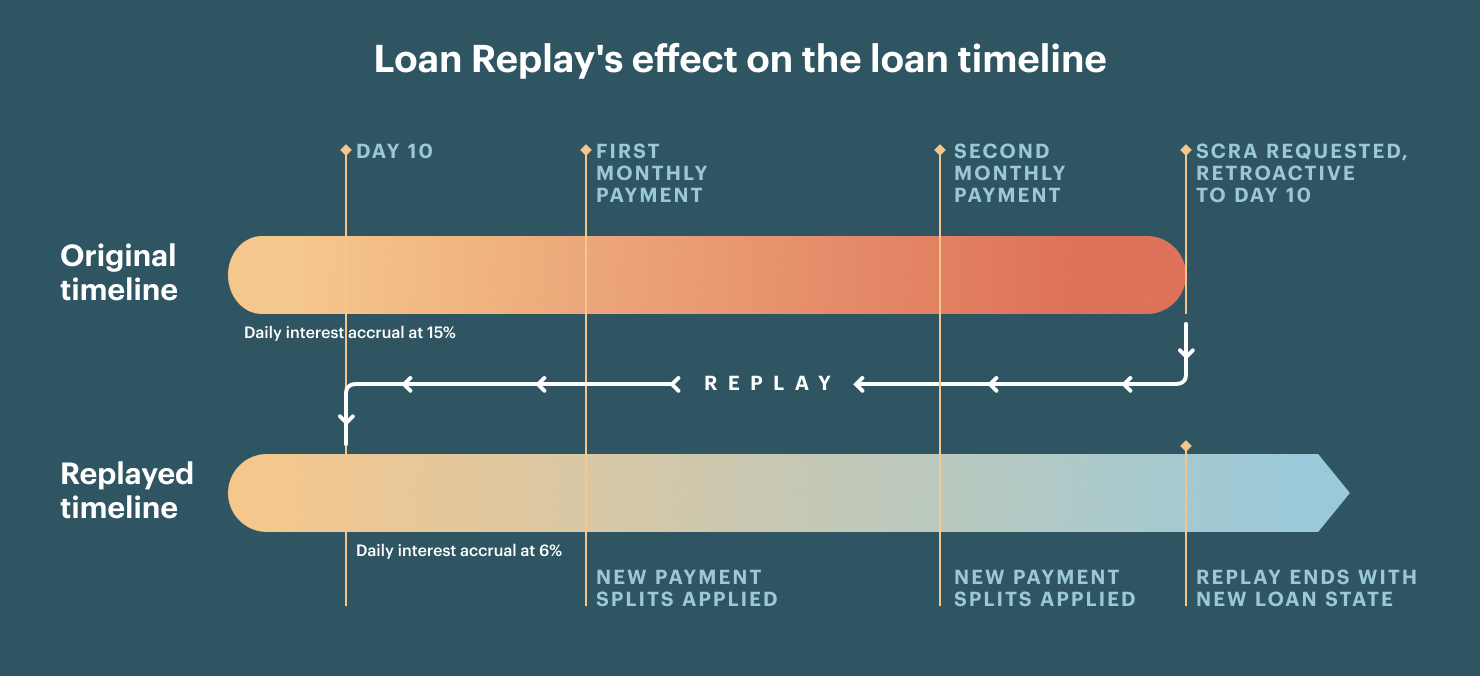
Peach handles this with Loan Replay, its retroactive recalculation feature. Loan Replay applies a servicing change at a past effective date and replays the interim period forward while preserving ledger history. In plain terms, the system reruns those two months as if the waiver had been in force the whole time.

Not a note bolted onto the current figure. A rebuilt span of time.
That replay runs automatically across the money on the account. Interest gets reaccrued over the corrected timeline. Fees get reapplied. So do repayments, against the new schedule. What comes out is a fresh split of each payment between principal and interest, plus a corrected current status for the loan.
So the next file carries what should have happened all along, not a patch with nothing behind it.
Loan Replay recomputes the loan from a corrected starting point and derives the new numbers itself. It's a recalculation engine, not a reconciliation or matching engine, so it doesn't check your records against the bureau's or match anything external against what's internal.
The ledger trail survives the rebuild. Original entries stay on the record. The change that set off the replay stays visible. You get the corrected months and the proof of how they got corrected.
That's the shift you want in your head. A backdated change isn't an edit to today's number. It's a rebuild of the timeline, and the rebuild is what keeps a corrected month reportable instead of leaving you a patched figure you can't defend.
What the Platform Does and What You Still Own
A dispute lands on a charged-off account. Your head of credit pulls the file to answer it.
Catch the reflex here. If the servicing system generated the Metro 2 file, it feels like that system also owns the dispute, the answer, and the bureau waiting on the other end.
It doesn't. That work stays with you.
You're the furnisher. A furnisher is the lender that sends account data to the credit bureaus, and the bureaus hold you, not your software, accountable for what that data says. Your platform supplies the numbers and keeps the record. Answering for them is your job.
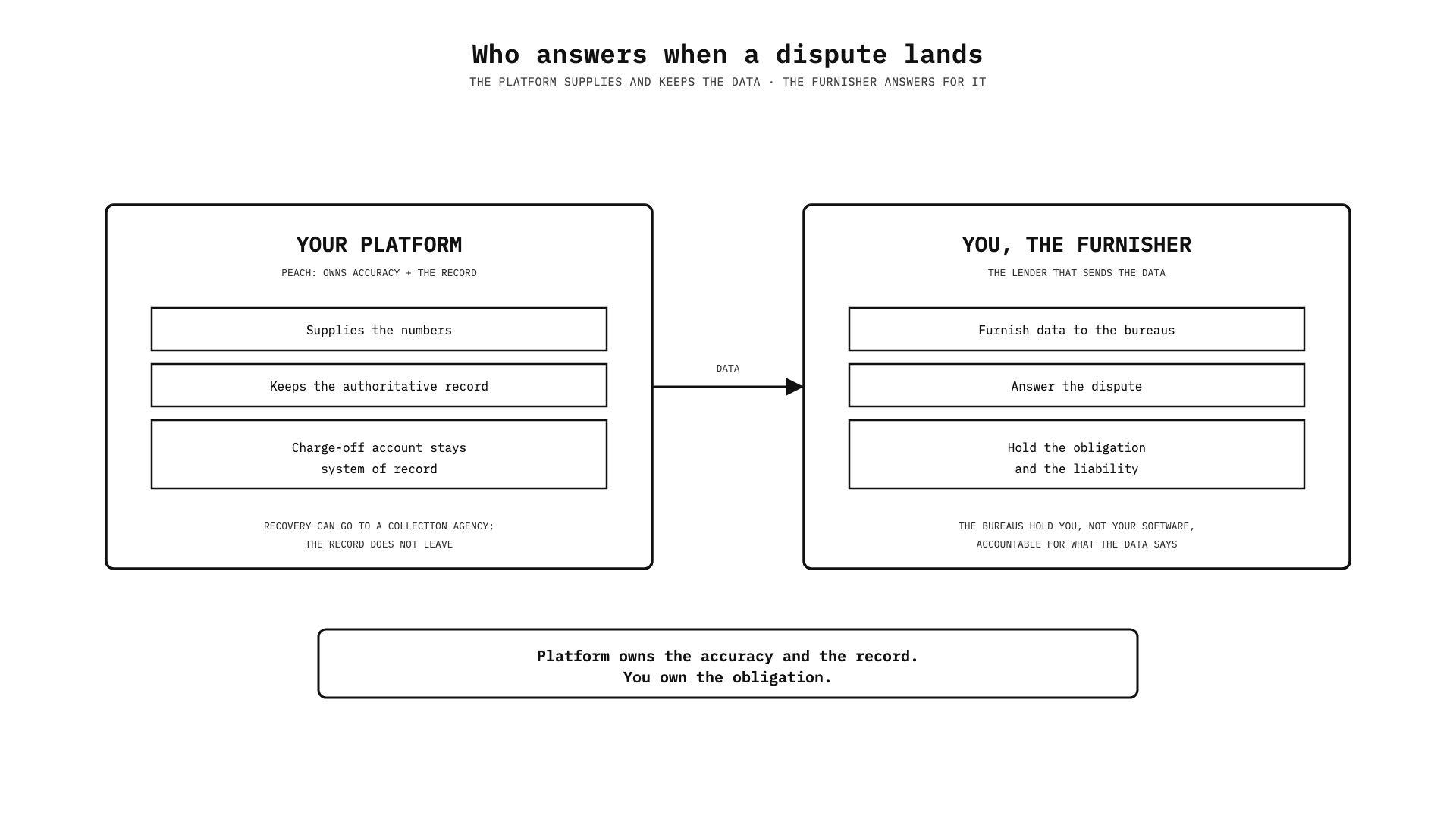
A charged-off account makes the split easy to see. Charge-off is a status on the loan, not the loan leaving your book. In Peach's data model that account can be handed to a collection agency for recovery while Peach stays the system of record. Nothing got wiped. Nothing exited. That authoritative record still sits where you can source an answer from it.
So when the dispute comes in, the answer didn't leave with the account. It's in the servicing system, ready to pull.
One more line worth holding. Peach doesn't originate loans, and it doesn't underwrite or make credit decisions. It manages the loan after it already exists. That's the record it holds and the data it stands behind.
Cleanest way to keep it straight. Your platform owns the accuracy and the record. You own the obligation.
Blur that, and you're assuming a system will answer a dispute it's only equipped to supply the data for.
How to Know the File Is Safe to Send
The CTO and the head of credit are in the last vendor call. They came in wanting a checklist. Which fields to eyeball before the monthly file goes out the door.
Wrong altitude.
A checklist at export time checks a file that's already written. By then the decision that shaped it's months old. You made it the day you picked the platform.
So judge the file before it exists. Ask whether the system underneath can represent your loan honestly, because a file can only be right if the thing generating it can model the loan right in the first place.
As a working read of how these evaluations go, three things earn the most weight in that room. Whether the platform can support your product structure, your fees, your interest calculations, and your loan modifications. Whether it holds up on performance, scalability, and stability as the portfolio grows. And whether it reports clearly, thoroughly, and accurately.
That last one is the tiebreaker. Performance you feel under load, product fit at launch. Accurate reporting is the criterion that shows up every month, for the life of every loan on the books. It's the one that decides whether the file matches reality.
Here's where buyers slip. They tend to weight the parts that shine in a demo, integrated origination and loan types they can configure by hand. Those look like power. Then they underweight the dull question, can this system report my loans truthfully, month after month.
The dull one wins. It recurs.
For the dispute, accuracy, and bureau-acceptance specifics, you don't need them relisted here. Peach's public credit-reporting documentation already lays them out, and that's where the detail lives, at docs.peachfinance.com/credit-reporting.
The buyers who get this right pick for the criterion that never stops mattering. Can this platform model my exact loan and report it accurately every month, for as long as those loans are on the books. Treat that as a directional read of what matters, without a quantified or settled criterion behind it. Make that call before the file is due.
Frequently asked questions
What is Metro 2 credit reporting?
Metro 2 credit reporting is the standardized monthly report lenders send to the credit bureaus. Your servicing platform generates it from account records that already exist, so the file reports what your system already knows about each loan. It sits in the post-origination period, after disbursement and underwriting are done. It doesn't originate the loan or decide who qualifies.
Is credit reporting a servicing function?
Yes. Credit reporting reads from the same system that handles account administration, payments, borrower communications, delinquency work, and collections. The Metro 2 file isn't composed fresh when you send it. It inherits whatever those account records say, including anything they got wrong. That's why reporting accuracy is record accuracy.
Who is responsible for credit reporting accuracy, the lender or the platform?
The lender. As the furnisher, you send the account data to the credit bureaus, and the bureaus hold you, not your software, accountable for what that data says. Your platform supplies the numbers and keeps the record. Answering for them is your job.
Can you fix a credit reporting error after the file has already been sent?
Not at export time. The send only reads prior state, so the fix happens in the account records the file is built from. When a change takes effect in the past, Peach's Loan Replay applies it at the correct effective date and replays the interim months forward while preserving ledger history, so the next file carries corrected months instead of a patch on today's balance.
lender’s priority list. But that doesn’t mean compliance is straightforward, even for lenders with the most earnest intentions. Often, legacy infrastructure is the culprit, making it difficult for lenders to take the actions clearly outlined in the law. Even regulations that haven’t changed for some time—like the—still present significant challenges for many lenders.
The SCRA grants active-duty service members the ability to request certain protections during the period of their deployment, enabling them to devote their energy to serving the country. These protections include a reduction in interest rate to a maximum of six percent on any pre-service loans. While the SCRA in its current version has been law since 2003, the number of recent enforcement actions indicates just how difficult it is for many lenders to comply with the SCRA’s interest rate protections.
Blunt tools in the absence of a scalpel
For example, in October of 2022 the Department of Justice (DOJ) announced that the financial leasing arm of GM agreed to pay over $3.5 million to resolve allegations in relation to
Peach’s approach to SCRA
At Peach, we brought real-life lending experience to the design of our platform. So from day one, we recognized the importance of being able to make retroactive changes to loans. (There are numerous applications beyond SCRA, including our Supported Portfolio Migration.) In the case of SCRA, Peach has long enabled lenders to retroactively change interest rates and waive past fees—as separate, manual actions.
Peach’s approach to SCRA
This was functional, but the ideal way to implement SCRA is to make these changes simultaneously. We now support this capability by leveraging the power of Peach's Loan Replay™ engine, which can make changes to the ledger at any time, and then recalculate a loan’s history in light of those changes. The new combined functionality is as user-friendly for your agents as processing a payment.
Peach’s approach to SCRA
Specifically, the new SCRA feature allows your agents to perform the following adjustments simultaneously on a loan of an active-duty service member:
- Lower interest rates to 6% (and lower the recurring payment during the active-duty period to account for the interest rate reduction)
- Waive fees, if necessary
- Enact these changes retroactively, if necessary, and replay the loan history with the rate and fee adjustments
- Preview the intended changes
“We launched our first product on Peach in six weeks. Eighteen months later.”
John Smith, CMO
Our SCRA functionality is available via API as well as through our white-label agent tool. The white-label agent interface can be seen here:
Peach’s approach to SCRA
Our SCRA functionality is available via API as well as through our white-label agent tool. The white-label agent interface can be seen here:
For those working directly with the API, this can be as simple as sending the following request body to the SCRA endpoint:
You’ll receive a response with either the actual post-SCRA adjusted payment plan or a preview of it. Below is a comparison of a payment plan prior to the SCRA adjustment, and the expected payments after the SCRA adjustment. The SCRA period is in effect for the first two months, and thus you will see the interest rates lowered to 6% in the response body (and the recurring amount due lowered by the amount of the interest rate reduction for the two relevant months). The origination fee has also been canceled.
The breadth of loan data needing to be adjusted means that rewriting loan histories requires the right design and abstractions, and having a built-in layer of abstraction to handle retroactive changes is the only feasible approach. Because of our team’s combined experience in the real world of lending, we know that the need to edit past loan events is inevitable. So we’ve designed a system that makes these changes as painless and automated as possible.