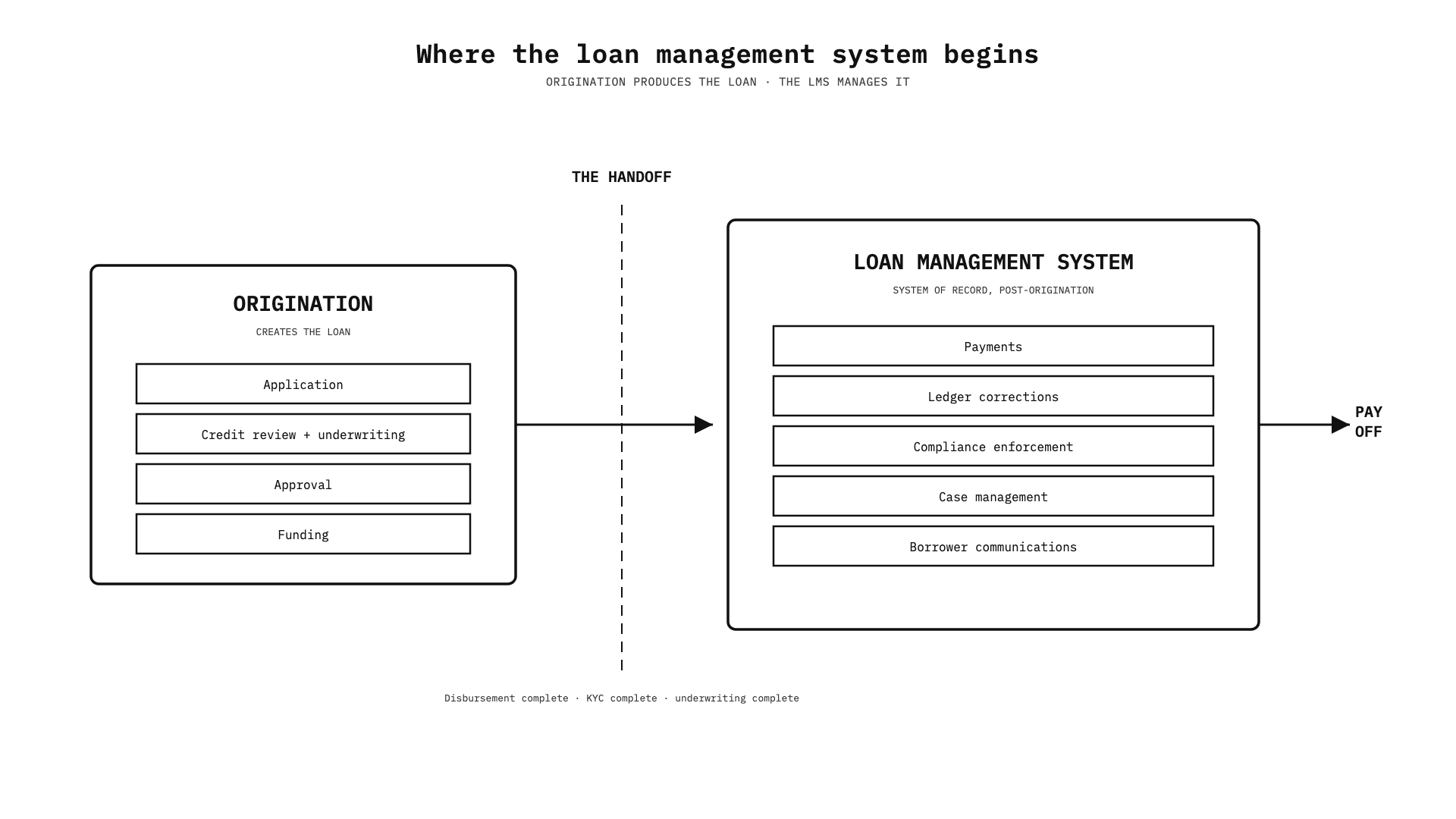
Origination builds the loan and underwriting sets who gets it and on what terms. A loan management system owns what comes next. It starts once the money is out and a borrower owes a real balance, and it services the account through payoff or charge-off across installment, revolving, and BNPL structures. The buying test is simple: ask where a capability lands on the loan's life, before the money or after.
Where the System's Working Life Actually Starts
The money already left. A borrower applied, got approved, and the funds hit their account. Now there's a loan sitting in front of you, and someone has to run it. What runs it?
Ask most people what a loan management system does and you'll hear the same answer. Software that automates the whole loan lifecycle, application through payoff. It sounds right. That's where things can get confusing.
Look at what happened before that loan showed up. Origination created it, the process that runs application, credit review, approval, and funding. Underwriting sat inside that same stretch, the evaluation of whether a borrower qualifies for credit and what terms they're offered. Both finished before the loan became a funded account. Both ran in their own systems.
That system wasn't in the room for any of it.
Its working life starts at a specific line. Post-origination, the period after disbursement, KYC, and underwriting are complete. Everything upstream, the application, the credit call, the wire, belongs to other software. A loan management system is a different system from the one that made the loan, built to pick up an account that already exists.
Real products draw that same line. Peach's Servicing Suite, one example, covers the end-to-end post-origination period: everything after disbursement, KYC, and underwriting.
Vendor definitions that fold origination into servicing blur that line, and it costs you. When one product claims to cover application through payoff, you lose the ability to tell two categories apart on a call. You can't tell which job the vendor actually does.
So when a booked loan lands as an account you now own, that's not a midpoint in this system's work. That's the first thing it ever sees.
What Servicing Has to Do Once the Loan Is Live
A borrower misses a scheduled payment. Nothing dramatic happens on their screen. On your side, the account just changed jobs.
On the on-time path, servicing looks simple. Money arrives, you post it, the balance ticks down. If that were the whole picture, calling this work "payment collection" would be fair enough.
It isn't the whole picture.
Loan servicing is the ongoing management of a loan after it's created, and that management spans account administration, payments, borrower communications, delinquency work, and collections. Four of those five only matter because payments don't always land.
Watch what one missed payment sets off. The account flips to delinquent, a state where the borrower is behind on a scheduled payment. Now the system tracks how far behind, and for how long. It decides what goes out, on which channel, and when a message can't go out at all. And it has to know the moment a routine late payment becomes something you escalate.
None of that lives on the happy path. All of it lives here.
There's a reason a loan servicing platform ships as a bundle. Peach's Servicing Suite carries a white-labeled borrower portal, a white-labeled agent CRM, communications, and collections under one roof. The pieces exist because the work does.
Keep following the account down. When recovery work begins, that's collections: work performed to recover an overdue balance. You can run it with your own team, or you can involve a collection agency. Either way is a real option, and either way is yours to pick.
Handing it off is where a lot of teams assume the loan leaves their system. It doesn't.
A charged-off loan can be assigned to a collection agency while you stay the system of record. Charge-off is a status, not an exit. That account is still yours to track, and involving an agency isn't the same as selling the debt. You still hold the history. And the servicer of record is still answerable for how that account gets handled.
So the shape of servicing isn't set by the months a loan pays on time. Those months are quiet. The load shows up the first time a payment doesn't, and it keeps showing up at every step after: the tracking, the messaging under rules, the escalation, the recovery, the account that's charged off and still open on your books.
Call this "payment collection" and you've named the easy part. The job is what happens when the money doesn't come.
The Different Shapes of Credit One System Has to Carry
Your product team wants to run a revolving line next to the installment product you already have. Same system, they ask, or does someone rebuild it?
Underneath that question sits an assumption you might not notice you're making. That a loan is a loan. Principal, a rate, a schedule. Track those three and you've tracked the loan.
That holds for one shape. It breaks the moment you carry more than one.
An asset class is a category of lending product, and the ones a servicing system has to model don't behave alike. An installment loan has a defined amount and a repayment period. Revolving credit works differently. The borrower draws against a limit, repays, and draws again, so the balance and the available room move up and down over the life of the account instead of counting down to zero.
A line of credit is that revolving idea made concrete. It's a facility the borrower draws against, repeatedly, up to a limit. And here's where the single-shape model quietly falls apart. In Peach's model, each draw is its own borrowing sub-unit inside the line, with its own identifier, and it can carry its own interest or promotional rate. One line, several draws, each on different economic terms at the same time.
Buy now, pay later adds another shape. It splits a single purchase into a set of installments the borrower pays down over a few weeks or months. Different mechanic again, different thing for the data model to hold.
So back to your team's question. Whether adding a shape is a small change or a months-long project depends on how the system was built to model shapes in the first place.
Peach is one example of how that can fall. Its configuration engine, Adaptive Core, carries more than 200 variables that control how the platform behaves. Within the shapes it already supports, a new loan type is a new configuration, not a rebuild of the underlying data model. The change goes live without a code deploy, though not every variable is changeable on a live portfolio. That's Peach's design, not a promise every system on the market works this way.
Here's what that means for you. The set of shapes a system can carry isn't a technical footnote buried in a spec sheet. It's a cap on what you can launch next. A system built around one loan shape will carry your installment book fine, right up until you want to launch the revolving line, and then the answer to your team's question is that someone rebuilds it.
Changing a Live Loan Without Rewriting Its History
A rate got set wrong three months ago. You caught it today. Now it has to take effect from the date it should have started, which means every statement the borrower has already seen for three months is wrong too.
The obvious fix is to open the record, type in the right rate, and save. Overwrite the old number with the correct one.
That works right up until someone asks what the borrower was actually charged in month one. You can't answer. You erased it.
Here's the line an auditable system holds. An immutable ledger keeps the original entries and marks them invalid rather than writing over them when a correction lands. The wrong number stays on the record, flagged as superseded. The right number sits beside it. Nothing that was true on the day it posted disappears.
That preservation is what makes a backdated fix possible without lying about history.

Peach's Loan Replay applies the servicing change at the past effective date, then replays the whole interim period forward to today. It reaccrues interest, reworks the split between principal and interest, and lands on a current status that reflects the rate as if it had been right all along. Those three months of statements get re-derived. What the borrower originally saw still exists in the trail underneath.
Two words get used here as if they mean the same thing. Loan Replay is a recalculation engine, not a reconciliation or matching engine. Recalculation recomputes the corrected state from the fixed inputs. Reconciliation compares two separate records and hunts for where they differ. You want the first one for a backdated rate fix. It rebuilds the loan. It doesn't referee a dispute between two versions of it.
Now the part a buyer has to hear plainly. That immutable ledger is a Peach architecture claim. It isn't a property every loan management system carries. Plenty of systems correct a loan by overwriting the field, and the old value is simply gone.
So the ability to backdate a change and still show a clean trail is a real dividing line between products. It's a design decision, not something the category guarantees.
Which gives you one question for the next vendor call. Can you apply a correction dated three months back, and still show me exactly what the borrower saw before the fix? Ask them to prove it on a live example. Don't assume it. The system that quietly overwrote the record will pass every demo, right up until an auditor asks the question you can't answer.
The Compliance and Exception Load the System Carries
You've probably filed compliance under people. Train the agents, write the policy, pull a sample of calls and audit them after the fact. The software runs the loan, and compliance rides alongside as a human discipline.
Hold that thought, because it cracks the moment an agent picks up the phone.
A collections agent is about to place a call. The rules on this borrower's account cap how many collection calls can go out in a set window, and this borrower has already hit the cap. The agent doesn't know that, or forgot, or is behind on a quota and dialing anyway.
Compliance is the controls and operating work a lender uses to follow applicable lending laws, regulations, and program rules. Some of that really is training and policy. A growing share of it's work the software does in the moment, whether or not a person remembers the rule.
Take Peach's Compliance Guard as one worked example, not the way every system does this. It turns federal and state rules into checks the software runs before an agent acts. It tracks that interaction window, and when the agent tries to place a call over the cap, the system refuses. Not a warning the agent can click past. The call doesn't go out.
And agents can't override program-level rules. A control your own operator can wave away in a hurry isn't much of a control.
The rules it watches cover the debt-collection statute most teams know as FDCPA, the Fair Debt Collection Practices Act. Add the Servicemembers Civil Relief Act (SCRA), the Telephone Consumer Protection Act (TCPA), the ban on unfair, deceptive, or abusive acts and practices (UDAP and UDAAP), the federal debt-collection rule known as Reg F, and the Bankruptcy Code.
Enforcement is only half the load the system carries. The other half is catching the event before anyone acts wrongly.
When a borrower files for bankruptcy, every outbound touch has to stop the instant the loan owner learns of the filing. Miss that window and you've contacted someone the law now shields. The timing is the whole test.
So the software watches for these events on its own.
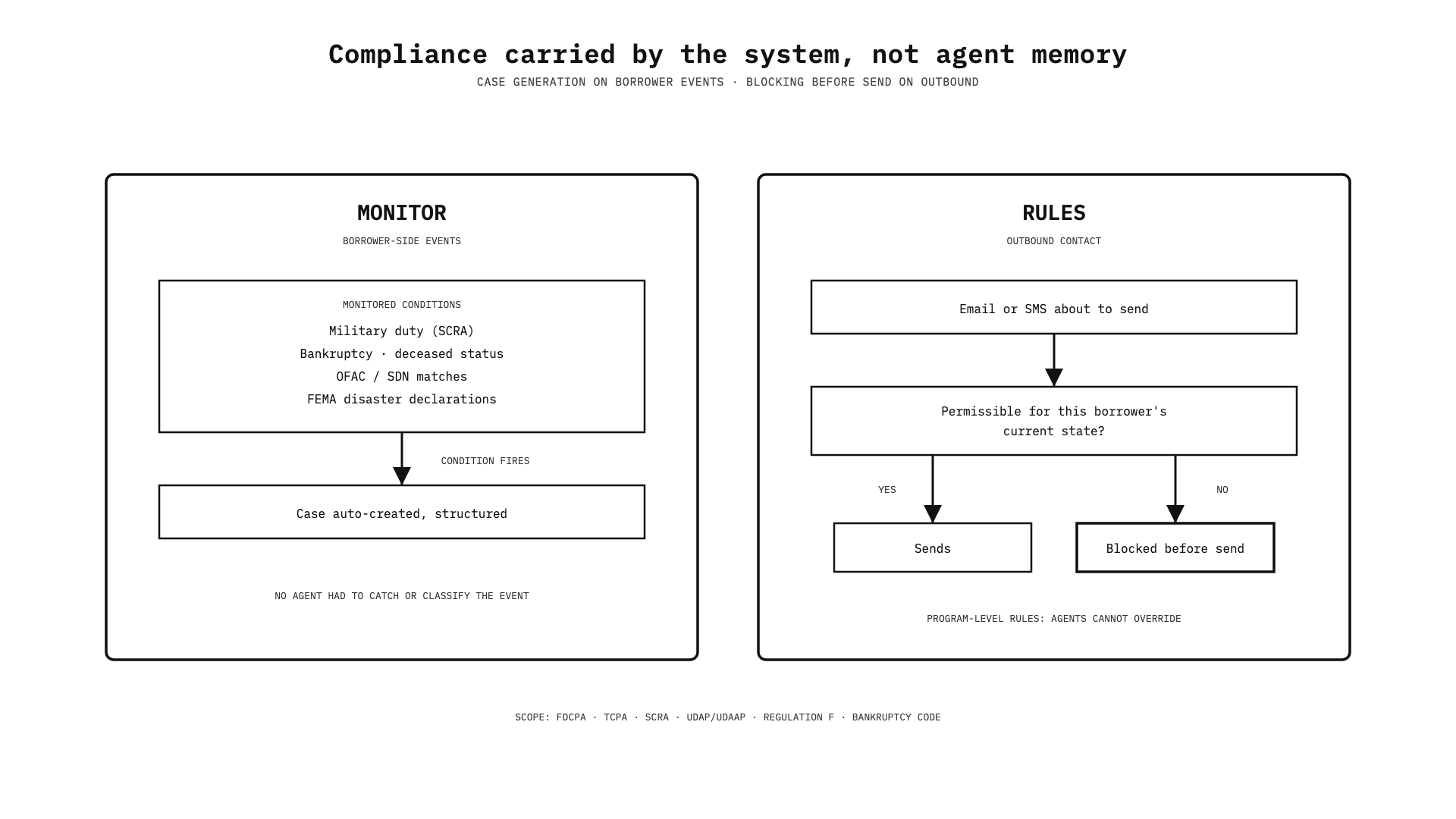
Compliance Guard auto-detects and opens a case when a borrower enters active military duty under SCRA, dies, files bankruptcy, matches an OFAC or SDN list, or gets caught in a FEMA disaster. A case here means a structured workflow for borrower events, disputes, restrictions, and exceptions, the defined path an account follows once the trigger fires. Nobody has to spot the filing and remember to flag it.
Which gives you one test to carry into the next vendor call. Not whether the software has a compliance page. Whether it holds the rule when your own agent, behind on a number, tries to cross it in the moment. A control a person can click past isn't enforcement. It's a reminder with better branding.
The borrower who gets that call anyway doesn't care which one you bought.
Getting Loan Data In and Out of the System
Picture the same book of loans getting pulled two directions at once.
Your finance team owes an investor a loan tape by Friday. A loan tape is a configurable loan-data output, the file you hand an investor or capital-markets partner so they can see the loans behind a deal. Your data team wants something else entirely. They want a full copy of the book dropped into Snowflake, refreshed on their own schedule, so they can run their own analysis without asking anyone.
One source. Two consumers. Both fed from the same live account data at the same time.
That breaks the assumption most people carry about a loan management system: that it's a closed tool, a set of screens where you look at loans and manage them, with the data locked inside those screens. Read it there, work it there, done.
A system worth buying doesn't work that way. It exposes the data.
Start with the programmatic side. An API is a way for two software systems to talk, one sends a request, the other sends back a response. Peach documents a RESTful, resource-oriented API and offers user-facing portals on top of it, so people who don't write code still have a way in. A webhook runs the other direction. It's a notification the system fires to another system the moment a subscribed event happens, so you're reacting to changes as they land instead of polling for them.
Then the bulk side, for teams that want their own copy.
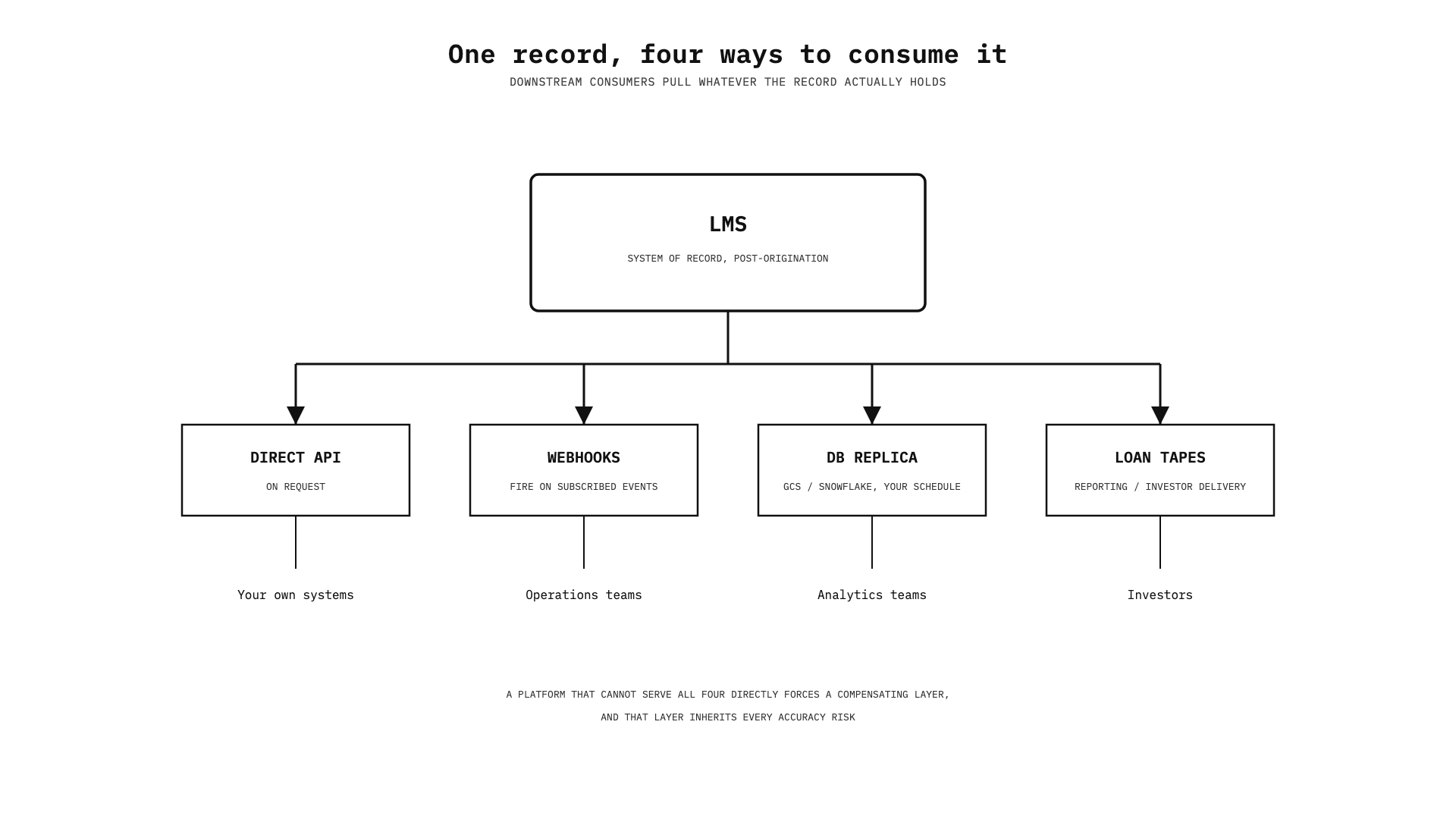
Peach names four ways to get at the data: the direct API, webhooks, a database replica pushed to GCS or Snowflake on your own schedule, and loan tapes. That's the data team's Snowflake replica and finance's investor file, served from one book.
This is structured access, not a free-for-all export. You control the timing and the method. The system still governs the shape of what comes out.
So on the next vendor call, treat this as part of the category, not a bonus feature. A system whose data you can only read inside its own screens is fine right up until the day you have an investor to report to and a data team that wants its own copy. That day, the closed box becomes the thing standing between you and both of them.
Locating the System on the Next Vendor Call
You're back on the call. The rep says they automate the loan lifecycle. Six months ago that line would have slipped right past you.
Now you have a question for it.
Which part? Before the money is out, or after?
That one question sorts almost everything you're about to hear. Teams describe credit the way it actually moves, from created to structured to serviced to monitored to closed. A loan management system owns the back half of that arc, the serviced-through-closed span, the part that starts once a real borrower owes a real balance.
Origination builds the loan. Underwriting decides who gets it and on what terms. Both finish before the money goes out. If a capability does its job before the loan is booked, it belongs to origination, not to the system you're buying to run the account afterward.
So run the test out loud. Does this thing operate after disbursement, KYC, and underwriting are done? If yes, it lives where an LMS lives. If the headline capability is application intake or a credit decision, you're looking at a different system wearing this one's name.
That's the whole tiebreaker. Where the work lands on the loan's life.
Run the products you've already seen through it. Compliance Guard checks an action once the loan is live. Loan Replay rebuilds a ledger that already exists. A loan tape reports accounts already on the books. Peach's Servicing Suite starts after disbursement, KYC, and underwriting. Every one of them lands after the money goes out.
Keep one more thing in view. This category is built for people running lending products and systems, not for a borrower shopping for a friendlier rate. When a page or a pitch drifts toward finding better loan terms, it stopped talking to you. You operate the book. That's a different job than borrowing against it.
And the book is the frame you grow into. Not one loan at a time, but your loans considered together, for operating them, reporting on them, and watching how they perform. A single account is where the servicing work happens. The portfolio tells you whether the system was built to carry it.
So next time someone sells you lifecycle automation, don't argue the word. Ask where the work lands. A definition that centers on origination is describing a different system, and it just happens to share a name with the one you need.
Frequently asked questions
What is a loan management system?
A loan management system runs the loan after the money goes out. It starts once a borrower owes a real balance, and it services the account through payoff or charge-off across installment, revolving, and BNPL structures.
How is a loan management system different from a loan origination system?
Origination is the process that runs application, credit review, approval, and funding, and it finishes before the loan becomes a funded account. A loan management system is a different system from the one that made the loan, built to pick up an account that already exists.
What does loan servicing include?
Loan servicing is the ongoing management of a loan after it's created. That management spans account administration, payments, borrower communications, delinquency work, and collections.
Does a charged-off loan leave the loan management system?
No. Charge-off is a status, not an exit. A charged-off loan can be assigned to a collection agency while you stay the system of record, and the account is still yours to track.
lender’s priority list. But that doesn’t mean compliance is straightforward, even for lenders with the most earnest intentions. Often, legacy infrastructure is the culprit, making it difficult for lenders to take the actions clearly outlined in the law. Even regulations that haven’t changed for some time—like the—still present significant challenges for many lenders.
The SCRA grants active-duty service members the ability to request certain protections during the period of their deployment, enabling them to devote their energy to serving the country. These protections include a reduction in interest rate to a maximum of six percent on any pre-service loans. While the SCRA in its current version has been law since 2003, the number of recent enforcement actions indicates just how difficult it is for many lenders to comply with the SCRA’s interest rate protections.
Blunt tools in the absence of a scalpel
For example, in October of 2022 the Department of Justice (DOJ) announced that the financial leasing arm of GM agreed to pay over $3.5 million to resolve allegations in relation to
Peach’s approach to SCRA
At Peach, we brought real-life lending experience to the design of our platform. So from day one, we recognized the importance of being able to make retroactive changes to loans. (There are numerous applications beyond SCRA, including our Supported Portfolio Migration.) In the case of SCRA, Peach has long enabled lenders to retroactively change interest rates and waive past fees—as separate, manual actions.
Peach’s approach to SCRA
This was functional, but the ideal way to implement SCRA is to make these changes simultaneously. We now support this capability by leveraging the power of Peach's Loan Replay™ engine, which can make changes to the ledger at any time, and then recalculate a loan’s history in light of those changes. The new combined functionality is as user-friendly for your agents as processing a payment.
Peach’s approach to SCRA
Specifically, the new SCRA feature allows your agents to perform the following adjustments simultaneously on a loan of an active-duty service member:
- Lower interest rates to 6% (and lower the recurring payment during the active-duty period to account for the interest rate reduction)
- Waive fees, if necessary
- Enact these changes retroactively, if necessary, and replay the loan history with the rate and fee adjustments
- Preview the intended changes
“We launched our first product on Peach in six weeks. Eighteen months later.”
John Smith, CMO
Our SCRA functionality is available via API as well as through our white-label agent tool. The white-label agent interface can be seen here:
Peach’s approach to SCRA
Our SCRA functionality is available via API as well as through our white-label agent tool. The white-label agent interface can be seen here:
For those working directly with the API, this can be as simple as sending the following request body to the SCRA endpoint:
You’ll receive a response with either the actual post-SCRA adjusted payment plan or a preview of it. Below is a comparison of a payment plan prior to the SCRA adjustment, and the expected payments after the SCRA adjustment. The SCRA period is in effect for the first two months, and thus you will see the interest rates lowered to 6% in the response body (and the recurring amount due lowered by the amount of the interest rate reduction for the two relevant months). The origination fee has also been canceled.
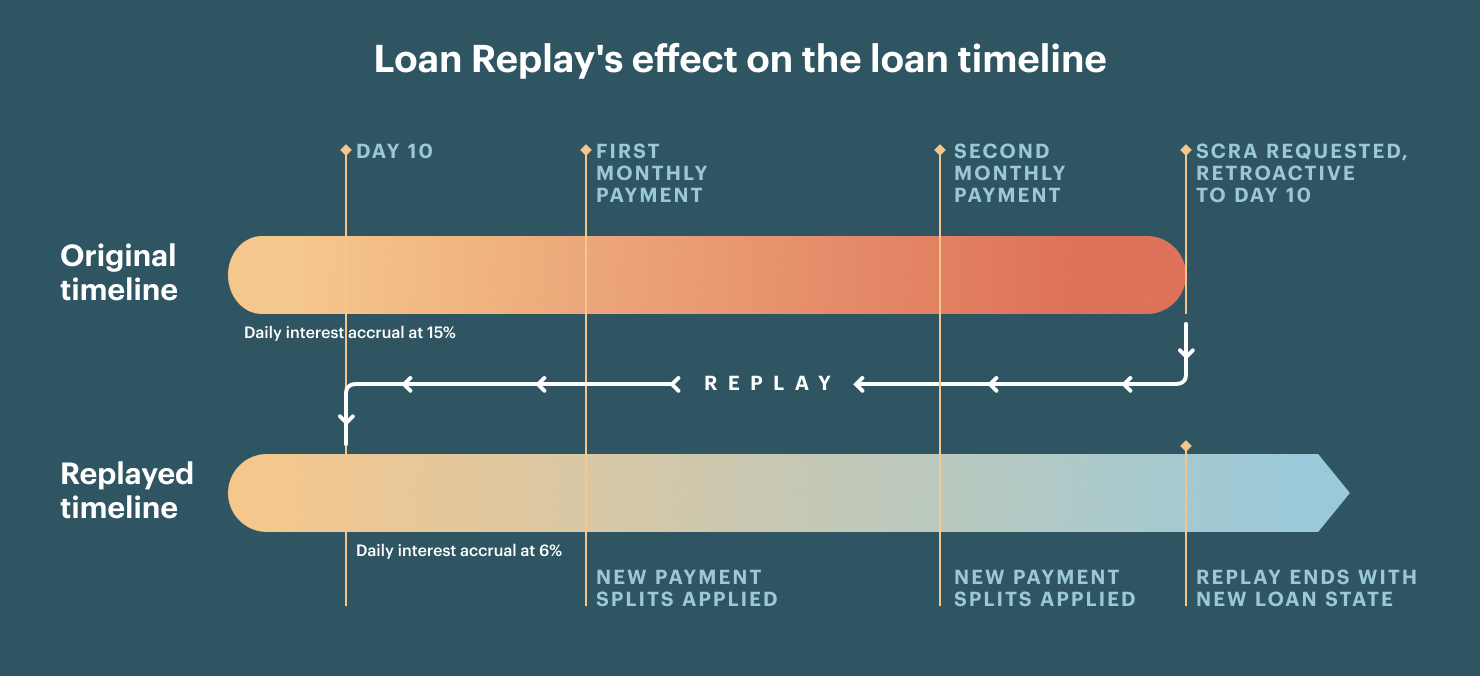
The breadth of loan data needing to be adjusted means that rewriting loan histories requires the right design and abstractions, and having a built-in layer of abstraction to handle retroactive changes is the only feasible approach. Because of our team’s combined experience in the real world of lending, we know that the need to edit past loan events is inevitable. So we’ve designed a system that makes these changes as painless and automated as possible.