
A servicing system detects active-duty status by scanning the Department of Defense list. When a borrower matches, the system opens a case with its own status and fields. SCRA compliance for lenders turns on timing. A system that checks on its own catches duty before the first servicing action ever fires. A system that waits finds out after the violation is already sitting on the account. If you service loans, that account is the one that shows up in your examination finding.
SCRA Compliance Lives in the Servicing Period, Not the Policy Binder
You’re a compliance lead, staring at an OCC finding that says SCRA violations, with accounts reported delinquent while the borrower was on active duty.
And now you’re asking a question that matters. What does our loan management system do when a borrower is deployed?
That’s the question.
The Servicemembers Civil Relief Act and the Military Lending Act protect active-duty military members. That protection isn't abstract. A protected servicemember may not be reported as delinquent, and contact rules tighten on the account too.
What most teams get wrong is timing. These obligations don't start at origination. They start later, in the post-origination period, while the loan is already sitting in your servicing system. That's after disbursement, identity checks, and underwriting are all done. A deployment can happen any time after that, and that is when the clock starts.
And the clock does not wait for the borrower to call.
For credit reporting, the protection window is anchored to the duty start date, not to the day the borrower tells you and not the day your team opens a ticket. That's where the delinquency marks on your examination finding came from.
So what does the system need to do?
It needs to produce two specific credit reporting outputs. Special Comment code AI applies when an active-duty military case exists and no higher-priority special comment applies. Account Status 11 is the other output. During the protected period, the account may report as current under Account Status 11, regardless of what the payment record says.
Applying code AI when it is the ranking special comment, and reporting under Account Status 11 through the protected period, are both things a system does on time, or late.
Peach ships case management for this out of the box. Military duty under SCRA is one case type among several compliance-sensitive situations you have to handle. The roster isn't the point, though. The timing is.
Read the finding again. Every violation traces to an action taken on the account during the protected period. A delinquency mark. A report that already went out.
None of that is a training failure. Your team knew the rule.
The system acted before anyone checked whether it should have, or it didn't.
Did your system know before the action, or after?
If Your System Waits for the Borrower to Call, You Are Already Behind
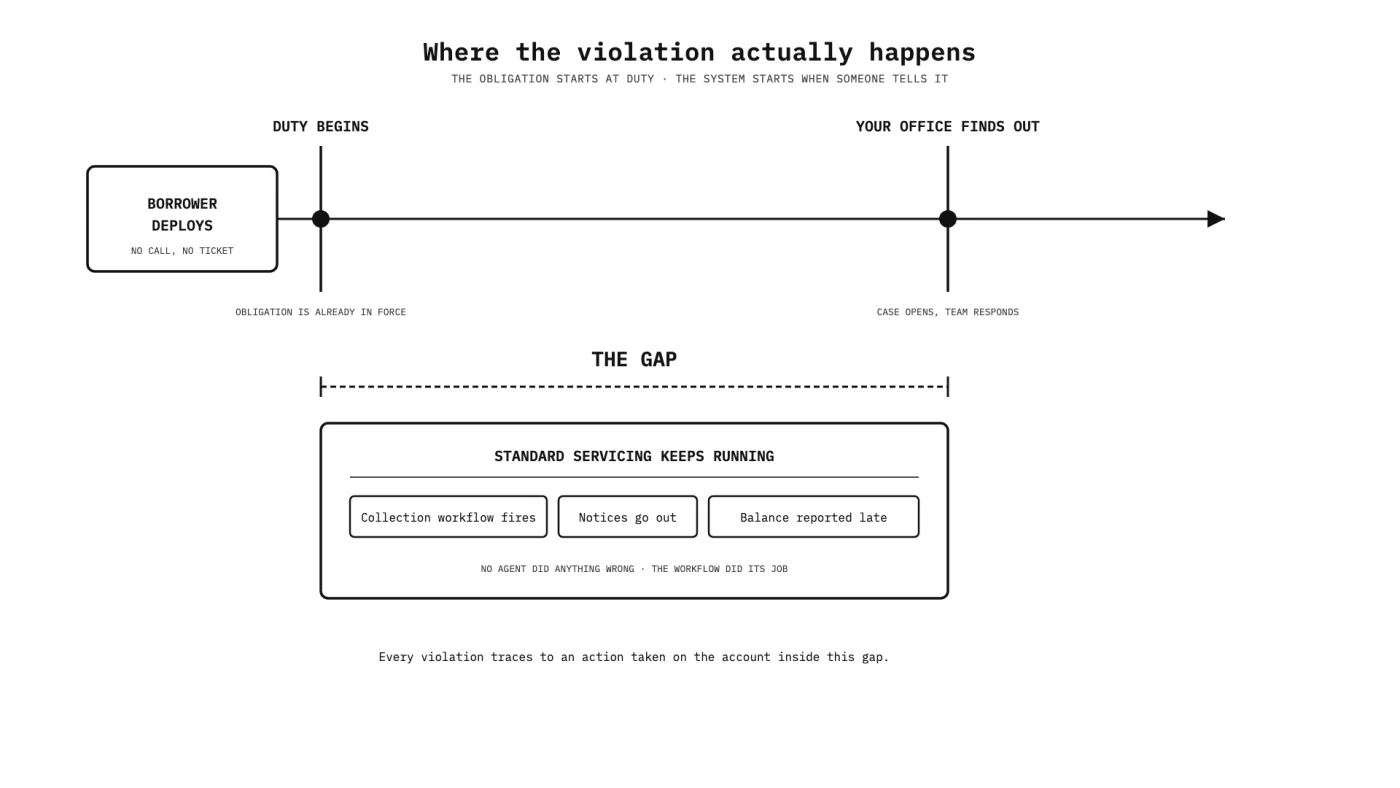
You can't train your way out of this. An agent who knows SCRA cold still can't act on a deployment nobody entered into the system. This isn't a discipline problem. The real problem sits in the stretch between the moment duty begins and the moment your office finds out, and no amount of coaching shrinks that gap.
A servicing system that checks the Department of Defense active duty list on its own closes that gap. It opens the case before the borrower ever contacts you, and the case arrives with structured workflow steps already built, so your team works a response instead of assembling one after the damage.
On an account that falls behind in that gap, the violation already happened before you ever found out.
How the System Finds Active-Duty Status Without Waiting
Monday morning. You open your case queue and there's already a case waiting on a borrower who never called you.
The branch of service is filled in. Active duty start date, filled in. End date too. Nobody on your team typed any of it.
Proactive detection runs backward from how most people picture this.
The old assumption is that you learn a borrower is on active duty when they tell you. They call, they send a letter, someone flags it. Until that happens, the account looks like any other, and you keep servicing it the way you'd service anyone.
Here's what actually happens.
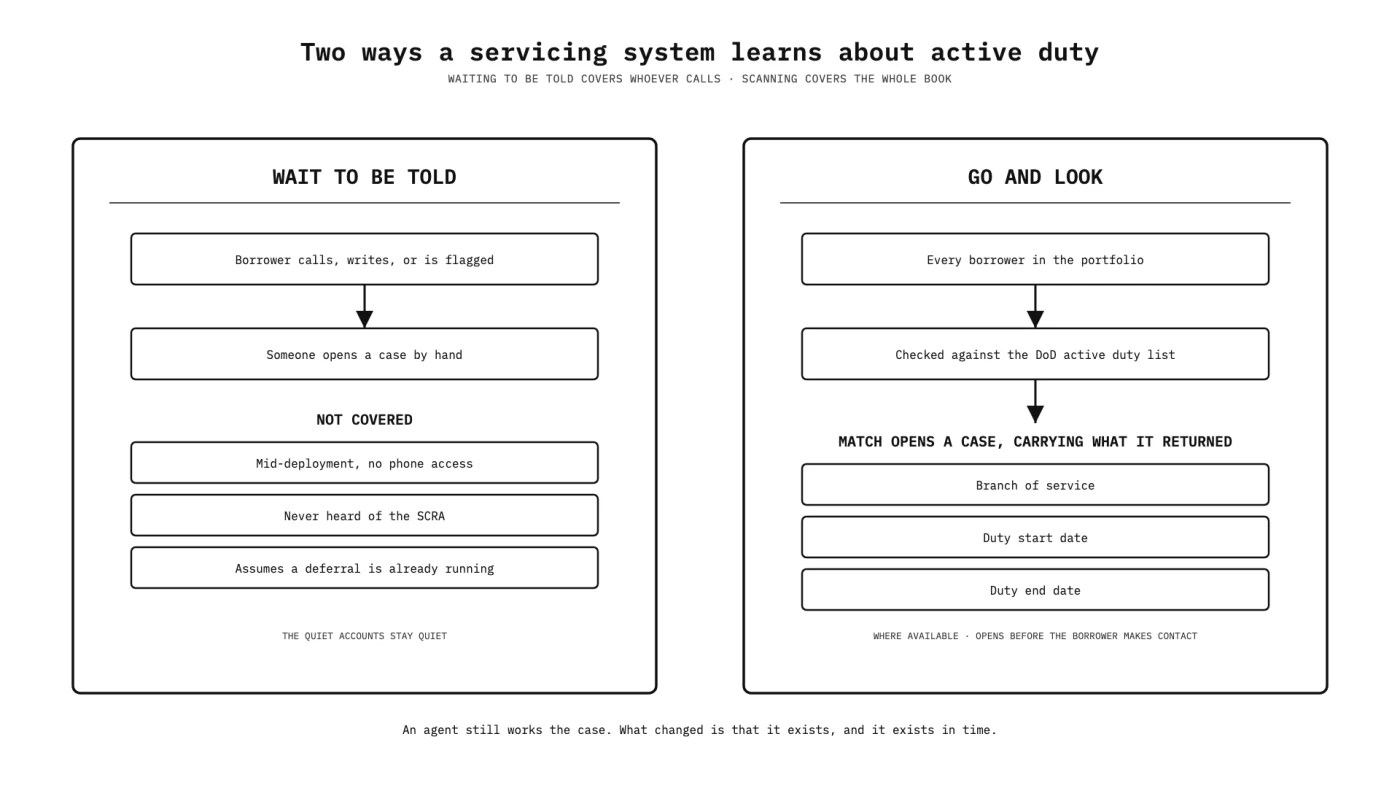
So how does a system find out on its own? An internal service checks your whole book against the Department of Defense active duty list. The Department of Defense active duty list is a government-maintained record of who is serving on active military duty. It isn't something you build or keep current yourself. The service reads it for you.
The scan doesn't wait for a suspicion. It doesn't run only on accounts somebody already worried about. It covers every borrower in the portfolio, the flagged and the quiet alike.
When a borrower matches, a case opens on its own.
And it opens populated. It carries the deployment data the match returned, typically the branch they serve in and the duty start and end dates where those are available, so your compliance team has something to work from. You aren't researching from a blank case. You're reviewing one that already carries the facts.
The duty start date, the duty end date and the branch of service aren't filler. The two dates feed the conditions that decide whether credit reporting protections switch on, which the next section walks through, and they tell you whether the protection window is open on any given reporting day.
The scan is also where the first credit reporting condition gets met. A Military Duty case has to exist on the account. Automatic case creation is what puts it there, without anyone remembering to open it.
The case opens for review, not for auto-resolution. One of your agents still works it. What changed is that the agent starts from populated context instead of a phone call that may never come.
And that's the real point. The gain is coverage. Speed was never the argument.
A servicemember mid-deployment with no phone access doesn't call you. A borrower who's never heard of the SCRA doesn't call you. Someone who assumes a deferral is already running doesn't call you. The scan finds each of those borrowers anyway, and the case opens the moment the match lands, because the system went looking instead of waiting to be told.
Four Conditions That Must All Be True Before Credit Reporting Protections Apply
Once a month, someone on your team builds the bureau submission. Before it goes out, they run a check. Which accounts should carry the military protections this cycle, and which should not, because the servicemember's duty period has already closed?
Knowing a borrower is on active duty doesn't answer that by itself.
The same two credit reporting outputs from the top of this piece, Special Comment code AI and Account Status 11, are what's at stake here.
Special Comment code AI is the notation the system attaches for the bureaus when an active military duty case exists and nothing higher in the special comment order applies. It's a note on the account record, not a payment status.
Account Status 11 is the one under which the account may report as current through the protected period. Reporting as current holds whatever the borrower actually paid, and it is the alternative to reporting a protected servicemember as delinquent.
For code AI and Account Status 11 to apply, four things have to be true at the same time.
All four true, on the reporting date
- A Military Duty case has to exist on the account.
- The Military Duty case has to be in Processing, or Completed with an Approved outcome. A case sitting in any other status doesn't count.
- The duty start date has to fall on or before the date you're reporting.
- The duty end date has to be either empty or a date on or after your reporting date.
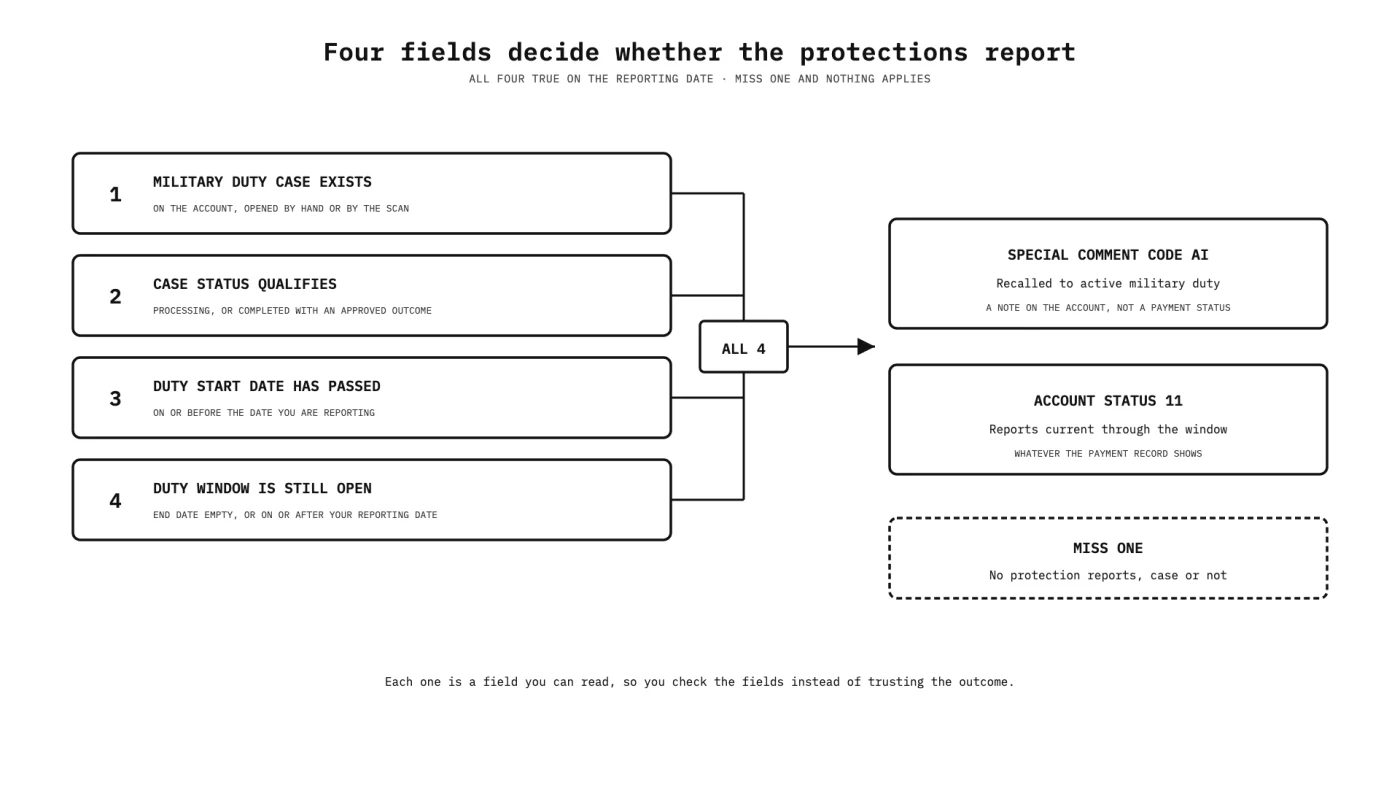
Miss one and the protection doesn't apply. A case in the wrong status stops it. So does a reporting date that lands after the duty end date, even if the system found the borrower on the DoD list and opened the case for you.
The case the scan opened on its own gives you the first condition for free. The case exists. The other three ride on what got written into it, the status it holds and the two duty dates.
The case, its status, and the two duty dates are all things you can read off the account. So the monthly question isn't whether the protections applied. It's whether the case, its status, and both duty dates line up. You check them one account at a time instead of trusting the outcome.
Blocking Contact Before It Reaches the Borrower
Say one of your agents works a collections queue and pulls up a past-due account. They set up the call and reach out to dial. The account belongs to a borrower on active duty, protected under the SCRA. Before the call connects, the system blocks it. No way for the agent to push it through.
Now picture a different scenario. A warning appears, the agent is twelve calls behind, and one click removes it. A dismissible warning isn’t real protection. It’s a prompt a rushed agent can ignore, and on a tough day, they probably will. A warning asks the agent to pause. A block doesn’t ask; the message simply can’t go out. A warning and a block are not two versions of the same safeguard. The warning relies on the agent’s judgment. The block doesn’t.
Every outbound message, whether sent on a schedule by the system or fired manually by an agent, first goes through a permissibility check. Before anything is sent, that check evaluates the channel and asks a simple question: is this exact message allowed to go to this exact borrower right now?
To answer, it weighs the message against the federal and state communication rules written into the system, and against how much contact room is left for that borrower inside the applicable window.
If the message falls outside those rules, or the borrower is already at the contact cap for that window, the message doesn't go. It isn't flagged for later review. It's blocked, and the agent who tried to send it can't push it through.
The check covers the machine too, not just the person at the keyboard. A nightly automated payment reminder aimed at the same protected account hits the same check and dies there, without anyone touching it. So the agent in the collections queue never gets to dial, and the system never quietly sends the reminder behind their back. The agent's call and the automated reminder stop at the same check.
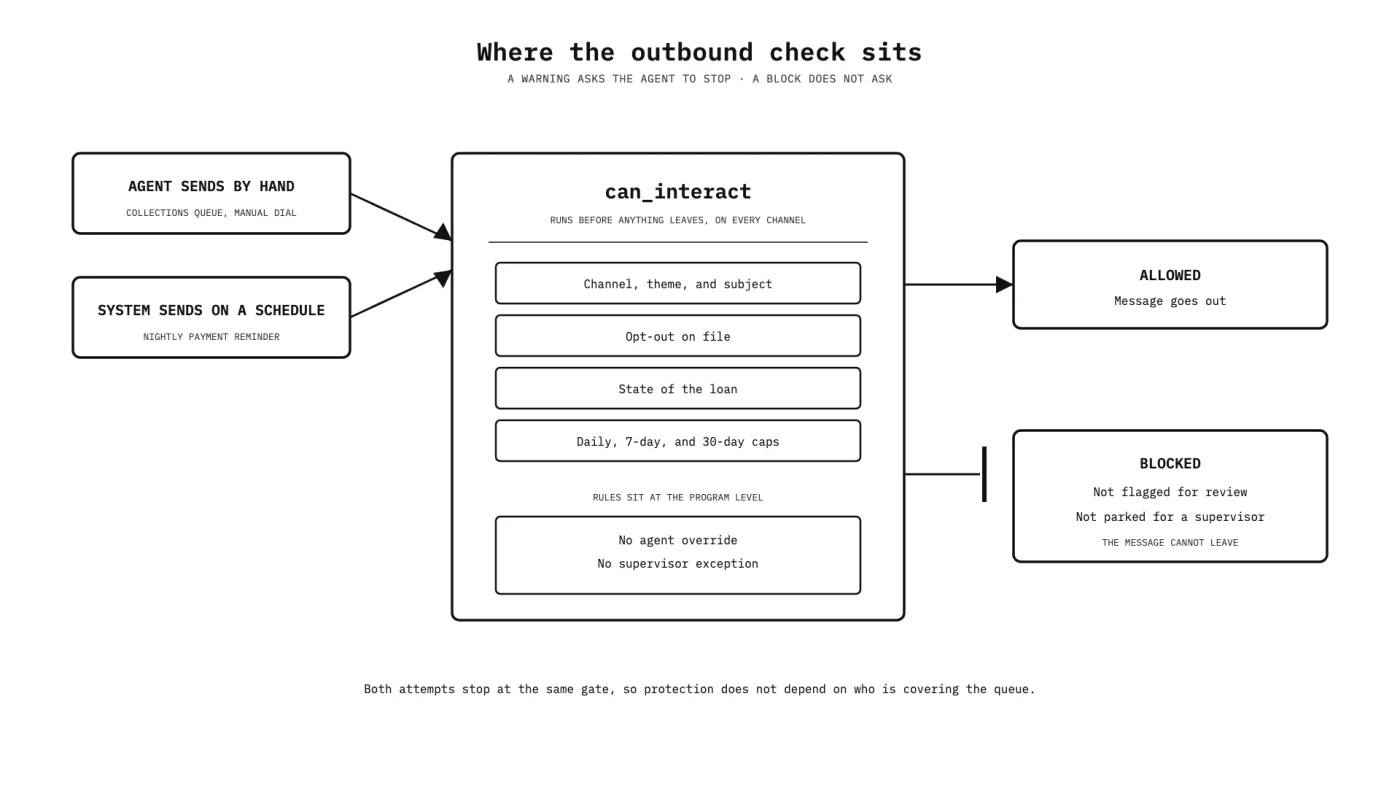
This is the job Compliance Guard Rules does. It takes the federal and state rules for contacting borrowers and writes them into the system as hard limits that run before a message ever leaves. Compliance Guard does not allow agent override on program-level rules, so where a contact restriction is configured at that level an individual agent cannot switch it off.
Where that restriction is configured, there's no click-through to get the call out the door. What it won't do is decide how you treat
What the Servicing System Handles and What Stays With the Lender
Your general counsel asks one question. If the platform catches active duty and opens the case, what does our team still have to do?
Fair question. Here’s the clean line.
The platform does the finding and the enforcing. It scans borrowers against the Department of Defense active duty list. It opens a Military Duty case with the branch and the dates. It blocks contact that would break the rules the moment an agent tries to send it. And four conditions still have to hold on the account before military protection applies in credit reporting.
That’s a lot. It isn’t everything.
So what’s left on your desk? The platform lives in the servicing period, after the money is out the door and the borrower is already yours. It never wrote the loan. It doesn’t underwrite. It doesn’t decide credit. And the creditor's calls under the SCRA stay with you.
You are the creditor. The data doesn’t change that.
Say a servicemember qualifies and the case is approved. The system reports the account current and stops the improper calls. What it won't do is decide how you handle a balance mid-deployment, or what you offer when duty ends. Those two are your call.
Military duty under SCRA ships preconfigured, one of the case types built out of the box for your team to tailor. Ready to use does not mean the work is done for you. Your team still opens it, reads it, and runs it.
So the platform closes the gap where you used to find out too late. It hands your team the branch, the dates, the case, accurate and on time. Then your team makes the call, because the call was always yours to make.
The Question That Separates a Proactive Servicing System From a Reactive One
You finish this with one thing to do this week. Ask your implementation team a single question about your current setup.
Not whether it supports the SCRA. Every servicing platform says yes to that one. Ask when it checks the Department of Defense active duty list, and what triggers the check. Does the system go looking on its own, or does it wait for a borrower to call and say they've been deployed?
That's the whole tell. Check without waiting to be told and you catch duty before the first servicing action. Wait on the borrower and you find out after servicing has already acted on the account.
Once the timing holds, you get a second question, and it's one you can answer yourself every month. Before each bureau submission, take the four conditions from earlier and read them on every protected account. The case, its status, and the two duty dates either line up on the reporting date or they don't. You check them one account at a time instead of trusting that the protection applied.
Detection opens the case. The outbound check blocks the contact that shouldn't go out. Opening the case and blocking the contact both depend on whether the duty status was found in time.
This piece covered finding active duty, opening the case, blocking the wrong contact, and reporting the account right.
So ask the timing question first. Capability is the easy claim. When the system looks is the answer that actually protects anyone.
Frequently asked questions
What are the SCRA rules for lenders?
The Servicemembers Civil Relief Act protects active-duty military members, and its obligations land in the servicing period, while the loan is already sitting in your system. A protected servicemember may not be reported as delinquent. Contact restrictions tighten too, under the federal and state communication rules the system enforces. For credit reporting, the protection window is anchored to the duty start date. Your system's clock starts later, when someone tells you.
How does a lender find out a borrower is on active duty?
Either the borrower tells you, or the system goes looking. An internal service checks your whole book against the Department of Defense active duty list, a government-maintained record of who is serving on active military duty. When a borrower matches, a case opens on its own, already carrying the branch of service, the day duty started, and the day it's set to end. The case opens before the borrower ever contacts you, so a servicemember mid-deployment with no phone access is still found.
When do SCRA obligations start for a lender?
For credit reporting, the protection window is anchored to the duty start date, whether or not they've told you and whether or not your team has opened a ticket. Between the day duty begins and the day your office finds out, every standard servicing action keeps running as if nothing changed. On an account that falls behind in that window, a collection workflow fires on schedule, notices go out, and the balance rolls to the bureau marked late. That stretch between duty starting and your office finding out is where the violation sits.
What has to be true before SCRA credit reporting protections apply?
Four things at the same time. A Military Duty case has to exist on the account. The case has to be in Processing, or Completed with an Approved outcome. The duty start date has to fall on or before the date you're reporting. The duty end date has to be either empty or a date on or after your reporting date. Miss one and the protection doesn't apply, even if the system found the borrower on the DoD list and opened the case for you.
lender’s priority list. But that doesn’t mean compliance is straightforward, even for lenders with the most earnest intentions. Often, legacy infrastructure is the culprit, making it difficult for lenders to take the actions clearly outlined in the law. Even regulations that haven’t changed for some time—like the—still present significant challenges for many lenders.
The SCRA grants active-duty service members the ability to request certain protections during the period of their deployment, enabling them to devote their energy to serving the country. These protections include a reduction in interest rate to a maximum of six percent on any pre-service loans. While the SCRA in its current version has been law since 2003, the number of recent enforcement actions indicates just how difficult it is for many lenders to comply with the SCRA’s interest rate protections.
Blunt tools in the absence of a scalpel
For example, in October of 2022 the Department of Justice (DOJ) announced that the financial leasing arm of GM agreed to pay over $3.5 million to resolve allegations in relation to
Peach’s approach to SCRA
At Peach, we brought real-life lending experience to the design of our platform. So from day one, we recognized the importance of being able to make retroactive changes to loans. (There are numerous applications beyond SCRA, including our Supported Portfolio Migration.) In the case of SCRA, Peach has long enabled lenders to retroactively change interest rates and waive past fees—as separate, manual actions.
Peach’s approach to SCRA
This was functional, but the ideal way to implement SCRA is to make these changes simultaneously. We now support this capability by leveraging the power of Peach's Loan Replay™ engine, which can make changes to the ledger at any time, and then recalculate a loan’s history in light of those changes. The new combined functionality is as user-friendly for your agents as processing a payment.
Peach’s approach to SCRA
Specifically, the new SCRA feature allows your agents to perform the following adjustments simultaneously on a loan of an active-duty service member:
- Lower interest rates to 6% (and lower the recurring payment during the active-duty period to account for the interest rate reduction)
- Waive fees, if necessary
- Enact these changes retroactively, if necessary, and replay the loan history with the rate and fee adjustments
- Preview the intended changes
“We launched our first product on Peach in six weeks. Eighteen months later.”
John Smith, CMO
Our SCRA functionality is available via API as well as through our white-label agent tool. The white-label agent interface can be seen here:
Peach’s approach to SCRA
Our SCRA functionality is available via API as well as through our white-label agent tool. The white-label agent interface can be seen here:
For those working directly with the API, this can be as simple as sending the following request body to the SCRA endpoint:
You’ll receive a response with either the actual post-SCRA adjusted payment plan or a preview of it. Below is a comparison of a payment plan prior to the SCRA adjustment, and the expected payments after the SCRA adjustment. The SCRA period is in effect for the first two months, and thus you will see the interest rates lowered to 6% in the response body (and the recurring amount due lowered by the amount of the interest rate reduction for the two relevant months). The origination fee has also been canceled.
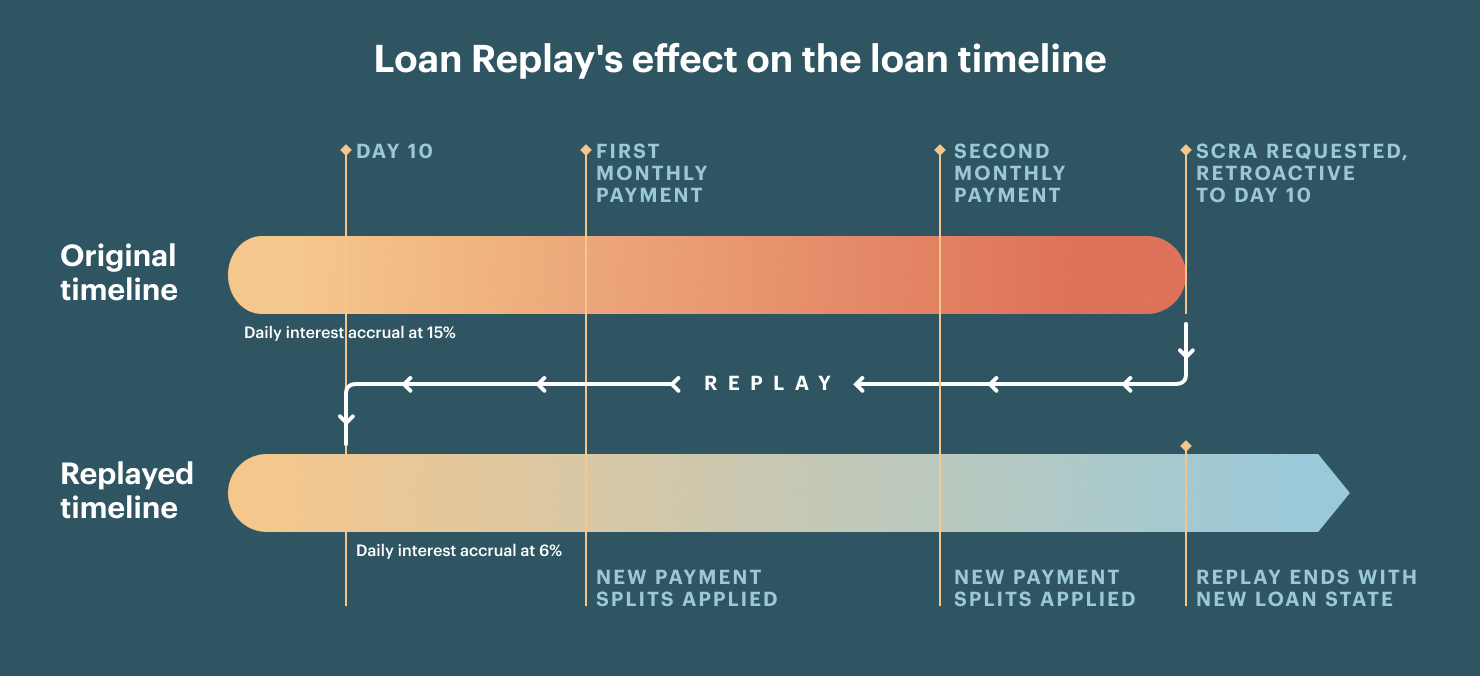
The breadth of loan data needing to be adjusted means that rewriting loan histories requires the right design and abstractions, and having a built-in layer of abstraction to handle retroactive changes is the only feasible approach. Because of our team’s combined experience in the real world of lending, we know that the need to edit past loan events is inevitable. So we’ve designed a system that makes these changes as painless and automated as possible.