Loan servicing manages a loan through its whole life after disbursement. The servicing record holds every payment, status, and balance in one place. Borrower statements, delinquency reports, and investor tapes all draw from that record, so a servicing error surfaces everywhere downstream.
Loan servicing, defined from the operator's side
You run engineering at a funded fintech. The loan just funded. You open a doc titled loan servicing, expecting the system side, and you get a page about how a homeowner's monthly payment gets collected.
That page answers a different question than yours.
Ask most people what loan servicing means and you hear the same thing: it's the company that takes your monthly payment and handles your escrow. That's the borrower's view. It's real, and it's the shallow end.
Here's the boundary you actually need. Origination creates the loan through application, credit review, approval, and funding. Underwriting decides whether a borrower qualifies and on what terms. Those two make the loan. Servicing is everything after it's live.

Post-origination is the name for that window, the period after disbursement, KYC, and underwriting are done. Servicing lives there. Peach's Servicing Suite is built for exactly that span, end to end: the borrower portal, the agent CRM, communications, and collections a live loan runs on.
So what's the operator's job on a live loan? Account administration. Payments. Talking to the borrower. Delinquency work when they fall behind, and collections when it goes further. That's servicing: the ongoing management of a loan after it's created.
Notice what's absent. Servicing doesn't originate the loan. It doesn't underwrite or make the credit decision. Those happened before the handoff, and the handoff is real. The loan is funded and live, and now someone has to run it day to day.
That's the shift. A monthly-payment answer describes what a borrower feels. Servicing is defined by what you have to do once the loan sits on your books. That's the definition the rest of this article is built on.
The live loan needs a record that tells the truth
A fee posted wrong three statements back. You're the head of credit, and you just found it.
Fixing it's the easy half. The hard half is the question a regulator asks next. When you fix it, can you still show exactly what the loan said before and after?
That's the part most people miss about keeping a live loan on the books. Account administration isn't a balance table you keep current. It's holding an authoritative record of each loan for its whole life, one you can correct without erasing what it used to say.
Here's where the design of the record starts to matter.
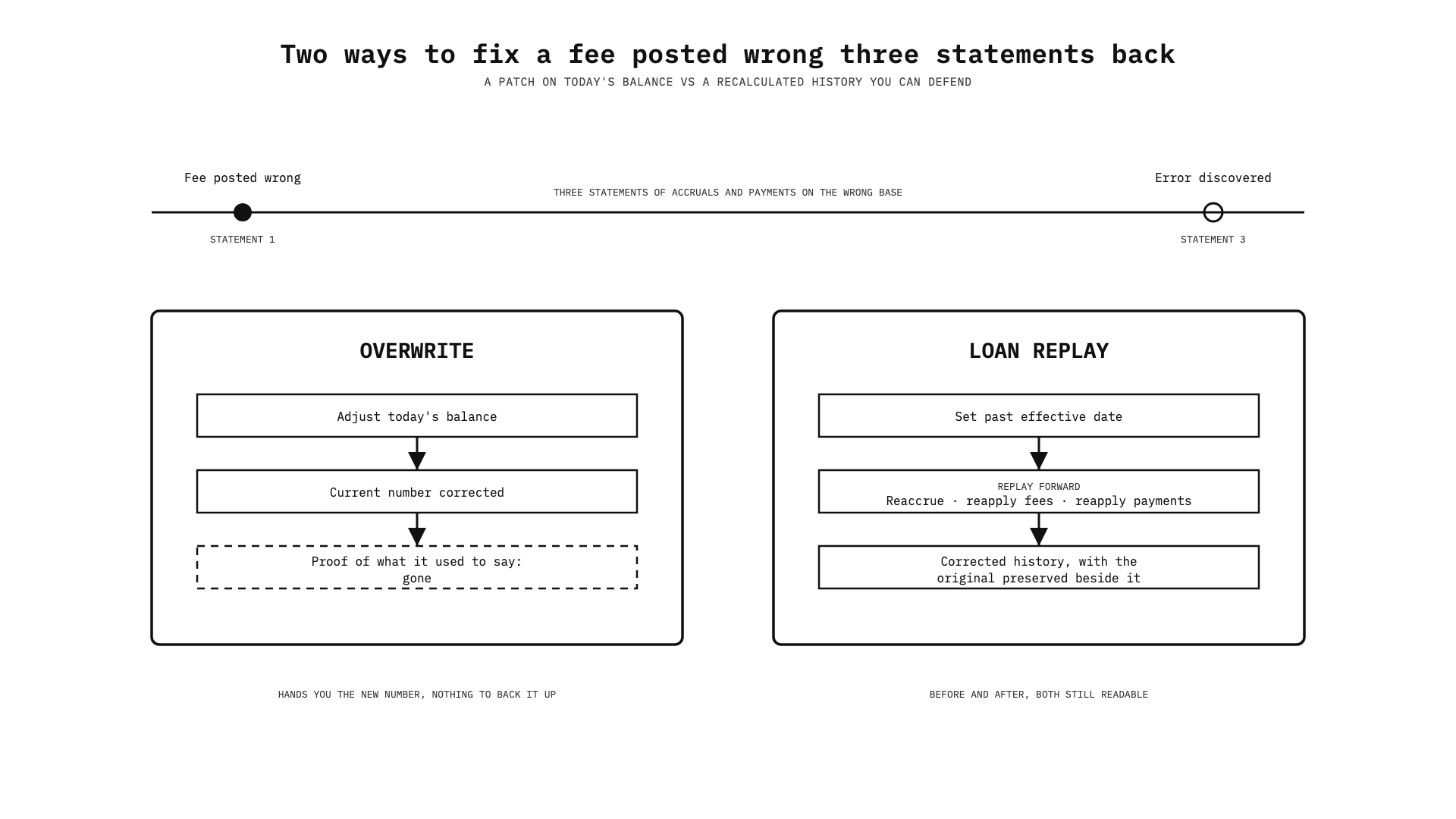
Some servicing cores use an immutable ledger. In plain terms, when you correct an entry, the original isn't overwritten. It stays, marked invalid, sitting beside the corrected version. Yesterday's number survives. So does today's.
That's not data hygiene. It's evidence. When someone asks you to defend a balance a year later, the proof you need is the before and the after, both still readable. A record that overwrites the old value in place hands you the new number and nothing to back it up.
Peach builds on that preserved history with Loan Replay. Apply a correction at the date it should have taken effect, and Loan Replay replays the interim period forward, reaccruing interest, reapplying fees and payments, and producing the updated principal-and-interest split and current status. It's a recalculation engine, so the fixed history stays internally consistent instead of just patching today's balance.
One more thing this record doesn't settle in place. Where it lives. A servicing core can sit beside a lender's existing core as a sub-ledger, or run as the primary lending core itself. Peach's Adaptive Core is built to do either. System of record is a placement you choose, not a single shape you inherit.
So when you weigh a servicing platform, ask what happens to yesterday's number when today's changes. A record that quietly overwrites its corrections looks convenient. It's a liability wearing convenience's clothes, and you find out which one you bought the first time you have to prove what a loan used to say.
Payments are a status problem, not just a transfer
A payment lands in the account this morning. Good. Then a second one posts, a retry from a card attempt that failed last week. The money's there, twice. What you can't tell, looking at two credits side by side, is what each one actually did.
That's the part nobody warns you about.
You came in believing payments were solved the day you could pull from a bank account or run a card. Move the money and you're done. Move the money and you're half done.
Payment processing is the movement and status handling of borrower payments, whether they ride a bank, a card, or an external processing arrangement. Read that twice. Movement and status. The transfer is one fact. What the payment did is a second fact, and your servicing system has to hold both about the same event.
Take a single payment. Part of it shrinks what the borrower owes. Part of it covers the cost of borrowing, the interest. Your system has to know that split for every payment, not just the total it collected this month. Miss it on one, and the balance you show is a guess. It's the same principal-and-interest split that has to survive a backdated correction, which is exactly what Peach's Loan Replay recomputes when one lands.
Back to those two credits. One settled. The other may reverse if the retry fails again. Until you know which, you don't know the balance, and the record you trusted a moment ago is only as good as the payment states feeding it.
Pulling the money is the easy half. Knowing, for every payment, its state and what it did to the balance is the hard half. That's why payments and the ledger aren't two systems you buy. They're one problem wearing two names.
Borrower communication is a governed workflow, not a mailbox
An agent has a reminder queued. Payment's late, the text is written, one tap sends it.
Don't send it.
That borrower filed a dispute last week and asked to be reached by mail only. The reminder view doesn't know that. It shows a phone number and a past-due balance, and it's one keystroke from breaking a promise the lender already made.
You probably picture communications as payment reminders by email or text. That's the part you see. Peach's servicing communications run wider than that, across email, SMS, phone, direct mail, and chat, so outreach isn't tied to a single medium. More ways to reach a borrower is the easy part. Knowing which one you're allowed to use for this borrower today is the hard part.
That's what a case is for. Case management is a structured workflow for borrower events, disputes, restrictions, and exceptions. Think of it as a record of a borrower's situation that carries the rules for handling them. A case holds status, tasks, fields, review rules, and interaction restrictions.
So the dispute isn't a note someone left in the file. It's a case on the account, and it changes what you may do.
Which is why the SMS reminder never fires. The account already carries a restriction that says mail only, and the system knew it before the agent did.
This is also why communications and cases can't be bought as two separate things. A borrower event can change both what you're permitted to say and how you're allowed to reach them. Peach ships case management already built for a catalog of these events rather than asking each lender to model them from scratch. Which events, and the exact tools behind them, we cover elsewhere.
Treating communications as a send channel misses where the control lives. The channel is what the borrower sees. The case decides whether you may use it at all.
When a loan goes bad, servicing doesn't stop
You charge off the account. In your head, that loan just left the building. Written off, off your books, and whatever's left to recover is someone else's job now.
Hold on to that account for one more minute.
Charge-off is a loan status. It says the lender has charged off the account, an accounting call that the money probably won't come back. It doesn't say the debt was forgiven. It wasn't sold or erased. The borrower still owes, and the loan still sits there.
Back up a step to see why. A borrower falls behind on a scheduled payment, and that's delinquency. The work to claw back the overdue balance is collections. Both live inside servicing. Neither is a door out. Charge-off doesn't open one either. It changes what the loan is doing, not whether it exists on your system.
Now the callback. That charged-off account goes to a collection agency for recovery. A month later the borrower calls to pay. You can run collections in-house or hand it to an agency, but either way you need the loan in front of you, its history and its status, right where it always was. Peach's Servicing Suite includes collections, and case management ships a collections case type out of the box, so a charged-off account keeps its full record while recovery runs. The agency does the recovery work. You stay the system of record. Two jobs, two owners, and people collapse them into one all the time.
That's the split that catches lenders off guard. A system that lets go of the loan at charge-off tosses the exact record the recovery still runs on.
Servicing runs inside the rules whether you built for it or not
An agent has a borrower on the line. Fourth call this week to the same person who's behind. One more after this and the account crosses the contact limit the rules allow for that stretch of days. So what stops the bad call?
If your answer is a well-trained agent who remembers the cap, you've already lost. People forget. They're rushed, they're mid-conversation, the count is sitting in another tab. The reliable version is a system that simply won't place the call once the limit is hit.
Most lenders picture compliance as a review lane off to the side. Legal checks the program, signs off, and the servicing team goes back to work. That picture breaks the moment you notice what the rules actually govern. They govern calling. Messaging. Collecting. The same acts your servicing operation performs all day.
Compliance is the controls and operating work you use to follow applicable lending laws, regulations, and program rules. If the rule and the action are the same act, the control can't sit in a binder. It has to live at the point where the agent clicks call.
That's what Compliance Guard does. It codifies federal and state regulations and blocks a non-compliant action in real time, at the moment it's attempted. On program-level rules, an agent can't override the block.
It watches a named set: the Fair Debt Collection Practices Act (FDCPA), which governs how you contact people about debts; the Servicemembers Civil Relief Act (SCRA), which protects active-duty military borrowers; the Telephone Consumer Protection Act (TCPA), which limits calls and texts; the rules against unfair, deceptive, or abusive acts and practices (UDAP and UDAAP); Regulation F (Reg F); and the Bankruptcy Code.
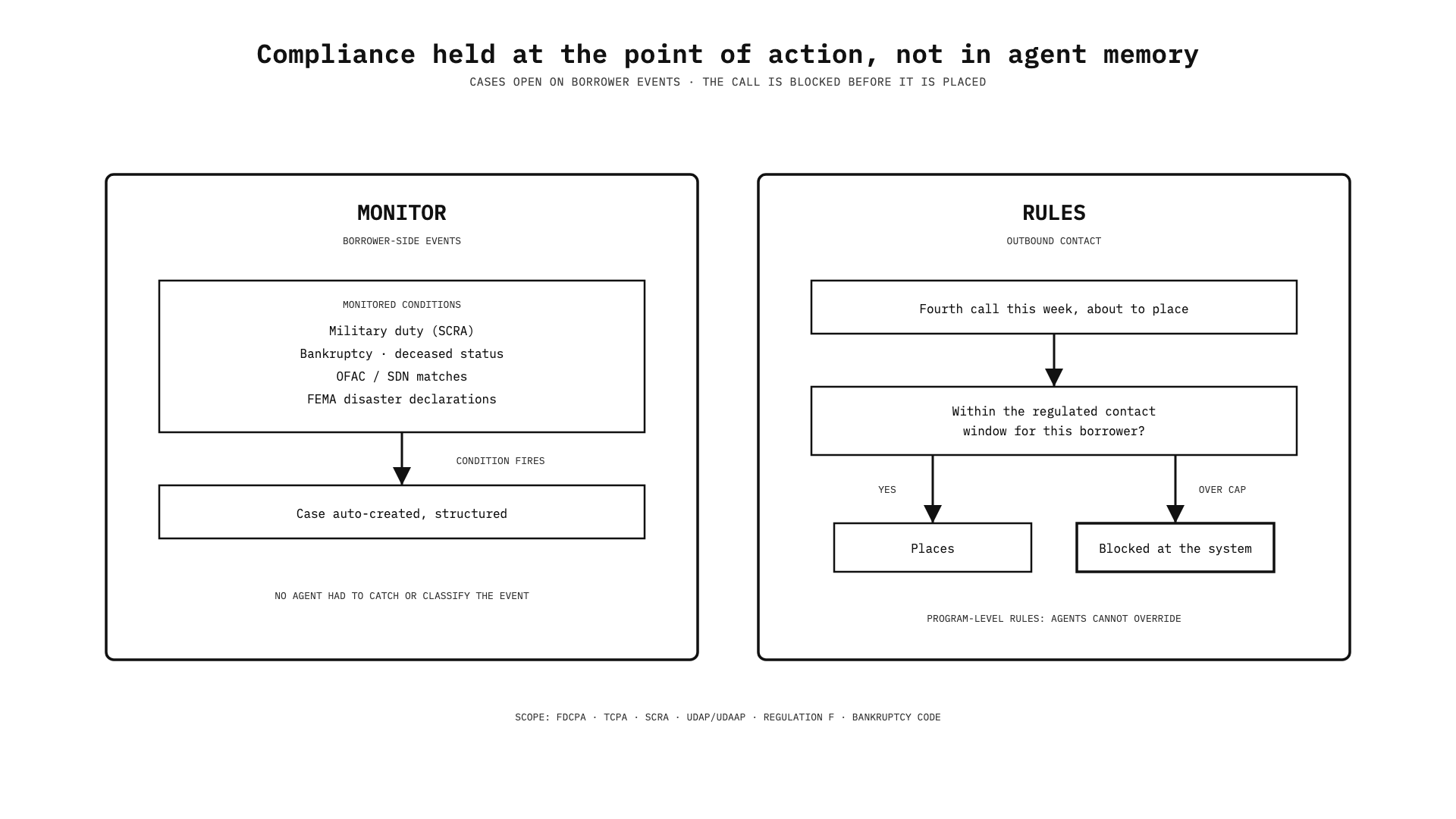
Back to that fourth call. Compliance Guard tracks the regulated interaction windows and blocks calls over the applicable cap at the system level, not by trusting agent discipline.
Compliance you trust an agent to remember is compliance you've already lost.
Why it matters: servicing is where the portfolio becomes real
Servicing sounds like the part that runs after the real work is done. Make the loans, then hand them to maintenance.
Then the head of credit has to show the board how the book is doing.
That picture comes from somewhere. Every number in it, the balances, the delinquency counts, the recovery on charged-off accounts, traces back to the servicing record underneath. A loan portfolio is just a lender's loans looked at together, for operating, reporting, and performance work. The view is only as honest as the record it's built on.
Which is where the last five sections come due at once.
The record has to stay true even when yesterday's number changes. Payments have to be applied and tracked, not just pulled. Communications have to run inside a workflow that knows when you may reach a borrower. Loans that go bad stay in servicing instead of falling off the edge. And the rules have to hold at the point of action, not in an agent's memory.
Here's the part that catches people. Those aren't five tools you grade one at a time. They share one record. A loan tape, the configurable file you hand an investor or a capital-markets partner, pulls from the same state your borrower statement does. Get the applied-payment logic wrong and the error doesn't stay put. It shows up in the statement, then in the delinquency report, then in the tape the board reads.

So servicing isn't a task. It's a system, and the whole thing has to be trustworthy at once, because every function drinks from the same well. That's the span Peach's Servicing Suite is built to cover end to end, from disbursement through payoff or charge-off.
This is the one place the loan and the whole book stay continuously true. Make a loan and you get one number right, once. Service it and you keep every number right, every day, across every account. Everything downstream inherits what you produce. If the record is wrong, the report is wrong, and you learn it in the room where you can least afford to.
The deeper pieces live in their own articles. What a loan management system actually is. The full inventory of post-origination tools. And the honest math on building it yourself versus buying it.
Servicing is where the loan lives out its economics. Build for that. Don't bolt it on.
Frequently Asked Questions
What is meant by loan servicing?
Loan servicing is the ongoing management of a loan after it is created: account administration, payments, borrower communications, delinquency work when a borrower falls behind, and collections when it goes further. It does not originate or underwrite the loan. Those happen before the handoff, and servicing runs the funded loan day to day.
What is the difference between loan servicing and loan origination?
Origination creates the loan through application, credit review, approval, and funding, and underwriting decides whether a borrower qualifies and on what terms. Those two make the loan. Servicing is everything after it is live, the day-to-day management of a funded loan on the lender's books.
Does a loan stay in servicing after charge-off?
Yes. Charge-off is a loan status, an accounting call that the money probably will not come back. It does not forgive the debt, and the loan was not sold or erased. The borrower still owes, and the loan stays in servicing as the system of record, even when recovery is handed to a collection agency.
What does a loan servicing platform handle?
A servicing platform keeps one authoritative record of each live loan and runs the work on top of it: applying and tracking payments, holding borrower communications inside a governed workflow, managing delinquency and collections, and enforcing lending rules at the point of action. Peach's Servicing Suite covers that end-to-end post-origination period.
lender’s priority list. But that doesn’t mean compliance is straightforward, even for lenders with the most earnest intentions. Often, legacy infrastructure is the culprit, making it difficult for lenders to take the actions clearly outlined in the law. Even regulations that haven’t changed for some time—like the—still present significant challenges for many lenders.
The SCRA grants active-duty service members the ability to request certain protections during the period of their deployment, enabling them to devote their energy to serving the country. These protections include a reduction in interest rate to a maximum of six percent on any pre-service loans. While the SCRA in its current version has been law since 2003, the number of recent enforcement actions indicates just how difficult it is for many lenders to comply with the SCRA’s interest rate protections.
Blunt tools in the absence of a scalpel
For example, in October of 2022 the Department of Justice (DOJ) announced that the financial leasing arm of GM agreed to pay over $3.5 million to resolve allegations in relation to
Peach’s approach to SCRA
At Peach, we brought real-life lending experience to the design of our platform. So from day one, we recognized the importance of being able to make retroactive changes to loans. (There are numerous applications beyond SCRA, including our Supported Portfolio Migration.) In the case of SCRA, Peach has long enabled lenders to retroactively change interest rates and waive past fees—as separate, manual actions.
Peach’s approach to SCRA
This was functional, but the ideal way to implement SCRA is to make these changes simultaneously. We now support this capability by leveraging the power of Peach's Loan Replay™ engine, which can make changes to the ledger at any time, and then recalculate a loan’s history in light of those changes. The new combined functionality is as user-friendly for your agents as processing a payment.
Peach’s approach to SCRA
Specifically, the new SCRA feature allows your agents to perform the following adjustments simultaneously on a loan of an active-duty service member:
- Lower interest rates to 6% (and lower the recurring payment during the active-duty period to account for the interest rate reduction)
- Waive fees, if necessary
- Enact these changes retroactively, if necessary, and replay the loan history with the rate and fee adjustments
- Preview the intended changes
“We launched our first product on Peach in six weeks. Eighteen months later.”
John Smith, CMO
Our SCRA functionality is available via API as well as through our white-label agent tool. The white-label agent interface can be seen here:
Peach’s approach to SCRA
Our SCRA functionality is available via API as well as through our white-label agent tool. The white-label agent interface can be seen here:
For those working directly with the API, this can be as simple as sending the following request body to the SCRA endpoint:
You’ll receive a response with either the actual post-SCRA adjusted payment plan or a preview of it. Below is a comparison of a payment plan prior to the SCRA adjustment, and the expected payments after the SCRA adjustment. The SCRA period is in effect for the first two months, and thus you will see the interest rates lowered to 6% in the response body (and the recurring amount due lowered by the amount of the interest rate reduction for the two relevant months). The origination fee has also been canceled.
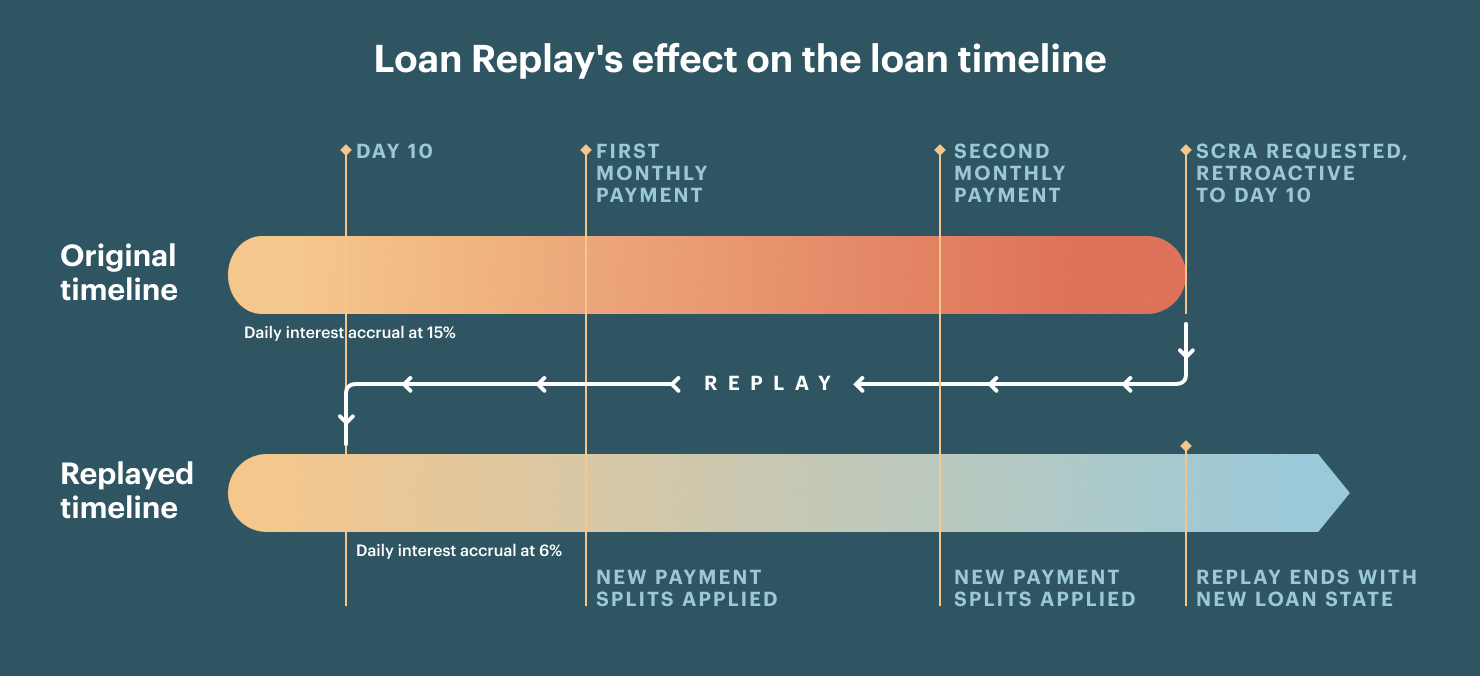
The breadth of loan data needing to be adjusted means that rewriting loan histories requires the right design and abstractions, and having a built-in layer of abstraction to handle retroactive changes is the only feasible approach. Because of our team’s combined experience in the real world of lending, we know that the need to edit past loan events is inevitable. So we’ve designed a system that makes these changes as painless and automated as possible.