In the traditional buy or build discussion, the “build” approach means choosing to internally construct software that involves custom development. The lender designs, creates, tests, and maintains its own software tailored to its specific requirements. Every part of the system can be designed to the lender’s needs and projected growth, highly specialized tools can be brought on, and resources hired to maintain the tech stack indefinitely. Building such a solution is often done by an in-house development team, who may partner with software development consultants on a project basis for support.
Advantages of Building:
- Customization: The software is tailored exactly to the lender's business processes and unique requirements. This offers a perfect fit and avoids the need for workarounds often associated with off-the-shelf solutions.
- Specificity: Custom-built software is designed to the exact specifications of the lender’s business. Compromise of features is not necessary as long as resources are available to create the customized specs needed.
- Competitive Edge: It allows for the creation of unique features that can differentiate the lender’s business in the marketplace, providing a significant competitive advantage. As one source notes, if developing software is core to the lender’s business needs, building it gives the lender a custom solution no one else will have.
- Control: Lenders have complete control over the software's functionality, security, and integration with other systems. Building also provides complete control and use of data.
- Intellectual Property: Building lender-owned software can protect intellectual property.
- Long-Term Value: Building software offers potential long-term value through customization and control.
Disadvantages of Building:
- Cost: High upfront investment is required for development, testing, and deployment. It typically costs more, especially in the beginning, and over-time maintenance costs will continue to increase as software, tech, or functions age.
- Time to Market: Development can take months or even years, delaying potential benefits. This also creates opportunity costs.
- Maintenance: Ongoing support and updates are necessary, requiring an in-house team or contracted developers. The lender’s team becomes the support function.
- Potential for Error: There's a greater potential for error if software development is not a lender’s core focus.
While the 'buy versus build' will continue to be a topic of consideration, it's clear that targeted build solutions retain significant value for lenders seeking to leverage proprietary knowledge and differentiate through unique market offerings. However, loan management and servicing, often viewed as just a commodity, presents an opportunity for strategic integration rather than wholesale custom development.
Peach addresses this by offering a robust, API-first platform that empowers lenders to selectively invest internal resources in bespoke builds, seamlessly integrating these into our comprehensive loan management and servicing infrastructure. This hybrid approach allows lenders to capitalize on Peach's deep domain expertise and market-ready capabilities, while simultaneously focusing their internal teams on developing truly differentiating features. By entrusting infrastructure maintenance and market-forward evolution to Peach, lenders not only streamline operations but also ensure long-term scalability and reduced maintenance overhead. This strategic partnership enables lenders to navigate the complexities of modern lending, optimizing both innovation and operational efficiency.
With Peach, it’s not a binary decision to build or buy, we offer the best of both options through integration. Interested in how we offer similar advantages to a “buy” decision with Peach? Check out our article on Buy smarter: integrate for ultimate lender agility or contact us today for a discovery session.
lender’s priority list. But that doesn’t mean compliance is straightforward, even for lenders with the most earnest intentions. Often, legacy infrastructure is the culprit, making it difficult for lenders to take the actions clearly outlined in the law. Even regulations that haven’t changed for some time—like the—still present significant challenges for many lenders.
The SCRA grants active-duty service members the ability to request certain protections during the period of their deployment, enabling them to devote their energy to serving the country. These protections include a reduction in interest rate to a maximum of six percent on any pre-service loans. While the SCRA in its current version has been law since 2003, the number of recent enforcement actions indicates just how difficult it is for many lenders to comply with the SCRA’s interest rate protections.
Blunt tools in the absence of a scalpel
For example, in October of 2022 the Department of Justice (DOJ) announced that the financial leasing arm of GM agreed to pay over $3.5 million to resolve allegations in relation to
Peach’s approach to SCRA
At Peach, we brought real-life lending experience to the design of our platform. So from day one, we recognized the importance of being able to make retroactive changes to loans. (There are numerous applications beyond SCRA, including our Supported Portfolio Migration.) In the case of SCRA, Peach has long enabled lenders to retroactively change interest rates and waive past fees—as separate, manual actions.
Peach’s approach to SCRA
This was functional, but the ideal way to implement SCRA is to make these changes simultaneously. We now support this capability by leveraging the power of Peach's Loan Replay™ engine, which can make changes to the ledger at any time, and then recalculate a loan’s history in light of those changes. The new combined functionality is as user-friendly for your agents as processing a payment.
Peach’s approach to SCRA
Specifically, the new SCRA feature allows your agents to perform the following adjustments simultaneously on a loan of an active-duty service member:
- Lower interest rates to 6% (and lower the recurring payment during the active-duty period to account for the interest rate reduction)
- Waive fees, if necessary
- Enact these changes retroactively, if necessary, and replay the loan history with the rate and fee adjustments
- Preview the intended changes
“We launched our first product on Peach in six weeks. Eighteen months later.”
John Smith, CMO
Our SCRA functionality is available via API as well as through our white-label agent tool. The white-label agent interface can be seen here:
Peach’s approach to SCRA
Our SCRA functionality is available via API as well as through our white-label agent tool. The white-label agent interface can be seen here:
For those working directly with the API, this can be as simple as sending the following request body to the SCRA endpoint:
You’ll receive a response with either the actual post-SCRA adjusted payment plan or a preview of it. Below is a comparison of a payment plan prior to the SCRA adjustment, and the expected payments after the SCRA adjustment. The SCRA period is in effect for the first two months, and thus you will see the interest rates lowered to 6% in the response body (and the recurring amount due lowered by the amount of the interest rate reduction for the two relevant months). The origination fee has also been canceled.
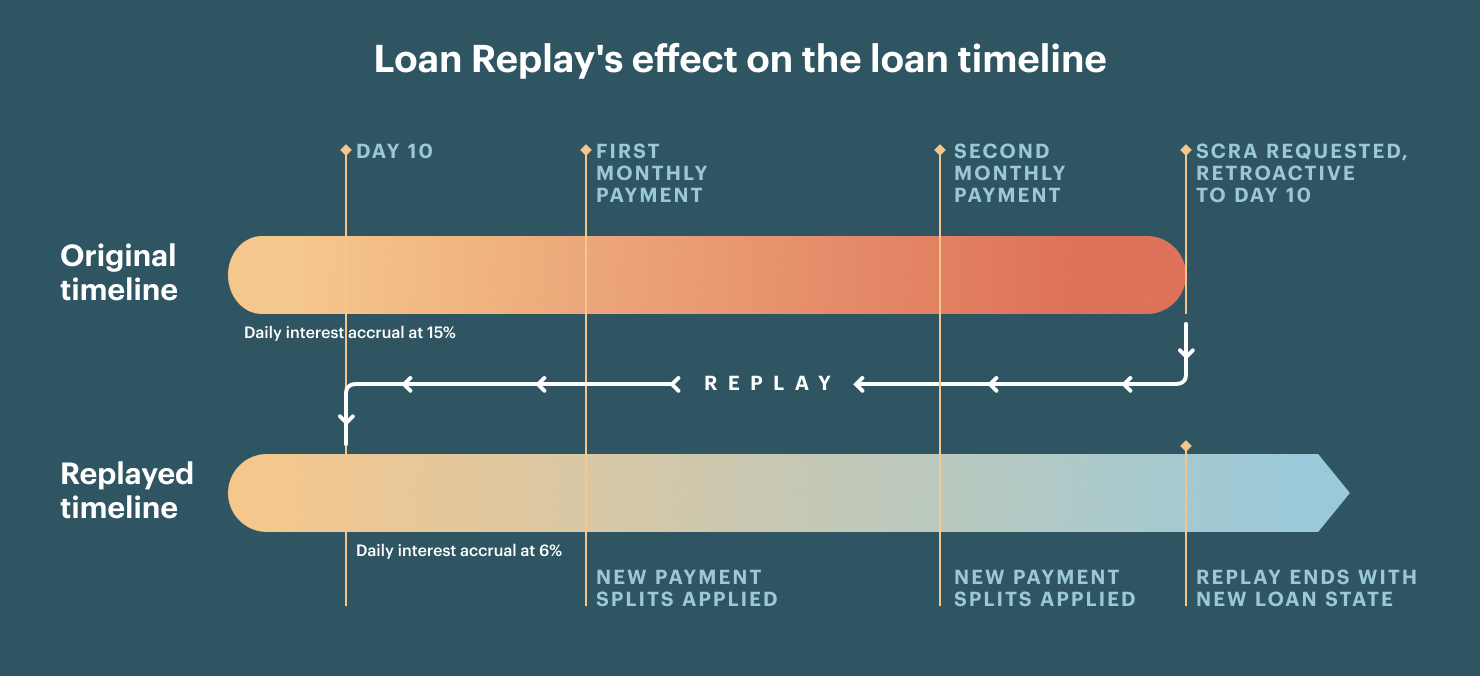
The breadth of loan data needing to be adjusted means that rewriting loan histories requires the right design and abstractions, and having a built-in layer of abstraction to handle retroactive changes is the only feasible approach. Because of our team’s combined experience in the real world of lending, we know that the need to edit past loan events is inevitable. So we’ve designed a system that makes these changes as painless and automated as possible.