Helping Borrowers Through Hard Times
The COVID-19 public health crisis has created unprecedented challenges for borrowers, lenders and servicers. This post focuses on how lenders and servicers can leverage Peach’s solutions to help borrowers in times of emergency and financial hardship.
What Borrowers Need
The full impact of COVID-19 on the economy is uncertain. But in the past few weeks, millions of workers have lost their jobs and small businesses are running out of capital. The federal government is racing to send checks to households, extend loans to small businesses, and encourage banks to start offering responsible small dollar loans to consumers. Federal and state governments are encouraging lenders to offer flexible accommodations to borrowers impacted by COVID-19.
As economic conditions deteriorate and borrower delinquencies increase, lenders need powerful tools to provide borrowers with flexible payment plans and loan modification options.
Most legacy servicing systems are too rigid to accommodate custom hardship programs, or they require significant manual work by back office personnel. This is costly and does not scale. We built Peach to provide greater flexibility. With Peach, you can deploy a wide range of tools to respond to borrower hardship, benefiting both borrowers and lenders.
What Peach Enables
Peach’s solution gives lenders and servicers various ways to handle hardships and loan modifications, including the ability to:
- Defer due dates to a future date, either within an existing loan term or with an extended term.
- Lower interest rates and suspend late fees.
- Pause collection efforts, including calls and/or overdue notifications.
- Lower recurring payment amounts by changing due date frequency.
- Lower recurring payment amounts by extending loan duration.
- Allow borrowers to prepay future recurring payments.
- Offer settlement plans to prevent charge-offs.
- Automatically execute a natural disaster relief plan according to lender specifications.
- Report loans as current to credit bureaus if the consumer fulfills the terms of the accommodation.
Peach automatically recalculates and/or re-amortizes in real time, allowing customer care agents to go over revised numbers and find the best solution for the borrower. There’s no custom code required.
Automation and Self-Service
Many of these features can be enabled in Peach’s white-label borrower portal as self-service actions for borrowers. Giving borrowers the ability to modify loans on their own gives them control and eases their burden in difficult times. This can significantly lower the load on customer care and collections teams, allowing them to focus on the most difficult cases.
In our next post, we address the challenge of keeping call centers operational during a crisis and how lenders can shift quickly to remote-work operations for loan servicing.
If you want more flexible ways to accommodate borrowers experiencing financial hardship, please email us at info@peachfinance.com.
lender’s priority list. But that doesn’t mean compliance is straightforward, even for lenders with the most earnest intentions. Often, legacy infrastructure is the culprit, making it difficult for lenders to take the actions clearly outlined in the law. Even regulations that haven’t changed for some time—like the—still present significant challenges for many lenders.
The SCRA grants active-duty service members the ability to request certain protections during the period of their deployment, enabling them to devote their energy to serving the country. These protections include a reduction in interest rate to a maximum of six percent on any pre-service loans. While the SCRA in its current version has been law since 2003, the number of recent enforcement actions indicates just how difficult it is for many lenders to comply with the SCRA’s interest rate protections.
Blunt tools in the absence of a scalpel
For example, in October of 2022 the Department of Justice (DOJ) announced that the financial leasing arm of GM agreed to pay over $3.5 million to resolve allegations in relation to
Peach’s approach to SCRA
At Peach, we brought real-life lending experience to the design of our platform. So from day one, we recognized the importance of being able to make retroactive changes to loans. (There are numerous applications beyond SCRA, including our Supported Portfolio Migration.) In the case of SCRA, Peach has long enabled lenders to retroactively change interest rates and waive past fees—as separate, manual actions.
Peach’s approach to SCRA
This was functional, but the ideal way to implement SCRA is to make these changes simultaneously. We now support this capability by leveraging the power of Peach's Loan Replay™ engine, which can make changes to the ledger at any time, and then recalculate a loan’s history in light of those changes. The new combined functionality is as user-friendly for your agents as processing a payment.
Peach’s approach to SCRA
Specifically, the new SCRA feature allows your agents to perform the following adjustments simultaneously on a loan of an active-duty service member:
- Lower interest rates to 6% (and lower the recurring payment during the active-duty period to account for the interest rate reduction)
- Waive fees, if necessary
- Enact these changes retroactively, if necessary, and replay the loan history with the rate and fee adjustments
- Preview the intended changes
“We launched our first product on Peach in six weeks. Eighteen months later.”
John Smith, CMO
Our SCRA functionality is available via API as well as through our white-label agent tool. The white-label agent interface can be seen here:
Peach’s approach to SCRA
Our SCRA functionality is available via API as well as through our white-label agent tool. The white-label agent interface can be seen here:
For those working directly with the API, this can be as simple as sending the following request body to the SCRA endpoint:
You’ll receive a response with either the actual post-SCRA adjusted payment plan or a preview of it. Below is a comparison of a payment plan prior to the SCRA adjustment, and the expected payments after the SCRA adjustment. The SCRA period is in effect for the first two months, and thus you will see the interest rates lowered to 6% in the response body (and the recurring amount due lowered by the amount of the interest rate reduction for the two relevant months). The origination fee has also been canceled.
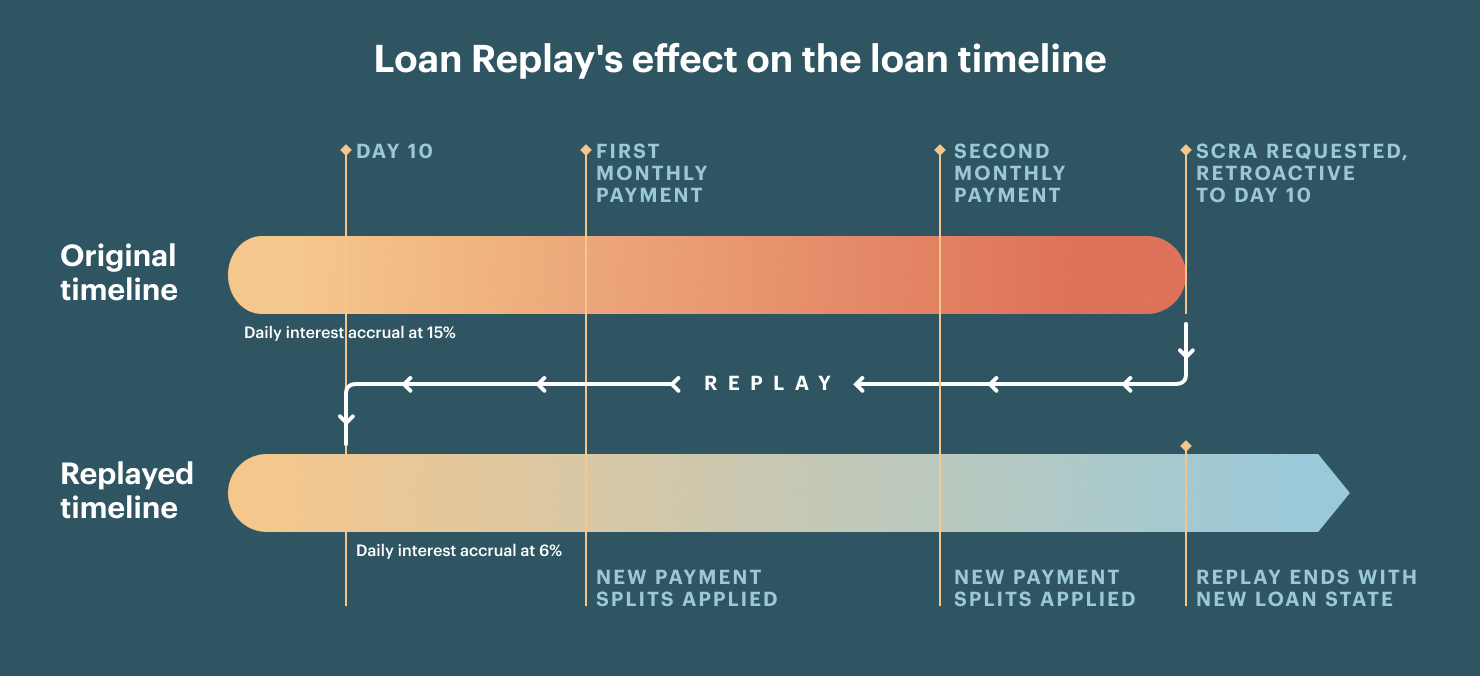
The breadth of loan data needing to be adjusted means that rewriting loan histories requires the right design and abstractions, and having a built-in layer of abstraction to handle retroactive changes is the only feasible approach. Because of our team’s combined experience in the real world of lending, we know that the need to edit past loan events is inevitable. So we’ve designed a system that makes these changes as painless and automated as possible.