How to Prepare Your Servicing Operation for a Post-Pandemic World
The dual public health and financial crises set off by COVID-19 has created unforeseen challenges for both borrowers and lenders. In a previous post, we highlighted how Peach’s modern loan servicing platform can provide flexible payment plans and loan modification options to borrowers in times of emergency. In this post, we’ll address the challenges lenders face in converting servicing call centers to remote-work operations—and how Peach’s software solutions can make this transition easy.
The Challenges of Remote Work
The recent COVID-19 outbreak has transformed call centers into potential transmission zones, creating health risks for workers. Regardless of whether states allow call centers to remain open, we believe all lenders need to be able to quickly shift servicing operations to remote work where legally possible to protect the health and safety of their employees—and to ensure business continuity.
However, this shift to remote work creates challenges that span across operations, technology, privacy, data security and compliance. Agents need remote access to servicing systems and tools to interact with borrowers while still protecting borrowers’ data in a home environment. Supervisors need to maintain the ability to audit and monitor agent performance for quality. Back office personnel need escalation tools, audit trails, and controls to ensure compliance.
Peach’s modern loan management and servicing platform addresses these challenges and gives lenders a push-button option to enable call center agents to work from home.
How Peach Enables Remote Work
Peach’s servicing platform is a scalable cloud-hosted solution (built on Google Cloud). That means anyone with internet access can be granted access to the system, including those with VoIP connections (without the need for VPN interference). Call center agents working remotely just need to connect an employer-provided computer to the internet and log in to Peach. The Peach application runs in the browser, so even a basic laptop is sufficient.
For each job function, Peach provides the tools and data employees need to do their job.
For agents, Peach provides an integrated suite of servicing and collections tools including a loan management system, a customer relationship management (CRM) system, cases and workflows and communication tools.
For supervisors, Peach provides real-time performance and SLA reports, call analytics, and recordings so supervisors can coach agents, monitor trends, and ensure quality.
For back office and compliance personnel, Peach provides access to real-time data and audit trails.
Peach provides a full set of controls and permissions to restrict agent access to shift hours. We also run velocity checks to prevent data abuse, prevent data from being inappropriately copied or downloaded, and ensure agents are working from an approved remote location.
Scaling and Training for Increased Demand
Current and future public health crises may stretch the limits of existing call-center capacity and create the need to onboard temporary workers. Legacy servicing systems are difficult to learn and take weeks of in-person training to use properly. Peach provides servicing tools that are intuitive and easy for agents to use. New agents can be trained on the Peach platform in days, not weeks, to allow lenders to quickly scale up to meet increasing demand.
If you’d like to learn more about how Peach helps lenders modernize their servicing operation, please email us at info@peachfinance.com.
****
About Peach
Peach is a cloud-native lending technology platform that helps fintechs and traditional financial institutions quickly launch new lending programs. Peach is the only lending platform built on an Adaptive Core™. The company’s fully integrated suite of API-based products includes a loan management system that supports virtually any non-mortgage asset class and features 250+ configuration variables; a suite of proprietary servicing tools, including a lending-specific CRM, borrower portal, agent portal, payment processing, communications, reporting and first-party collections tools; and Compliance Guard™, a proprietary compliance monitoring system. Peach can also accrue interest and generate repayment schedules during loan origination. Peach was built by leaders from top fintechs like Affirm, Avant and Prosper, who set out to create the most configurable, robust, compliance-forward and future-proof lending platform in the market. Learn more at peachfinance.com.
lender’s priority list. But that doesn’t mean compliance is straightforward, even for lenders with the most earnest intentions. Often, legacy infrastructure is the culprit, making it difficult for lenders to take the actions clearly outlined in the law. Even regulations that haven’t changed for some time—like the—still present significant challenges for many lenders.
The SCRA grants active-duty service members the ability to request certain protections during the period of their deployment, enabling them to devote their energy to serving the country. These protections include a reduction in interest rate to a maximum of six percent on any pre-service loans. While the SCRA in its current version has been law since 2003, the number of recent enforcement actions indicates just how difficult it is for many lenders to comply with the SCRA’s interest rate protections.
Blunt tools in the absence of a scalpel
For example, in October of 2022 the Department of Justice (DOJ) announced that the financial leasing arm of GM agreed to pay over $3.5 million to resolve allegations in relation to
Peach’s approach to SCRA
At Peach, we brought real-life lending experience to the design of our platform. So from day one, we recognized the importance of being able to make retroactive changes to loans. (There are numerous applications beyond SCRA, including our Supported Portfolio Migration.) In the case of SCRA, Peach has long enabled lenders to retroactively change interest rates and waive past fees—as separate, manual actions.
Peach’s approach to SCRA
This was functional, but the ideal way to implement SCRA is to make these changes simultaneously. We now support this capability by leveraging the power of Peach's Loan Replay™ engine, which can make changes to the ledger at any time, and then recalculate a loan’s history in light of those changes. The new combined functionality is as user-friendly for your agents as processing a payment.
Peach’s approach to SCRA
Specifically, the new SCRA feature allows your agents to perform the following adjustments simultaneously on a loan of an active-duty service member:
- Lower interest rates to 6% (and lower the recurring payment during the active-duty period to account for the interest rate reduction)
- Waive fees, if necessary
- Enact these changes retroactively, if necessary, and replay the loan history with the rate and fee adjustments
- Preview the intended changes
“We launched our first product on Peach in six weeks. Eighteen months later.”
John Smith, CMO
Our SCRA functionality is available via API as well as through our white-label agent tool. The white-label agent interface can be seen here:
Peach’s approach to SCRA
Our SCRA functionality is available via API as well as through our white-label agent tool. The white-label agent interface can be seen here:
For those working directly with the API, this can be as simple as sending the following request body to the SCRA endpoint:
You’ll receive a response with either the actual post-SCRA adjusted payment plan or a preview of it. Below is a comparison of a payment plan prior to the SCRA adjustment, and the expected payments after the SCRA adjustment. The SCRA period is in effect for the first two months, and thus you will see the interest rates lowered to 6% in the response body (and the recurring amount due lowered by the amount of the interest rate reduction for the two relevant months). The origination fee has also been canceled.
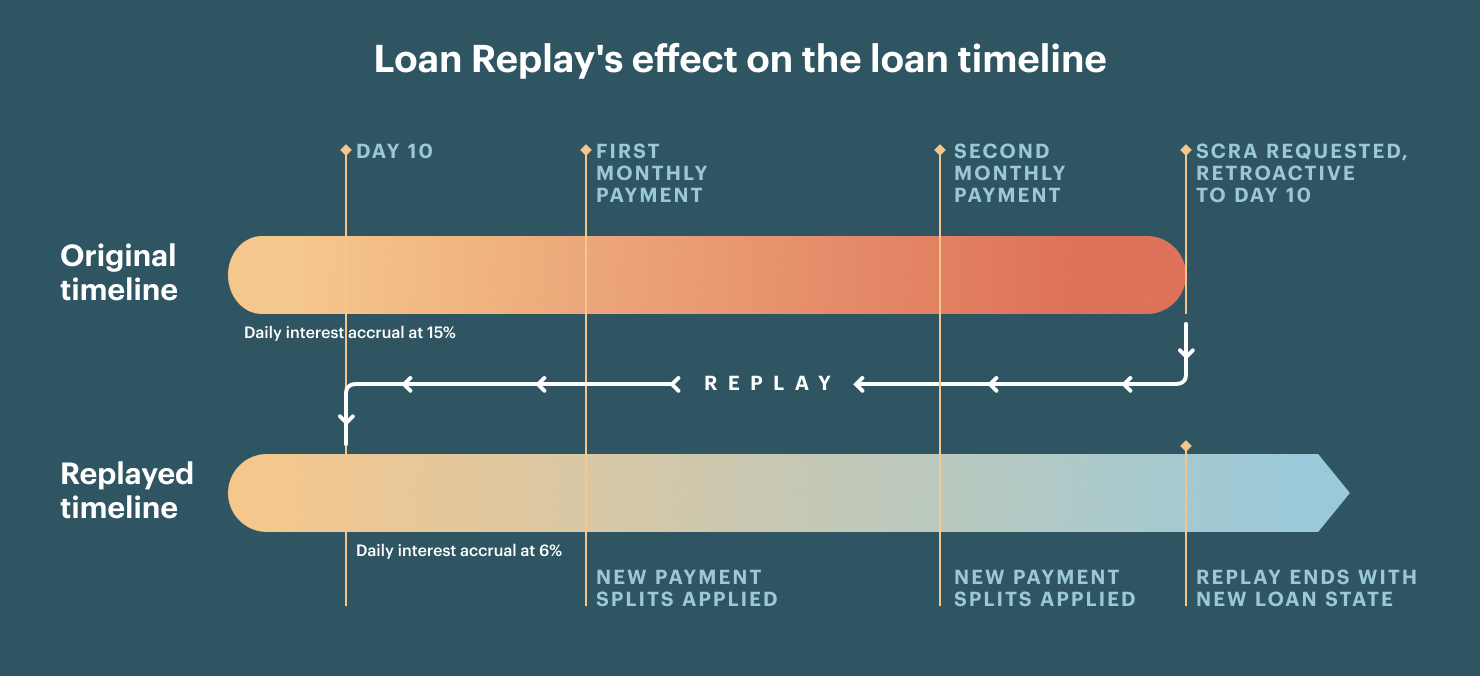
The breadth of loan data needing to be adjusted means that rewriting loan histories requires the right design and abstractions, and having a built-in layer of abstraction to handle retroactive changes is the only feasible approach. Because of our team’s combined experience in the real world of lending, we know that the need to edit past loan events is inevitable. So we’ve designed a system that makes these changes as painless and automated as possible.