
In this Q&A with Crowdfund Insider, Peach CEO Eddie Oistacher takes a look into the future of loan servicing. Here's an excerpt from the article.
--
Q: We often hear of “financial institutions vs. fintechs,” as if this is a battle with a binary outcome. Is this an accurate assessment within the lending space?
A: Not at all — in fact, nothing could be further from the truth. Once upon a time, fintechs may have been perceived as a threat to the existence of traditional financial institutions (FIs), but that perception has radically changed. This is for two reasons.
First, the fintech that had hoped to replace FIs wholesale have been largely unsuccessful. That’s not to say they haven’t built great businesses. But instead of replacing FIs, these fintechs have found a niche — doing certain things like point-of-sale financing, underwriting, and onboarding better than their FI counterparts. These more focused solutions don’t pose an existential threat to FIs.
Secondly, a very large portion of today’s fintechs in the lending space aim not to replace FIs, but to serve them. For every fintech building machine learning-based underwriting for their own benefit, there’s another fintech offering a similar technology to bolster the existing offerings of FIs. And in large part, FIs have embraced this symbiosis, acknowledging that they need help in certain areas in order to stay competitive.
So, in this way, we’re settling into a very healthy balance between fintechs — with their specialized product offerings and nimble approach to financial services innovation — and FIs — with their comprehensive product offerings, offline presence and established customer bases. It’s certainly true to say that the emergence of fintechs has made FIs better, that FIs’ resilience has compelled fintechs to be better, and that customers have benefited a great deal from...
lender’s priority list. But that doesn’t mean compliance is straightforward, even for lenders with the most earnest intentions. Often, legacy infrastructure is the culprit, making it difficult for lenders to take the actions clearly outlined in the law. Even regulations that haven’t changed for some time—like the—still present significant challenges for many lenders.
The SCRA grants active-duty service members the ability to request certain protections during the period of their deployment, enabling them to devote their energy to serving the country. These protections include a reduction in interest rate to a maximum of six percent on any pre-service loans. While the SCRA in its current version has been law since 2003, the number of recent enforcement actions indicates just how difficult it is for many lenders to comply with the SCRA’s interest rate protections.
Blunt tools in the absence of a scalpel
For example, in October of 2022 the Department of Justice (DOJ) announced that the financial leasing arm of GM agreed to pay over $3.5 million to resolve allegations in relation to
Peach’s approach to SCRA
At Peach, we brought real-life lending experience to the design of our platform. So from day one, we recognized the importance of being able to make retroactive changes to loans. (There are numerous applications beyond SCRA, including our Supported Portfolio Migration.) In the case of SCRA, Peach has long enabled lenders to retroactively change interest rates and waive past fees—as separate, manual actions.
Peach’s approach to SCRA
This was functional, but the ideal way to implement SCRA is to make these changes simultaneously. We now support this capability by leveraging the power of Peach's Loan Replay™ engine, which can make changes to the ledger at any time, and then recalculate a loan’s history in light of those changes. The new combined functionality is as user-friendly for your agents as processing a payment.
Peach’s approach to SCRA
Specifically, the new SCRA feature allows your agents to perform the following adjustments simultaneously on a loan of an active-duty service member:
- Lower interest rates to 6% (and lower the recurring payment during the active-duty period to account for the interest rate reduction)
- Waive fees, if necessary
- Enact these changes retroactively, if necessary, and replay the loan history with the rate and fee adjustments
- Preview the intended changes
“We launched our first product on Peach in six weeks. Eighteen months later.”
John Smith, CMO
Our SCRA functionality is available via API as well as through our white-label agent tool. The white-label agent interface can be seen here:
Peach’s approach to SCRA
Our SCRA functionality is available via API as well as through our white-label agent tool. The white-label agent interface can be seen here:
For those working directly with the API, this can be as simple as sending the following request body to the SCRA endpoint:
You’ll receive a response with either the actual post-SCRA adjusted payment plan or a preview of it. Below is a comparison of a payment plan prior to the SCRA adjustment, and the expected payments after the SCRA adjustment. The SCRA period is in effect for the first two months, and thus you will see the interest rates lowered to 6% in the response body (and the recurring amount due lowered by the amount of the interest rate reduction for the two relevant months). The origination fee has also been canceled.
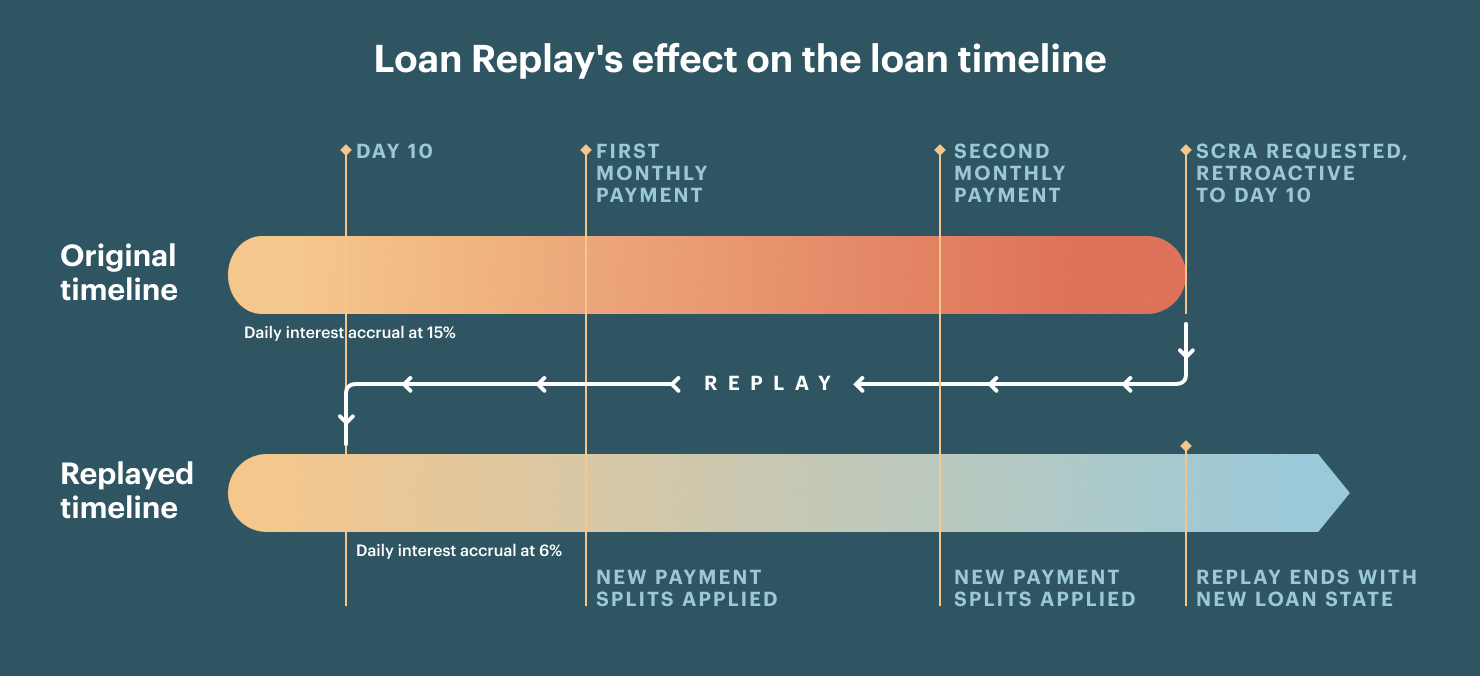
The breadth of loan data needing to be adjusted means that rewriting loan histories requires the right design and abstractions, and having a built-in layer of abstraction to handle retroactive changes is the only feasible approach. Because of our team’s combined experience in the real world of lending, we know that the need to edit past loan events is inevitable. So we’ve designed a system that makes these changes as painless and automated as possible.