
Peach CEO and Co-Founder Eddie Oistacher joined Peter Renton on the Fintech One-on-One podcast to chat about Peach's founding story, the biggest challenges lenders face today, and how Peach helps lenders meet borrowers halfway during a downturn.
They also discussed how Peach's supported Portfolio Migration capability is changing the game for lenders who want to modernize their servicing technology.
An excerpt from the podcast
Peter: I’d like to talk about loan servicing. There’s a lot of talk about a potential recession this year, and the economic environment may end up being quite challenging. How should lenders be thinking about servicing given what may be in store for us this year?
Eddie: Downturns in lending always make for an interesting discussion. At previous companies, we learned a lot about these recessionary periods, gaining insight into how people behave during a recession and what the lenders that survived did differently from those that eventually had to write off entire portfolios.
I think the key for any lender is to keep the borrower financially healthy and happy. Because in the end, these are your loyal customers, and losing them during a downturn probably means losing them forever.
We put so much effort and money into acquiring these customers, so during this kind of economic environment you just need to be flexible enough to weather the period where the customer may experience financial hardship. The required flexibility can take a lot of different forms as you work with your customers to find a solution. One way, for example, can be allowing your customer to make no payments for a certain period of time. Or you can do things like lowering the monthly payment for a given period, refinancing the loan, extending the term, waiving fees, or lowering interest for a while.
So there are multiple different ways for you to help the customer and keep them on your platform without charging them off or writing them off in your books. And that’s where robust and modern technology is key. If the lender doesn’t have all these tools, then they’re likely going to lose the customer forever. Because if the customer can’t pay what the lender is asking, they’ll have no choice but to walk away and either file for bankruptcy or default on the loan.
Peter: Right, got it. On your website, it talks about the Adaptive Core™, which it looks like you’ve trademarked. What is an Adaptive Core™ and why is that important?
Eddie: Our Adaptive Core is our proprietary loan management system, which is the heartbeat of what we do. You can think about it in this way: If you need to make a change to a lending program, the Adaptive Core enables you to change a configuration, instead of changing code or introducing a new feature. It is basically an ability for lenders to quickly and easily launch and modify lending products. And because we support virtually any asset class, it’s very adaptive to your needs and offers a great deal of flexibility.
We have 200+ variables that control the loan behavior without needing a single line of code—not from us and not from the lender...
lender’s priority list. But that doesn’t mean compliance is straightforward, even for lenders with the most earnest intentions. Often, legacy infrastructure is the culprit, making it difficult for lenders to take the actions clearly outlined in the law. Even regulations that haven’t changed for some time—like the—still present significant challenges for many lenders.
The SCRA grants active-duty service members the ability to request certain protections during the period of their deployment, enabling them to devote their energy to serving the country. These protections include a reduction in interest rate to a maximum of six percent on any pre-service loans. While the SCRA in its current version has been law since 2003, the number of recent enforcement actions indicates just how difficult it is for many lenders to comply with the SCRA’s interest rate protections.
Blunt tools in the absence of a scalpel
For example, in October of 2022 the Department of Justice (DOJ) announced that the financial leasing arm of GM agreed to pay over $3.5 million to resolve allegations in relation to
Peach’s approach to SCRA
At Peach, we brought real-life lending experience to the design of our platform. So from day one, we recognized the importance of being able to make retroactive changes to loans. (There are numerous applications beyond SCRA, including our Supported Portfolio Migration.) In the case of SCRA, Peach has long enabled lenders to retroactively change interest rates and waive past fees—as separate, manual actions.
Peach’s approach to SCRA
This was functional, but the ideal way to implement SCRA is to make these changes simultaneously. We now support this capability by leveraging the power of Peach's Loan Replay™ engine, which can make changes to the ledger at any time, and then recalculate a loan’s history in light of those changes. The new combined functionality is as user-friendly for your agents as processing a payment.
Peach’s approach to SCRA
Specifically, the new SCRA feature allows your agents to perform the following adjustments simultaneously on a loan of an active-duty service member:
- Lower interest rates to 6% (and lower the recurring payment during the active-duty period to account for the interest rate reduction)
- Waive fees, if necessary
- Enact these changes retroactively, if necessary, and replay the loan history with the rate and fee adjustments
- Preview the intended changes
“We launched our first product on Peach in six weeks. Eighteen months later.”
John Smith, CMO
Our SCRA functionality is available via API as well as through our white-label agent tool. The white-label agent interface can be seen here:
Peach’s approach to SCRA
Our SCRA functionality is available via API as well as through our white-label agent tool. The white-label agent interface can be seen here:
For those working directly with the API, this can be as simple as sending the following request body to the SCRA endpoint:
You’ll receive a response with either the actual post-SCRA adjusted payment plan or a preview of it. Below is a comparison of a payment plan prior to the SCRA adjustment, and the expected payments after the SCRA adjustment. The SCRA period is in effect for the first two months, and thus you will see the interest rates lowered to 6% in the response body (and the recurring amount due lowered by the amount of the interest rate reduction for the two relevant months). The origination fee has also been canceled.
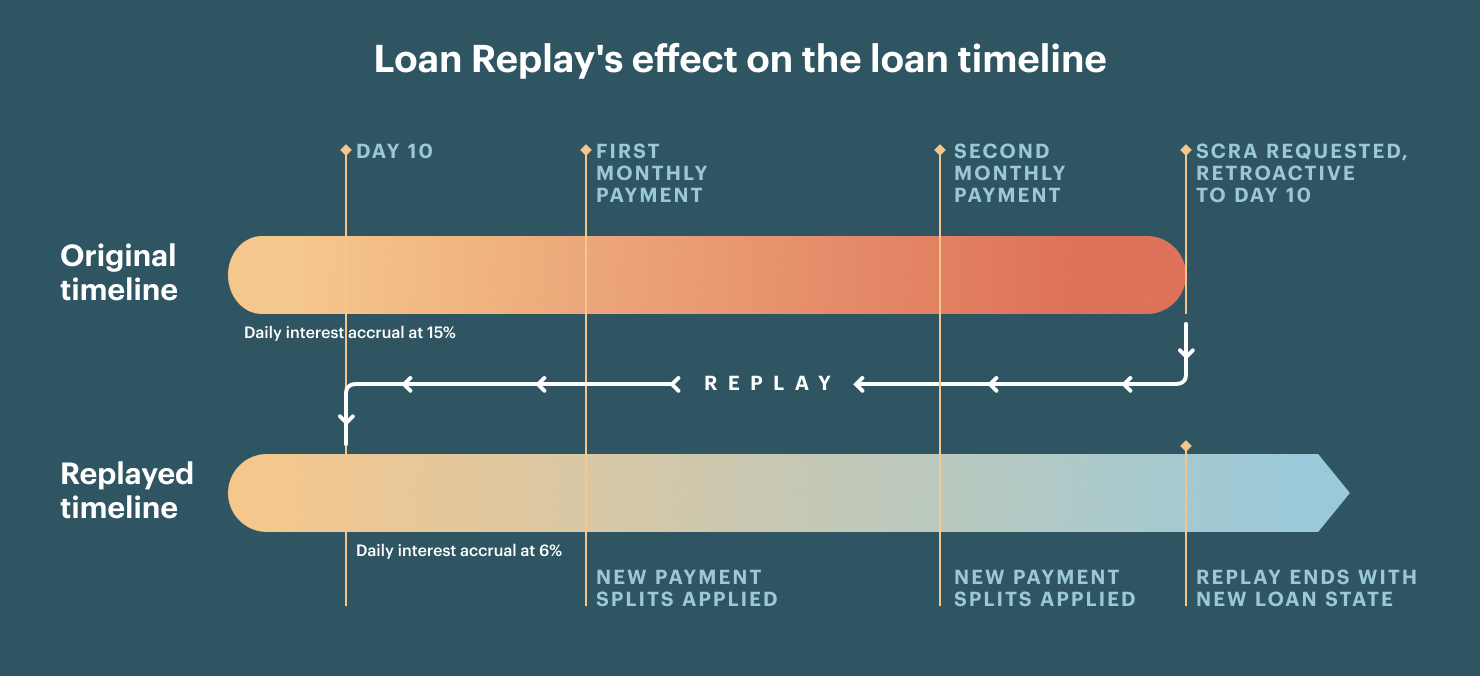
The breadth of loan data needing to be adjusted means that rewriting loan histories requires the right design and abstractions, and having a built-in layer of abstraction to handle retroactive changes is the only feasible approach. Because of our team’s combined experience in the real world of lending, we know that the need to edit past loan events is inevitable. So we’ve designed a system that makes these changes as painless and automated as possible.