
In today's competitive lending landscape, customer experience has become a key differentiator. While the origination side of the customer experience is focused mainly on reducing friction during borrower onboarding—as well as optimizing underwriting to approve more borrowers—the post-origination side is all about increasing customer satisfaction as the loan is being repaid. While origination is vitally important, it’s the post-origination experience that comprises most of the lender-borrower relationship, and that the borrower is most likely to remember.
This article will address the post-origination side of lending, and the servicing technology that underpins it. We’ll look at five ways modern servicing technology is enabling lenders to offer their borrowers convenience, transparency, and personalized service.
1. Better self-service
These days, most borrowers prefer to self-service if at all possible. But technology is often a limiting factor. Modern servicing technology is the key to unlocking the kinds of self-service functionality borrowers have come to expect:
- Access loan balances, payment histories, upcoming due dates, and statements across a wide range of devices
- Make and schedule payments, and set up autopay
- Customize repayment schedules, including setting up personalized due dates and payment frequencies
Offering robust self-service functionality—including the flexibility to modify payment schedules—gives borrowers control over their repayment experience while enabling lenders to reduce contact rates and lower operational costs.
2. Enhanced customer support
Self-service options can significantly reduce the need for direct support from agents. But when borrowers do need help, modern servicing technology can make it more effective and efficient by providing:
- A robust, lending-specific CRM
- AI-powered features, like case summaries and call transcription, to increase agent efficiency
- Preconfigured cases and workflows to increase agent productivity and accuracy
- Detailed customer profiles and case histories, giving agents a full view of each borrower's history
Customer support experiences typically lag behind other aspects of the post-origination experience in terms of customer satisfaction. But these tools can enable faster, more effective problem resolution, leading to higher customer satisfaction. Providing out-of-the-box cases and workflows for common scenarios enables lenders to launch their lending programs much more quickly, and helps them reduce risk by ensuring all workflows are vetted by compliance. Lenders should also expect their servicing technology to offer the flexibility to customize additional cases, workflows, and templates as needed.
3. Omnichannel communications and alerts
Modern servicing systems enable lenders to reach their borrower wherever they are. Specifically, these servicing systems should provide:
- Communications templates for all common cases and workflows that are optimized for the user experience and compliant with federal and state regulations
- Customized payment reminders
- Omnichannel support, including email, SMS, two-way texting, and chat
- Unrestricted ability to personalize and customize outbound communications
Omnichannel communications are a critical way to reach customers at the times and on the channels that are most convenient for them. By delivering communications on their terms, and in a seamless and transparent way, lenders can maximize customer satisfaction and increase on-time payments.
4. Flexible and convenient payment options
Modern loan servicing technology makes it easier for borrowers to pay the way they want to. This can have an impact not just on borrower satisfaction, but also on repayment rates. Best-in-class capabilities include:
- Support for multiple payment methods: ACH, debit, and credit
- Ability to modify due dates to align with borrowers’ paychecks
- Customizable payment frequencies and amounts
- Self-service autopay functionality
These flexible options not only improve the customer experience but can also lead to higher repayment rates.
5. Seamless borrower accommodations
No matter how well you’re prepared for the happy path, there will always be borrowers who need accommodations of various types. Modern servicing technology can make it easier and less resource-intensive to handle scenarios like:
- Bankruptcy and natural disasters
- Military deployment (requiring SCRA protections)
- Financial hardship
Modern servicing technology can give you the flexibility to accommodate scenarios that require pausing payments, modifying payment plans, making retroactive changes to the ledger, and more. When lenders have the flexibility to turn unhappy paths into happy paths, they can deliver a better customer experience and ensure compliance at the same time.
–
Modern loan servicing technology has transformed what used to be a limiting and frustrating post-origination experience. By investing in modern servicing technology, lenders can significantly increase customer satisfaction and loyalty, and reduce servicing costs.
As technology continues to evolve, and especially as AI becomes more proficient at augmenting the efforts of customer service agents, we can expect increasing benefits to lenders and borrowers alike. Lenders who stay at the forefront of these technological advancements will be best positioned to meet and exceed customer expectations in an increasingly competitive market.
lender’s priority list. But that doesn’t mean compliance is straightforward, even for lenders with the most earnest intentions. Often, legacy infrastructure is the culprit, making it difficult for lenders to take the actions clearly outlined in the law. Even regulations that haven’t changed for some time—like the—still present significant challenges for many lenders.
The SCRA grants active-duty service members the ability to request certain protections during the period of their deployment, enabling them to devote their energy to serving the country. These protections include a reduction in interest rate to a maximum of six percent on any pre-service loans. While the SCRA in its current version has been law since 2003, the number of recent enforcement actions indicates just how difficult it is for many lenders to comply with the SCRA’s interest rate protections.
Blunt tools in the absence of a scalpel
For example, in October of 2022 the Department of Justice (DOJ) announced that the financial leasing arm of GM agreed to pay over $3.5 million to resolve allegations in relation to
Peach’s approach to SCRA
At Peach, we brought real-life lending experience to the design of our platform. So from day one, we recognized the importance of being able to make retroactive changes to loans. (There are numerous applications beyond SCRA, including our Supported Portfolio Migration.) In the case of SCRA, Peach has long enabled lenders to retroactively change interest rates and waive past fees—as separate, manual actions.
Peach’s approach to SCRA
This was functional, but the ideal way to implement SCRA is to make these changes simultaneously. We now support this capability by leveraging the power of Peach's Loan Replay™ engine, which can make changes to the ledger at any time, and then recalculate a loan’s history in light of those changes. The new combined functionality is as user-friendly for your agents as processing a payment.
Peach’s approach to SCRA
Specifically, the new SCRA feature allows your agents to perform the following adjustments simultaneously on a loan of an active-duty service member:
- Lower interest rates to 6% (and lower the recurring payment during the active-duty period to account for the interest rate reduction)
- Waive fees, if necessary
- Enact these changes retroactively, if necessary, and replay the loan history with the rate and fee adjustments
- Preview the intended changes
“We launched our first product on Peach in six weeks. Eighteen months later.”
John Smith, CMO
Our SCRA functionality is available via API as well as through our white-label agent tool. The white-label agent interface can be seen here:
Peach’s approach to SCRA
Our SCRA functionality is available via API as well as through our white-label agent tool. The white-label agent interface can be seen here:
For those working directly with the API, this can be as simple as sending the following request body to the SCRA endpoint:
You’ll receive a response with either the actual post-SCRA adjusted payment plan or a preview of it. Below is a comparison of a payment plan prior to the SCRA adjustment, and the expected payments after the SCRA adjustment. The SCRA period is in effect for the first two months, and thus you will see the interest rates lowered to 6% in the response body (and the recurring amount due lowered by the amount of the interest rate reduction for the two relevant months). The origination fee has also been canceled.
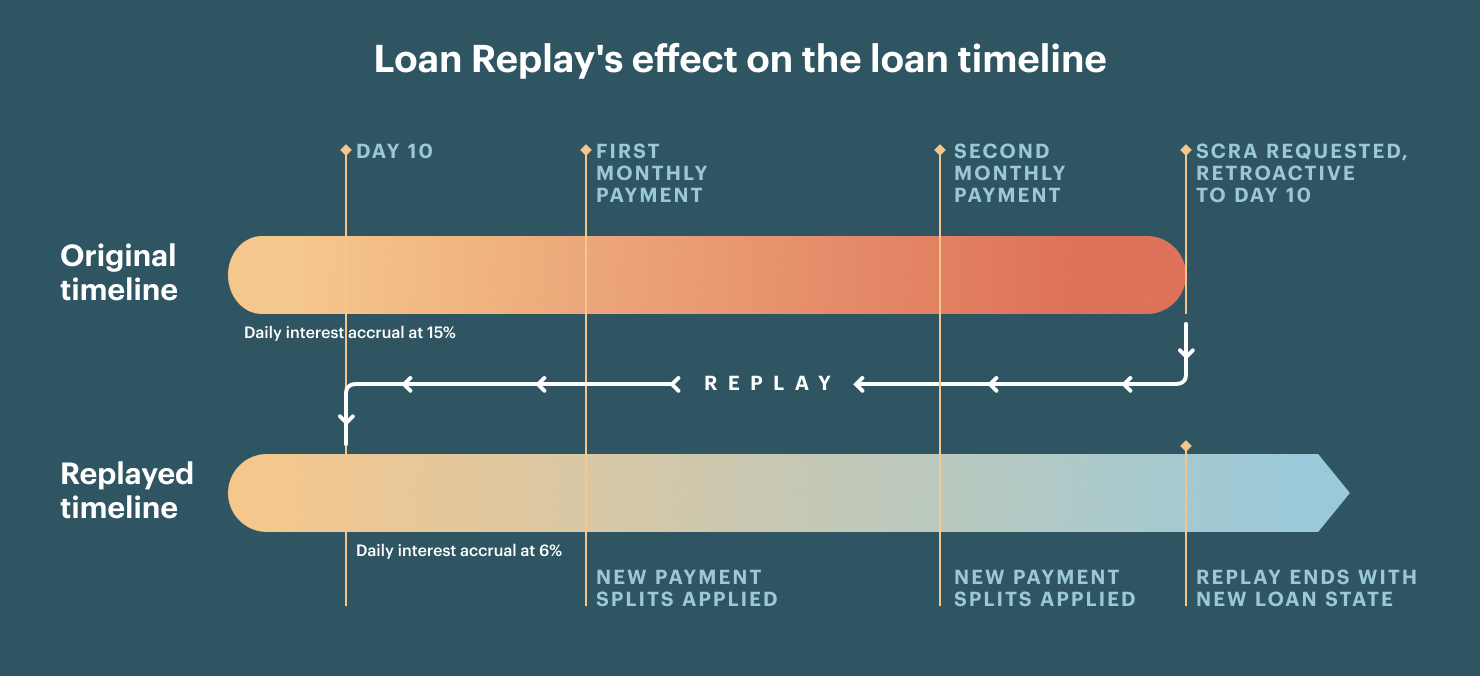
The breadth of loan data needing to be adjusted means that rewriting loan histories requires the right design and abstractions, and having a built-in layer of abstraction to handle retroactive changes is the only feasible approach. Because of our team’s combined experience in the real world of lending, we know that the need to edit past loan events is inevitable. So we’ve designed a system that makes these changes as painless and automated as possible.