On May 22, 2024, the Consumer Financial Protection Bureau (CFPB) issued an interpretive rule targeting buy now, pay later (BNPL) products. The rule positions BNPL products similarly to credit cards under the Truth in Lending Act (TILA), thus subjecting BNPL providers to new requirements around periodic statements, billing disputes and returns.
The rule is currently open for public feedback, providing a brief transition period for BNPL providers to align their operations with the new standards. The rule is set to take effect after 60 days.
In this article, we’ll review the required changes and discuss the ones most likely to pose challenges for BNPL providers. We’ll also cover the ways in which Peach was designed to natively solve for the rule’s requirements.
Key provisions of the new rule
With BNPL now classified similarly to traditional credit cards, providers must offer similar consumer protections, such as the ability to dispute charges and the provision of clear and concise periodic billing statements.
- Periodic statements: Lenders must provide regular and detailed billing statements to consumers showing transactions, fees and other relevant information.
- Dispute resolution: Procedures must be established for resolving billing errors and other disputes reported by consumers. Payment obligations must be paused during such investigations.
- Refunds for returned products: Providers must credit refunds to consumers’ accounts when products are returned or services are canceled.
Though these provisions may sound simple on the surface, they are nontrivial for many BNPL providers. Servicing technology is perhaps the most complex part of the lending tech stack, and even small changes can require an extensive retrofitting of existing infrastructure.
To take returns and disputes as an example, more than 13% of BNPL transactions have historically involved returns or disputes, translating to $1.8 billion in disputed or returned transactions at five surveyed firms in 2021 alone. So any requirements related to returns or disputes that are not already accounted for can quickly lead to an unsustainable amount of manual work—dramatically lowering operational efficiency.
The creation of periodic billing statements can also create additional work for BNPL providers who have not historically generated statements. Lenders must create a standardized process for generating statements at specific times as required by regulation, including fetching accurate and timely accounting data when needed.
Given that this interpretive rule is the latest in a series of BNPL-related moves made by the CFPB, it’s not unlikely that additional BNPL requirements will be introduced in the future. In light of this, some BNPL providers may choose to take a long-term view when it comes to their infrastructure—investing in flexible technology that enables them to continue to adapt not only to changing regulations, but to evolving markets and consumer preferences as well.
How Peach solves for the CFPB’s BNPL requirements
Given Peach powers credit card programs for many of our clients, and thus we already support statements, refunds and disputes, we’re able to support all of these requirements out of the box for BNPL as well. We’ll briefly cover some of the more salient capabilities that are native to our platform.
- Statements: Peach builds CARD Act-compliant statements out of the box—not only for credit cards and BNPL, but also for all line of credit and installment loan products. For lenders who would like to render their own statements, we also serve up all the information required to build compliant statements via API.
- Refunds: Our system natively allows lenders to issue refunds, both through agent tooling and systematically via API. Our system can leverage our proprietary Loan Replay™ capability to automatically ensure that retroactive changes are accounted for and that an accurate history of the loan (including principal/interest splits) is reflected. Additionally, we give BNPL providers flexibility in how they handle recurring payment amounts in the event of returns. Lenders can keep the same recurring payment amount while shortening the repayment term, or they can reamortize the outstanding balance to reduce the recurring payment amount.
- Disputes: Peach provides out-of-the-box agent tooling around customer disputes, empowering agents to create disputes, monitor cases and follow workflows as they progress toward resolution. Our system can freeze accounts, temporarily stop loans from accruing interest, and pause payment requirements for borrowers as required during disputes.
- Multi-capture transactions: With Peach, BNPL providers can track every item in a transaction individually. This way, if a customer finances multiple items and only a subset of them are subject to a refund or a dispute, lenders have granular control over accounting for each item.
- Credit reporting: Peach builds Metro 2® files out of the box for all credit products. We can furnish files directly to the credit bureaus if desired using the lender’s subscriber ID number. Though credit reporting is not part of the CFPB’s latest rule, it’s a potential focus area of future CFPB guidance.
Peach’s Supported Portfolio Migration
The additional requirements laid out by the CFPB are substantial for BNPL providers whose servicing systems weren’t built to support generating precise statements, freezing payments for disputes and issuing returns. Peach’s Supported Portfolio Migration technology provides lenders with a path to modernizing their servicing technology that drastically reduces the time, cost and risks associated with a typical migration.
With Peach, the migration is conducted through the same APIs lenders use to manage the Peach integration. Leveraging our proprietary Loan Replay technology, we significantly reduce the amount of data that needs to be migrated—while preserving full loan and servicing case histories.
We’d love to discuss how we can help your BNPL program meet the requirements of the CFPB’s new rule. To speak with our team, please contact us.
The information provided in this article does not, and is not intended to, constitute legal advice; instead, all information content, and materials available in this article are for general informational purposes only. Information in this article may not constitute the most up-to-date legal or other information. Readers of this article should contact their attorney to obtain advice with respect to any particular legal matter.
lender’s priority list. But that doesn’t mean compliance is straightforward, even for lenders with the most earnest intentions. Often, legacy infrastructure is the culprit, making it difficult for lenders to take the actions clearly outlined in the law. Even regulations that haven’t changed for some time—like the—still present significant challenges for many lenders.
The SCRA grants active-duty service members the ability to request certain protections during the period of their deployment, enabling them to devote their energy to serving the country. These protections include a reduction in interest rate to a maximum of six percent on any pre-service loans. While the SCRA in its current version has been law since 2003, the number of recent enforcement actions indicates just how difficult it is for many lenders to comply with the SCRA’s interest rate protections.
Blunt tools in the absence of a scalpel
For example, in October of 2022 the Department of Justice (DOJ) announced that the financial leasing arm of GM agreed to pay over $3.5 million to resolve allegations in relation to
Peach’s approach to SCRA
At Peach, we brought real-life lending experience to the design of our platform. So from day one, we recognized the importance of being able to make retroactive changes to loans. (There are numerous applications beyond SCRA, including our Supported Portfolio Migration.) In the case of SCRA, Peach has long enabled lenders to retroactively change interest rates and waive past fees—as separate, manual actions.
Peach’s approach to SCRA
This was functional, but the ideal way to implement SCRA is to make these changes simultaneously. We now support this capability by leveraging the power of Peach's Loan Replay™ engine, which can make changes to the ledger at any time, and then recalculate a loan’s history in light of those changes. The new combined functionality is as user-friendly for your agents as processing a payment.
Peach’s approach to SCRA
Specifically, the new SCRA feature allows your agents to perform the following adjustments simultaneously on a loan of an active-duty service member:
- Lower interest rates to 6% (and lower the recurring payment during the active-duty period to account for the interest rate reduction)
- Waive fees, if necessary
- Enact these changes retroactively, if necessary, and replay the loan history with the rate and fee adjustments
- Preview the intended changes
“We launched our first product on Peach in six weeks. Eighteen months later.”
John Smith, CMO
Our SCRA functionality is available via API as well as through our white-label agent tool. The white-label agent interface can be seen here:
Peach’s approach to SCRA
Our SCRA functionality is available via API as well as through our white-label agent tool. The white-label agent interface can be seen here:
For those working directly with the API, this can be as simple as sending the following request body to the SCRA endpoint:
You’ll receive a response with either the actual post-SCRA adjusted payment plan or a preview of it. Below is a comparison of a payment plan prior to the SCRA adjustment, and the expected payments after the SCRA adjustment. The SCRA period is in effect for the first two months, and thus you will see the interest rates lowered to 6% in the response body (and the recurring amount due lowered by the amount of the interest rate reduction for the two relevant months). The origination fee has also been canceled.
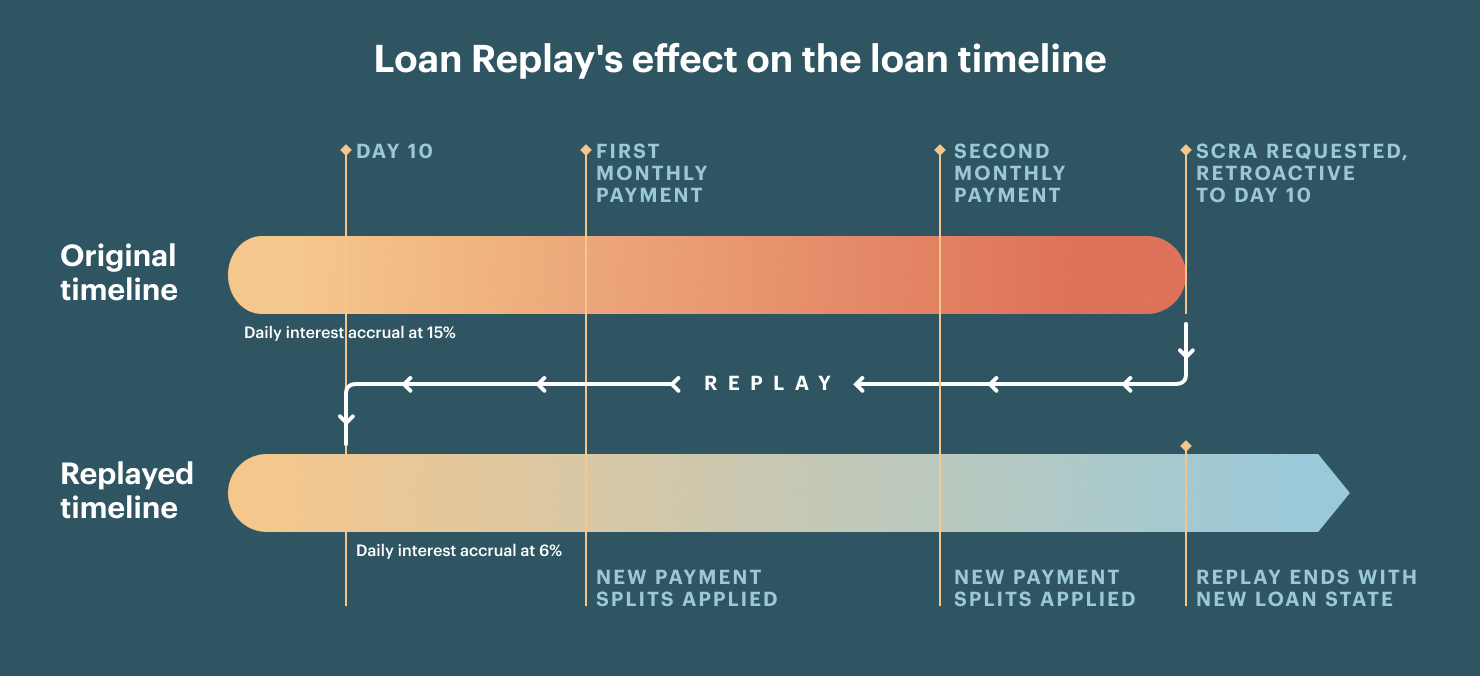
The breadth of loan data needing to be adjusted means that rewriting loan histories requires the right design and abstractions, and having a built-in layer of abstraction to handle retroactive changes is the only feasible approach. Because of our team’s combined experience in the real world of lending, we know that the need to edit past loan events is inevitable. So we’ve designed a system that makes these changes as painless and automated as possible.