The CFPB’s new debt collection rule, Regulation F, lays out important requirements for lenders, servicers and debt collectors. Because Regulation F just recently took effect, we wanted to expand on our previous Regulation F blog post—and to outline some of the ways we’re helping alleviate the Regulation F compliance burden for our customers through smart automation and forward-looking product development.
Who Needs to Comply with Regulation F?
Regulation F is the implementing regulation of the Fair Debt Collection Practices Act (FDCPA), which is written to apply to “debt collectors.” While this seems to exclude creditors and first-party servicers, these entities can in fact be in violation of certain FDCPA requirements according to longstanding CFPB guidance.
As a result, many banks, credit unions, and fintech lenders and servicers have decided it’s important to comply with at least some of Regulation F’s new requirements. For your organization, the decision ultimately comes down to risk tolerance.
What Parts of Regulation F Pose the Greatest Implementation Challenges?
Regulation F introduces several new requirements, including call frequency limits, text and email rules, model validation notices, and additional disclosures. In our prior blog post, we talked about how Peach helps lenders and servicers comply with call frequency limits. Now we’ll cover our approach to two additional provisions that present major implementation hurdles: (1) compliance with “inconvenient time and place” requirements, and (2) safe harbor procedures for text messages and emails.
Challenge 1: Inconvenient Time and Place Requirements
It’s well known in the industry that the FDCPA prohibits debt collectors from contacting consumers for debt collection purposes between 9 p.m. and 8 a.m. But Regulation F clarifies that the FDCPA’s statutory language is actually significantly more restrictive.
- Consumer-Designated Preferences. Regulation F states that a debt collector cannot contact a consumer for debt collection purposes at any time or place “known or which should be known to be inconvenient to the consumer.” This puts the onus on the debt collector to honor consumer requests regarding when and where they want to be contacted. For example, a consumer might ask not to be contacted between 3–5 p.m. on Tuesdays.
- Conflicting Information on the Consumer’s Location. Regulation F adds that if a debt collector has conflicting information about a consumer’s local time zone, it can’t attempt to communicate at a time that would be inconvenient in any of the consumer’s possible locations.
Challenge 2: Safe Harbor Procedures for Text Messages and Emails
Regulation F confirms that text messages and emails can be used for debt collection purposes. At the same time, debt collectors have a responsibility to prevent unintentional third-party disclosures of debt. While debt collectors are free to implement their own procedures, Regulation F outlines specific ones that provide safe harbor protection against unintentional third-party disclosure claims brought under the FDCPA.
How Peach Helps Creditors and Servicers Comply with Regulation F
One of the challenges with legacy solutions is that most lack a thoughtful and ongoing commitment to compliance. As regulations evolve, these legacy solutions typically require significant resource investments to power manual processes and ad-hoc solutions.
By contrast, Peach allows creditors and servicers to swiftly implement an automated plan to comply with new federal and state requirements. You can instantly turn on any of our new Regulation F capabilities.
Solution 1: Inconvenient Time and Place Requirements
Peach’s proprietary Compliance Guard™ solution automates compliance for inconvenient time and place requirements. We capture consumer-designated preferences on inconvenient times and places and issue an alert to block any communication attempts that would be in violation. Compliance Guard also scans multiple borrower data points to ensure that outbound communications are made during compliant periods if there’s ambiguity about where the borrower resides. Compliance Guard applies to debt collection calls, texts and emails.
Solution 2: Safe Harbor Procedures for Text Messages and Emails
Peach makes it easy for organizations to take advantage of Regulation F’s new safe harbor protections for text messages and emails if they choose.
- For text messages, Peach’s Compliance Guard modules have been updated to obtain re-consent from consumers and to provide scanning of the Federal Communications Commission’s Reassigned Numbers Database to confirm that phone numbers have not been reassigned. As with other automated rules, Compliance Guard would recommend blocking any non-compliant text messages.
- For emails, Peach’s platform already tracks consents and opt-outs, ensuring that consumer requests are promptly stored and honored.
While Regulation F introduces additional regulatory complexity for lenders and servicers alike, and raises the stakes for staying compliant, Peach’s compliance-by-design approach makes it easy for our customers to stay ahead of ever-evolving regulations like Regulation F.
If you’d like to learn more about how Peach can help your organization automate compliance while providing a best-in-class servicing experience, email us at info@peachfinance.com.
lender’s priority list. But that doesn’t mean compliance is straightforward, even for lenders with the most earnest intentions. Often, legacy infrastructure is the culprit, making it difficult for lenders to take the actions clearly outlined in the law. Even regulations that haven’t changed for some time—like the—still present significant challenges for many lenders.
The SCRA grants active-duty service members the ability to request certain protections during the period of their deployment, enabling them to devote their energy to serving the country. These protections include a reduction in interest rate to a maximum of six percent on any pre-service loans. While the SCRA in its current version has been law since 2003, the number of recent enforcement actions indicates just how difficult it is for many lenders to comply with the SCRA’s interest rate protections.
Blunt tools in the absence of a scalpel
For example, in October of 2022 the Department of Justice (DOJ) announced that the financial leasing arm of GM agreed to pay over $3.5 million to resolve allegations in relation to
Peach’s approach to SCRA
At Peach, we brought real-life lending experience to the design of our platform. So from day one, we recognized the importance of being able to make retroactive changes to loans. (There are numerous applications beyond SCRA, including our Supported Portfolio Migration.) In the case of SCRA, Peach has long enabled lenders to retroactively change interest rates and waive past fees—as separate, manual actions.
Peach’s approach to SCRA
This was functional, but the ideal way to implement SCRA is to make these changes simultaneously. We now support this capability by leveraging the power of Peach's Loan Replay™ engine, which can make changes to the ledger at any time, and then recalculate a loan’s history in light of those changes. The new combined functionality is as user-friendly for your agents as processing a payment.
Peach’s approach to SCRA
Specifically, the new SCRA feature allows your agents to perform the following adjustments simultaneously on a loan of an active-duty service member:
- Lower interest rates to 6% (and lower the recurring payment during the active-duty period to account for the interest rate reduction)
- Waive fees, if necessary
- Enact these changes retroactively, if necessary, and replay the loan history with the rate and fee adjustments
- Preview the intended changes
“We launched our first product on Peach in six weeks. Eighteen months later.”
John Smith, CMO
Our SCRA functionality is available via API as well as through our white-label agent tool. The white-label agent interface can be seen here:
Peach’s approach to SCRA
Our SCRA functionality is available via API as well as through our white-label agent tool. The white-label agent interface can be seen here:
For those working directly with the API, this can be as simple as sending the following request body to the SCRA endpoint:
You’ll receive a response with either the actual post-SCRA adjusted payment plan or a preview of it. Below is a comparison of a payment plan prior to the SCRA adjustment, and the expected payments after the SCRA adjustment. The SCRA period is in effect for the first two months, and thus you will see the interest rates lowered to 6% in the response body (and the recurring amount due lowered by the amount of the interest rate reduction for the two relevant months). The origination fee has also been canceled.
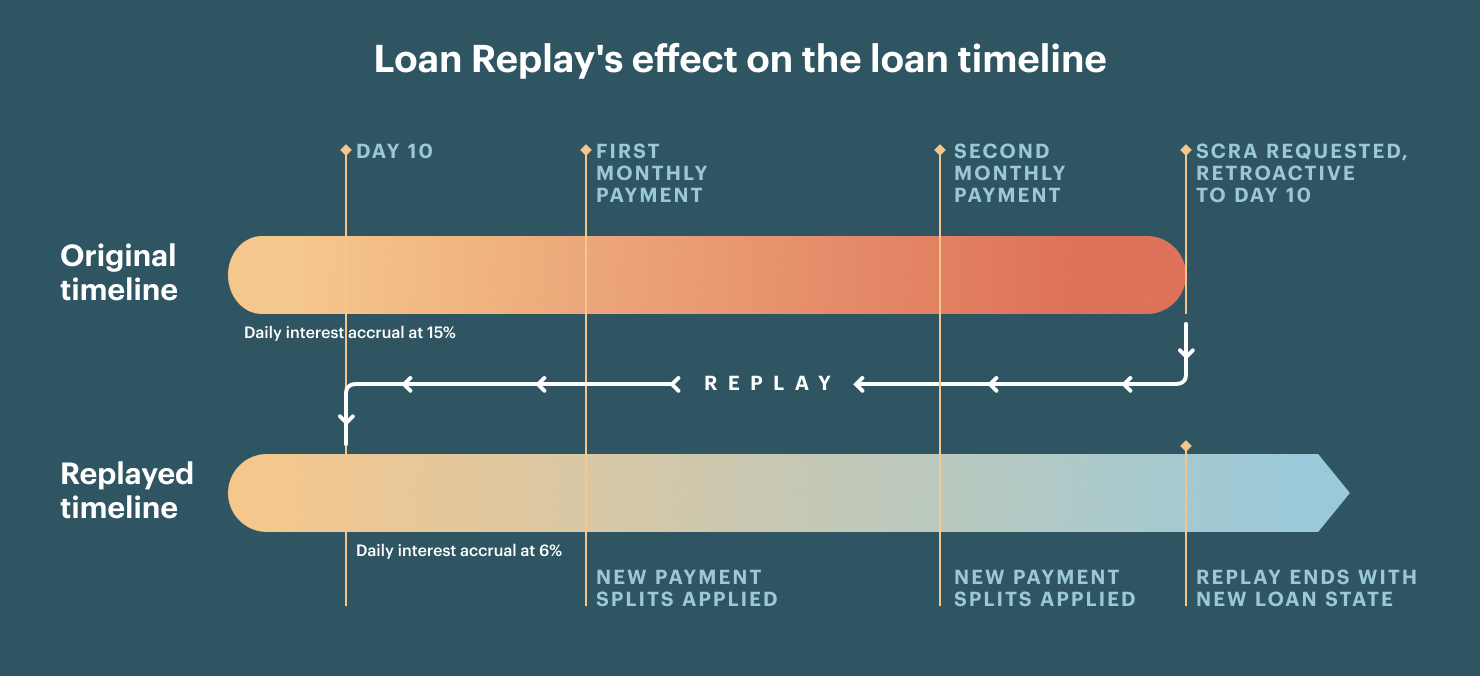
The breadth of loan data needing to be adjusted means that rewriting loan histories requires the right design and abstractions, and having a built-in layer of abstraction to handle retroactive changes is the only feasible approach. Because of our team’s combined experience in the real world of lending, we know that the need to edit past loan events is inevitable. So we’ve designed a system that makes these changes as painless and automated as possible.