Launching a new lending program means that compliance must be in place before the first loan goes out the door, not something to configure after the program is live.
Every loan issued under a non-compliant configuration is a liability that's far easier to correct early on than to remediate weeks or months into an active portfolio.
This checklist of loan servicing compliance requirements is a practical pre-launch reference and not legal advice, focused on consumer and specialty lender products, such as BNPL, personal loans, credit cards, and business lending. It doesn’t cover mortgage lending, where the compliance landscape is different.
Why Compliance Needs to Be Ready Before You Launch
Retrofitting compliance after the first loan goes out is always more expensive than building it correctly before. Correcting disclosures, reprocessing fees, notifying borrowers of errors, and reconstructing audit trails after the fact carries a cumulative cost that exceeds what it would have taken to verify the setup in the first place.
That exposure compounds with every loan that follows a non-compliant configuration.
Federal and state-level scrutiny on consumer lending has increased, particularly for newer product types. The Consumer Financial Protection Bureau (CFPB) continues to issue guidance for BNPL offerings through market monitoring orders and published research, while state regulators have moved to fill gaps where federal rules have not yet settled.
A program that launches without accounting for that regulatory environment is making assumptions about what it can and cannot do that may already be outdated.
Most regulations governing consumer lending are also not new, but enforcement actions keep coming. The Servicemembers Civil Relief Act (SCRA) has been law since 2003, and enforcement actions for SCRA violations have continued for over a decade. The problem is rarely that lenders do not know the rule, but that their infrastructure does not reliably catch the cases to which the rule applies.
The same considerations apply whether an established lender is expanding into a new product or a fintech is launching its first lending program. In either case, compliance should be built into servicing operations before the first loan is originated.
The Pre-Launch Loan Servicing Compliance Checklist
Loan servicing covers the operational management of a loan from issuance through final payoff, and its core functions include payment processing, billing, borrower communication, delinquency management, regulatory reporting requirements, and loan-level data accuracy. Each carries compliance obligations that must be configured and verified before the first loan books.
Those responsibilities look different depending on the lending product. [BNPL] programs, for example, often involve dynamic repayment schedules, higher transaction volumes, and a merchant layer that creates operational complexity standard installment loan frameworks were not designed to handle. Accurate management and auditing of promotional programs and product returns add another layer that standard servicing setups rarely account for.
Borrowers also arrive from a checkout experience, not a loan application, which shapes their expectations around transparency, simplicity, and how disputes and returns are handled.
How BNPL Loan Servicing Works: Core Functions and Requirements
The lending compliance checklist below is organized around the core servicing functions lenders should review before launch. Working through each area individually makes it easier to identify compliance gaps before they affect borrowers or require costly remediation.
Disclosures and Terms
Required pre-loan disclosures must reflect the actual product terms, including the fee schedule, the payment structure, the APR or finance charge calculation method (if applicable), and any conditions that alter those terms.
For BNPL and personal loan products governed by the Truth in Lending Act (TILA) and Regulation Z, the disclosure requirements specify what information must appear, how it must be presented, and when it must be delivered before the borrower is legally obligated to the loan terms.
There are also state-specific requirements to account for, as different states mandate itemizations, right-to-cancel notices, or plain-language summaries beyond the federal minimum. A single disclosure template applied uniformly across states is almost always inadequate for a multi-state program.
Before the program goes live, confirm that:
- The disclosed fee schedule and payment structure match what the system will actually apply.
- State-level disclosure requirements have been reviewed for every state where the program will operate.
- The mechanism for delivering disclosures meets the requirements of the product type and each applicable state.
Payment Processing and Servicing Setup
Payment configuration failures are among the most common sources of compliance problems in new lending programs. Common issues include grace periods that don’t apply correctly, retry logic that triggers fees outside the permitted window, and autopay setups that do not honor borrower cancellations.
The Telephone Consumer Protection Act (TCPA) governs outbound communications to borrowers, including calls and texts.
A program that sends automated payment reminders without verifying borrower contact preferences or state restrictions is issuing non-compliant communications from day one.
Before launch, confirm that:
- Payment schedules, retry logic, and grace periods have been configured and tested against actual loan scenarios.
- Payment reminders, confirmations, and delinquency notices include required disclosures and are sent at the appropriate time.
- Email and SMS preferences, including opt-in and opt-out requirements, are correctly handled at origination.
Delinquency and Collections Readiness
Every lending program will have delinquent loans. The question is whether the collections workflow is compliant before the first one appears, or whether the team is building after complaints start.
The Fair Debt Collection Practices Act (FDCPA) governs how debt collectors communicate with borrowers during collections, and Regulation F sets the specific contact rules that implement it. State-level rules vary, and a single national collections workflow applied across all states creates exposure in at least some of them.
The right-to-cure window can begin in 30 days in one state and 10 days in another, and some states impose stricter contact frequency limits than the federal baseline.
Review whether:
- Grace periods, late fee policies, and escalation paths have been clearly defined for each product and verified against Reg F.
- Collections workflows account for state-level rules that differ from the federal baseline, and the system enforces those variations.
Credit Reporting Readiness
Whether a product will report to credit bureaus is a decision that needs to be made and documented before the program goes live. Getting the reporting setup right matters, but so does having a clear process for correcting errors when they surface.
For programs that will report to credit bureaus, Metro 2 is the industry standard file format for Equifax, Experian, and TransUnion. Each bureau requires a data furnisher relationship and a subscriber identifier number before reporting can begin. Under the Fair Credit Reporting Act (FCRA), a data furnisher that reports inaccurate information and fails to correct it after a dispute is flagged is in violation. That means the correction workflow needs to be in place before the first file goes out.
Key items to review include:
- Whether Metro 2 file generation is configured and subscriber identifiers are secured.
- Whether SFTP delivery has been tested and confirmed before the first file is submitted.
- Whether a process exists to identify and correct reporting errors before any borrower data is furnished to the bureaus.
- Whether there's a correction workflow that connects bureau dispute notifications to updates in the servicing system and an accurate file in the next reporting cycle.
Audit Trail and Monitoring
Compliance depends on being able to demonstrate what happened, when it happened, and why. This means that every action taken on a loan must be recorded from the day operations start. There should also be a process for flagging non-compliant configurations before the program goes live, not only after an examination exposes them.
Some compliance obligations go further than recordkeeping and require real-time detection and automatic case creation. An example is SCRA. Even though it hasn’t changed in decades, it still catches lenders off guard because it requires retroactive changes to loans. The infrastructure has to spot the case before the next communication goes out.
Simply put, when a borrower receives deployment orders after taking out a loan, their protections apply from the activation date. If the servicing system waits for the borrower to flag this themselves, non-compliant communications may have already gone out in the interim.
Confirm the following are operational before issuing the first loan:
- Every loan-level action can be logged and retrieved, including payments, account modifications, and borrower communications, with retroactive changes preserved rather than overwritten.
- Non-compliant configurations are detected and flagged before they reach production.
- Compliance requirements such as SCRA are supported at the infrastructure level, including the ability to apply retroactive loan adjustments when a borrower becomes eligible.
- Portfolio monitoring is running against relevant borrower status lists on a defined schedule, with cases opening automatically on a match.
- Pre-send compliance checks run on every outbound communication before delivery, enforcing channel restrictions and contact frequency limits at the program level.
[Peach's Compliance Guard] handles the monitoring, case creation, and pre-send checking for lenders, all of which support internal reviews and regulatory examinations.
Ongoing Regulatory Monitoring
Launch day isn't the finish line. Consumer lending requirements continue to evolve, and servicing operations need a process for keeping pace with new guidance and changing state regulations.
For example, in BNPL, federal regulatory attention has not resolved into a fixed set of requirements. A program without an active process for tracking developments would eventually operate on assumptions that may already be outdated.
As part of your ongoing compliance program, make sure:
- Someone is responsible for monitoring CFPB guidance and state-level regulatory changes.
- Compliance reviews continue after launch and don’t end post-implementation.
- Servicing configurations are updated whenever products expand or regulatory requirements change.
How Peach Supports Compliance Before and After Launch
Completing a loan servicing compliance checklist before launch helps reduce operational risk and avoid costly rework down the line. Every item on the checklist represents work that can be handled before the first loan books or turn into a bigger, more expensive problem once the portfolio is active.
Compliance Guard, built into Peach's loan servicing platform, helps lenders manage many of the areas covered in this checklist. It automates monitoring, case creation, pre-send checks, and audit trail controls, tasks that are often handled manually and are easy to miss under pressure.
Compliance Guard Monitor regularly scans active borrowers against the DoD active duty list, bankruptcy court filings, and the OFAC SDN list. When a match is found, a case is automatically created and pre-filled with the relevant borrower details, so servicing teams can act immediately rather than piecing together what triggered the flag.
Compliance Guard Rules check every outbound communication before it leaves the platform. Channel restrictions and contact frequency limits are enforced at the program level, with no agent override, helping stop non-compliant messages before they reach borrowers.
Audit trail requirements are handled at the ledger level with every loan-level action logged in a permanent record. When changes are made, the original entry is retained rather than deleted, so there is always a traceable history of what happened and when.
If a retroactive correction is needed, such as an SCRA rate adjustment that should have applied from a borrower's activation date, Peach’s Loan Replay™ feature recalculates the loan history from that point forward, reaccruing interest and reapplying payments under the corrected terms.
Compliance Guard isn’t a one-time setup. It continues monitoring as rules and programs change over time. This helps keep servicing operations audit-ready long after the first loan is issued.
See how Peach’s Compliance Guard keeps your program audit-ready.
lender’s priority list. But that doesn’t mean compliance is straightforward, even for lenders with the most earnest intentions. Often, legacy infrastructure is the culprit, making it difficult for lenders to take the actions clearly outlined in the law. Even regulations that haven’t changed for some time—like the—still present significant challenges for many lenders.
The SCRA grants active-duty service members the ability to request certain protections during the period of their deployment, enabling them to devote their energy to serving the country. These protections include a reduction in interest rate to a maximum of six percent on any pre-service loans. While the SCRA in its current version has been law since 2003, the number of recent enforcement actions indicates just how difficult it is for many lenders to comply with the SCRA’s interest rate protections.
Blunt tools in the absence of a scalpel
For example, in October of 2022 the Department of Justice (DOJ) announced that the financial leasing arm of GM agreed to pay over $3.5 million to resolve allegations in relation to
Peach’s approach to SCRA
At Peach, we brought real-life lending experience to the design of our platform. So from day one, we recognized the importance of being able to make retroactive changes to loans. (There are numerous applications beyond SCRA, including our Supported Portfolio Migration.) In the case of SCRA, Peach has long enabled lenders to retroactively change interest rates and waive past fees—as separate, manual actions.
Peach’s approach to SCRA
This was functional, but the ideal way to implement SCRA is to make these changes simultaneously. We now support this capability by leveraging the power of Peach's Loan Replay™ engine, which can make changes to the ledger at any time, and then recalculate a loan’s history in light of those changes. The new combined functionality is as user-friendly for your agents as processing a payment.
Peach’s approach to SCRA
Specifically, the new SCRA feature allows your agents to perform the following adjustments simultaneously on a loan of an active-duty service member:
- Lower interest rates to 6% (and lower the recurring payment during the active-duty period to account for the interest rate reduction)
- Waive fees, if necessary
- Enact these changes retroactively, if necessary, and replay the loan history with the rate and fee adjustments
- Preview the intended changes
“We launched our first product on Peach in six weeks. Eighteen months later.”
John Smith, CMO
Our SCRA functionality is available via API as well as through our white-label agent tool. The white-label agent interface can be seen here:
Peach’s approach to SCRA
Our SCRA functionality is available via API as well as through our white-label agent tool. The white-label agent interface can be seen here:
For those working directly with the API, this can be as simple as sending the following request body to the SCRA endpoint:
You’ll receive a response with either the actual post-SCRA adjusted payment plan or a preview of it. Below is a comparison of a payment plan prior to the SCRA adjustment, and the expected payments after the SCRA adjustment. The SCRA period is in effect for the first two months, and thus you will see the interest rates lowered to 6% in the response body (and the recurring amount due lowered by the amount of the interest rate reduction for the two relevant months). The origination fee has also been canceled.
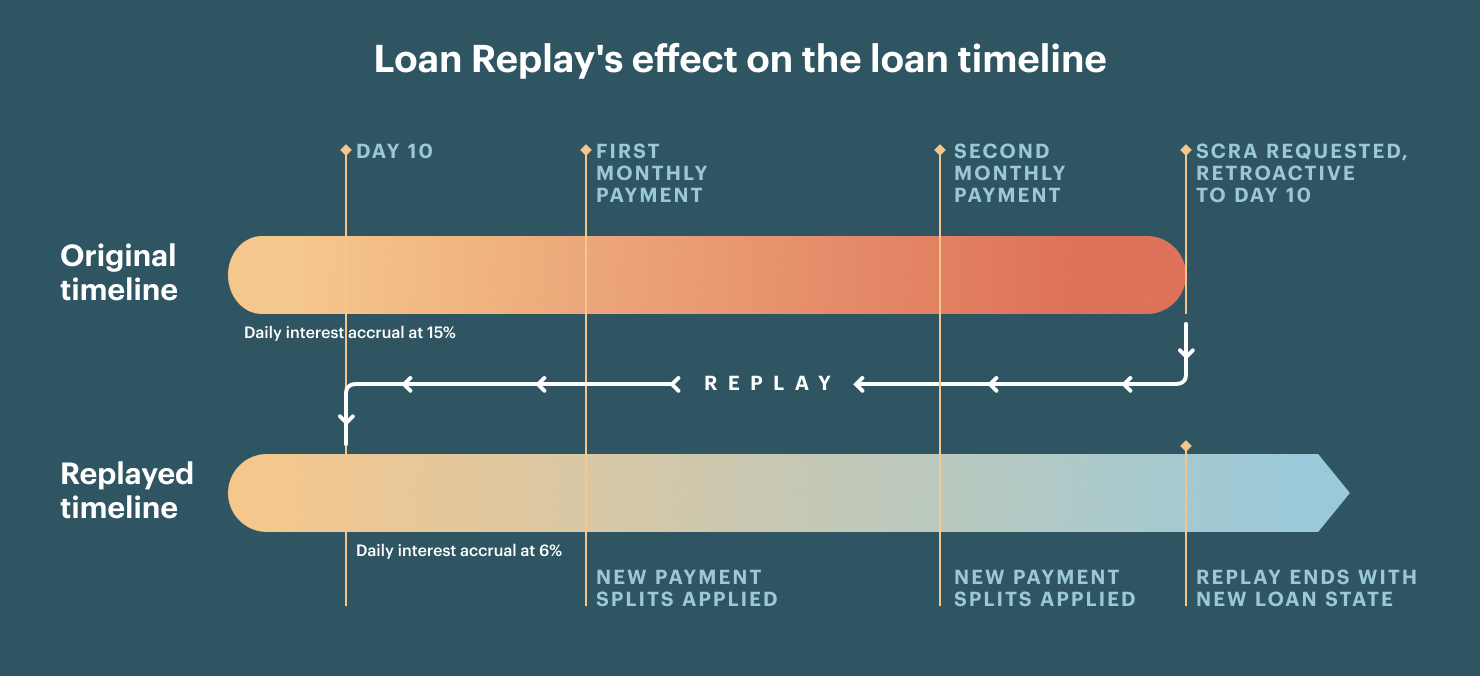
The breadth of loan data needing to be adjusted means that rewriting loan histories requires the right design and abstractions, and having a built-in layer of abstraction to handle retroactive changes is the only feasible approach. Because of our team’s combined experience in the real world of lending, we know that the need to edit past loan events is inevitable. So we’ve designed a system that makes these changes as painless and automated as possible.