Loan approvals can take seconds. What comes after is where the real work begins.
Once a BNPL loan is issued, the payment schedule needs to run on time, the retry logic needs to fire when a payment fails, a delinquency sequence must start when installments are missed, and if the purchase gets returned three weeks later, the loan balance has to recalculate from that date forward without breaking the ledger.
Most BNPL conversations focus on the origination and checkout. But the lender-side operational and regulatory complexity starts after the loan is live. Regulation F and state-level rules all apply, and have to run at BNPL scale: high volume, thin margins, and very little room for manual work.
That's what BNPL servicing is about. And as regulatory oversight tightens and the market grows, post-origination operations are becoming the variable that determines whether a BNPL product stays profitable.
What is Buy Now, Pay Later (BNPL)?
BNPL is a short-duration consumer credit product that splits purchases into installments, typically repaid over six to twelve weeks at 0% APR. For lenders, it's still a loan, but one that demands the same servicing infrastructure as traditional credit, compressed into a shorter window and delivered at much higher volume.
As regulatory security increases, particularly from the Consumer Financial Protection Bureau (CFPB) and at the state level, servicing infrastructure is becoming more critical because many BNPL programs are being treated like other consumer credit products for operational and compliance purposes.
What Is Loan Servicing, and How Does It Apply to BNPL?
Loan servicing is the operational management of a loan from issuance to payoff. It includes payment processing, installment scheduling, billing, borrower communication, delinquency management, regulatory reporting, and ledger accuracy. These functions run continuously from the moment a loan is issued until the final payment clears.
BNPL loan management follows the same servicing principles but introduces additional operational requirements. Compared with traditional installment lending, servicing infrastructure must support:
- Short repayment windows: Most BNPL products resolve in a matter of weeks, though some high-ticket financing programs on platforms like Peach extend up 12 months or up to 48 months. Either way, servicing functions run on a tighter, more compressed schedule than a traditional installment loan would require.
- High transaction volume: Large portfolios of small loans require automation at scale, with no dependency on manual review.
- Merchant-driven complexity: Each loan is tied to a specific purchase from a specific merchant, so returns, reversals, and partial refunds flow directly through the loan record.
- Borrower expectations: BNPL users don't think of themselves as loan customers when selecting a payment option at checkout. Servicing must match the checkout experience while remaining compliant.
Why BNPL Servicing is Becoming More Complex
BNPL transaction volume has grown roughly 20% annually since 2021, reaching an estimated $70 billion in 2025. During the 2025 holiday season alone, consumers financed about $20 billion in online spending with BNPL.
As BNPL expands beyond apparel and electronics into groceries, travel, and everyday spending, lenders must service far more loans across more merchants while managing payments, refunds, borrower communications, and compliance at scale.
Repayment performance is also becoming more challenging. While charge-off rates remain relatively low at 1.83%, roughly 40-42% of BNPL users have made at least one late payment in the previous year. At the same time, the CFPB found that more than three-fifths of borrowers held multiple BNPL loans simultaneously, with one-third borrowing from more than one provider.
As portfolios grow and regulatory expectations evolve, efficient post-origination operations are becoming essential in operating efficient BNPL programs. Lenders need [servicing platforms] that can automate high-volume workflows while maintaining accuracy and compliance.
How BNPL Loan Servicing Works: Core Functions and Requirements
BNPL servicing means managing several operational areas, each with unique requirements that standard loan servicing infrastructure wasn't built to handle. The functions below form the operational backbone of a BNPL program after origination.
Payment Scheduling and Installment Management
Every installment on a BNPL loan must be tracked independently, processed on schedule, and updated in real time as conditions change. When a payment fails, retry logic should run automatically, and accounts that exhaust retries should escalate without manual intervention.
The platform also needs to support multiple repayment structures natively without custom engineering, whether that's pay-in-4, bi-weekly, or monthly.
Returns, Reversals, and Retroactive Recalculation
A return on a BNPL loan is more than a refund. The purchase amount changes, installment schedules must be recalculated, and any fees applied tied to the original balance may need adjustment, all while keeping the original ledger entries intact for audit and compliance purposes.
During peak return windows, thousands of returns can hit within a matter of days. Platforms that can't handle these changes automatically end up pushing significant manual work onto ops teams.
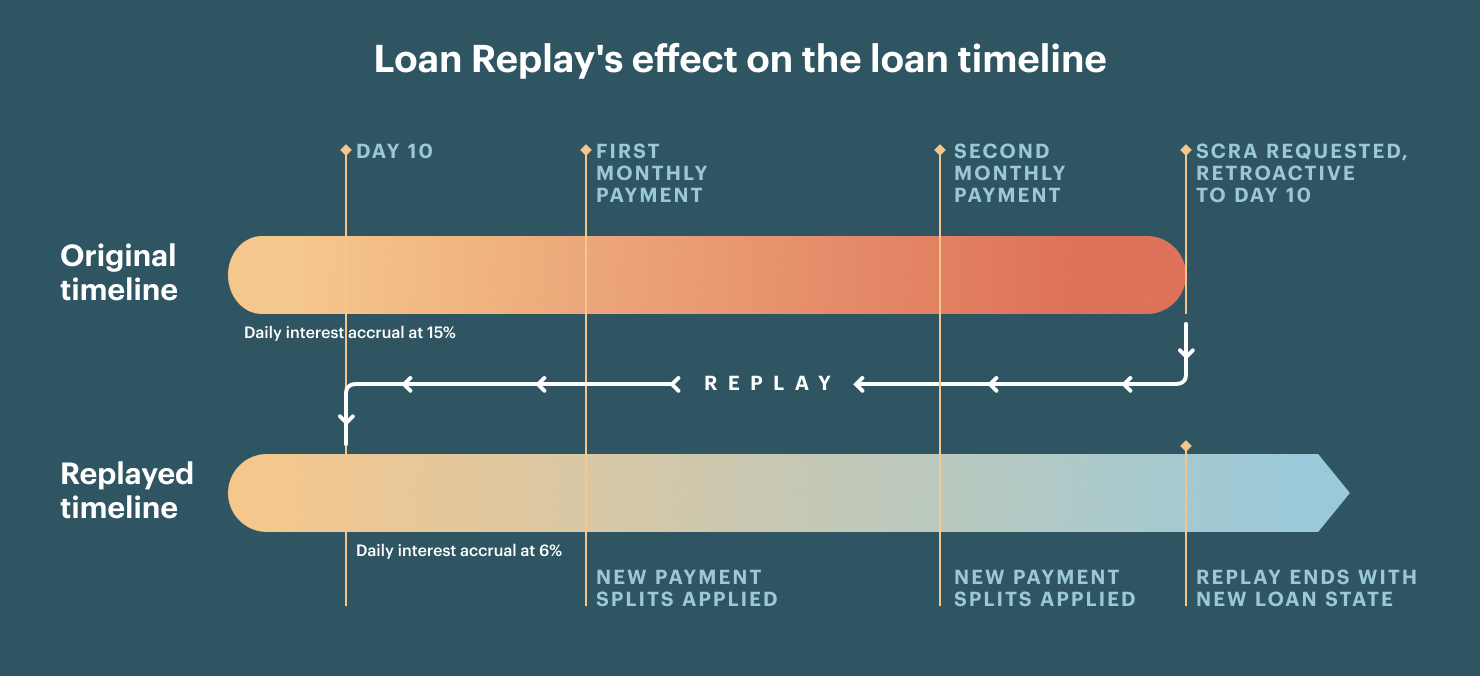
Loan Replay™ is designed for exactly this scenario. When a return or reversal occurs, it replays the loan history forward from the date of the change, reaccruing interest at the correct rate and reapplying payments against the updated balance. The original ledger entries are invalidated rather than overwritten, and the entire process runs automatically, no spreadsheets required.
Split Shipments and Multi-Merchant Loans
Some purchases unfold in stages and require funding to be released over time, such as home improvement projects with multiple funding stages, medical procedures with separate advances for each step, or an order split across multiple merchants. In these cases, each capture needs to be tracked independently on the same loan record.
Standard installment infrastructure wasn’t built for this model. It assumes one disbursement tied to one purchase, which forces lenders to either build custom logic for each merchant relationship or rely on a platform that supports multi-capture lending natively.
Multi-Capture Installment Loan™ was designed to handle this complexity. Each merchant capture is recorded independently within a single loan record, with its own timing, amount, and status. It also calculates periodic payments based on the initial advance schedule and accrues interest accurately based on the actual dates for each advance. That means a partial refund or issue with one capture doesn’t impact the others, and no custom code is required per merchant.
Borrower Communication and Notifications
Payment reminders, confirmations, statements, and delinquency notices need to match the borrower’s checkout experience. That means honoring channel preferences (email, SMS), handling opt-in and opt-out correctly, and delivering required disclosure requirements on jurisdiction.
The communication layer is also where compliance risk is highest. Contact frequency limits under the Telephone Consumer Protection Act (TCPA) and the Fair Debt Collection Practices Act (FDCPA) govern every outbound collection contact, whether that’s a reminder or delinquency notice.
If a message goes through the wrong channel, exceeds contact limits, or ignores an opt-out, the risk is already created. Those checks have to happen automatically before a notification is sent, not discovered later in an audit.
Delinquency Management and Collections
When a borrower misses an installment, a defined sequence starts automatically: a grace period, retry logic, late fee application (where permitted), and escalation to collections if the account remains unpaid. Each step has to run in the correct order and in sync with every downstream system connected to that account.
When they don't, disputes follow. Even on a $100 BNPL loan, a single dispute can cost more to resolve than the loan earns.
Delinquency workflows must also operate within strict regulatory boundaries:
- Regulation F governs debt collection practices at the federal level
- CFPB guidance has tightened compliance expectations for how BNPL delinquencies are handled
- State-level rules can be even more restrictive
Despite their low balance, BNPL loans are subject to the same contact restrictions, disclosure, and audit trail requirements as larger personal loans, with a fraction of the margin to absorb any manual work.
Credit Reporting
Historically, most BNPL programs have not reported to the credit bureaus, but that’s changing. Metro 2 file generation, timely payment status reporting, and correction workflows for disputed or adjusted trades are becoming standard operational requirements rather than one-time configurations. As loan statuses change through payments, returns, or delinquency, reporting has to update in step.
Where many platforms break down is on the correction side. A payment flagged as late may have been received on time but processed after a system delay. In that case, the lender must submit a correction within specific Metro 2 timelines, regenerate the file, and transmit it accurately. At scale, that process can’t rely on manual processes; it has to run automatically across high-volume portfolios.
Compliance and Regulatory Monitoring
The compliance layer in a BNPL servicing platform has two jobs.
First, every outbound message is checked before it’s sent. Messages are validated against the borrower's contact permissions, current loan state, and remaining contact capacity across daily, weekly, and thirty-day windows. There’s no agent override, and every decision is logged to maintain an audit trail.
Second, compliance monitoring runs constantly across the portfolio. [Compliance Guard Monitor] automatically checks active borrowers against external status lists, including bankruptcy filings, OFAC matches, and servicemember activation orders, on a defined schedule. When a match is detected, the system flags the account and opens a case.
At BNPL transaction volumes, manual review isn’t viable. Borrower status changes don’t wait for quarterly reviews, and compliance infrastructure has to detect and act on those changes as they happen.
How BNPL Servicing Differs from Traditional Loan Servicing
Traditional installment servicing infrastructure wasn't built for BNPL economics. Short loan lifecycles, high transaction volume, and merchant-driven complexity introduce challenges that standard loan platforms aren’t designed to handle.
Shorter Lifecycle
BNPL loans typically resolve in six to twelve weeks, often opening and closing before a traditional installment platform completes its first billing cycle. That compressed lifecycle forces every servicing function into a much tighter operating window, leaving far less time to resolve exceptions before the loan reaches payoff.
Higher Volume, Lower Margin
A $75 BNPL loan on a 2% net interest margin generates less than $2 in interest income over its life. If a servicing team member touches that account once to fix an autopay setup or adjusts a due date, the account is a loss. BNPL servicing only works at a margin if it's largely automated.
Merchant Layer
Unlike traditional consumer lending, BNPL introduces a merchant layer that lenders must manage. Returns, refund processing, per-merchant program terms, and merchant-level reporting all flow through the same servicing system. The platform has to reconcile refunds against loan balances, track merchant captures, and support independent merchant terms (0% promotional financing on one, deferred interest on another) without custom engineering for each relationship.
Consumer Expectation Mismatch
Borrowers who choose BNPL at checkout don’t think of themselves as lenders. They selected a payment option at checkout, and they expect the servicing experience to reflect that. Payment notifications/reminders should feel like an order update, and disputes should be resolved through familiar channels. When servicing looks like a bank statement instead of a fintech experience, the friction gets attributed to the merchant, not the lender.
Per-merchant Configurability
BNPL platforms rarely follow a single template. One merchant may offer 0% promotional financing, another deferred interest, and a third a custom repayment structure. Servicing platforms have to support these configurations independently without treating each one as a separate engineering project. Platforms with over 200 configuration variables can support that flexibility without custom code per merchant.
What to Look for in a BNPL Servicing Platform
A BNPL servicing platform needs to handle the following without custom builds per product, per merchant, or per regulation:
- Flexible installment configuration: Pay-in-4, pay-in-3, and monthly repayment structures should be configurable per program without engineering involvement each time a new product or merchant comes online.
- Automated returns and reversal handling: Balances, schedules, and fees should recalculate automatically on a return or partial refund. Ops teams shouldn't be reconciling by hand during peak return windows.
- Multi-capture support: Each merchant capture is tracked independently on the same loan record, out of the box. Split shipments and multi-merchant purchases are handled natively without custom code.
- Automated compliance monitoring: Pre-send checks run before every outbound communication. Portfolio-wide monitoring checks borrower status against external lists on a continuous schedule, rather than relying on periodic manual reviews.
- Real-time payment and status updates across all touchpoints: Every payment event is visible across the platform as it happens, from authorization through settlement, and disputes are resolved inside the servicing system, not a separate tool.
- Programmable infrastructure: [API-first architecture] that integrates with the existing checkout and lending stack. Configuration changes shouldn't require code deployments or release cycles.
lender’s priority list. But that doesn’t mean compliance is straightforward, even for lenders with the most earnest intentions. Often, legacy infrastructure is the culprit, making it difficult for lenders to take the actions clearly outlined in the law. Even regulations that haven’t changed for some time—like the—still present significant challenges for many lenders.
The SCRA grants active-duty service members the ability to request certain protections during the period of their deployment, enabling them to devote their energy to serving the country. These protections include a reduction in interest rate to a maximum of six percent on any pre-service loans. While the SCRA in its current version has been law since 2003, the number of recent enforcement actions indicates just how difficult it is for many lenders to comply with the SCRA’s interest rate protections.
Blunt tools in the absence of a scalpel
For example, in October of 2022 the Department of Justice (DOJ) announced that the financial leasing arm of GM agreed to pay over $3.5 million to resolve allegations in relation to
Peach’s approach to SCRA
At Peach, we brought real-life lending experience to the design of our platform. So from day one, we recognized the importance of being able to make retroactive changes to loans. (There are numerous applications beyond SCRA, including our Supported Portfolio Migration.) In the case of SCRA, Peach has long enabled lenders to retroactively change interest rates and waive past fees—as separate, manual actions.
Peach’s approach to SCRA
This was functional, but the ideal way to implement SCRA is to make these changes simultaneously. We now support this capability by leveraging the power of Peach's Loan Replay™ engine, which can make changes to the ledger at any time, and then recalculate a loan’s history in light of those changes. The new combined functionality is as user-friendly for your agents as processing a payment.
Peach’s approach to SCRA
Specifically, the new SCRA feature allows your agents to perform the following adjustments simultaneously on a loan of an active-duty service member:
- Lower interest rates to 6% (and lower the recurring payment during the active-duty period to account for the interest rate reduction)
- Waive fees, if necessary
- Enact these changes retroactively, if necessary, and replay the loan history with the rate and fee adjustments
- Preview the intended changes
“We launched our first product on Peach in six weeks. Eighteen months later.”
John Smith, CMO
Our SCRA functionality is available via API as well as through our white-label agent tool. The white-label agent interface can be seen here:
Peach’s approach to SCRA
Our SCRA functionality is available via API as well as through our white-label agent tool. The white-label agent interface can be seen here:
For those working directly with the API, this can be as simple as sending the following request body to the SCRA endpoint:
You’ll receive a response with either the actual post-SCRA adjusted payment plan or a preview of it. Below is a comparison of a payment plan prior to the SCRA adjustment, and the expected payments after the SCRA adjustment. The SCRA period is in effect for the first two months, and thus you will see the interest rates lowered to 6% in the response body (and the recurring amount due lowered by the amount of the interest rate reduction for the two relevant months). The origination fee has also been canceled.
The breadth of loan data needing to be adjusted means that rewriting loan histories requires the right design and abstractions, and having a built-in layer of abstraction to handle retroactive changes is the only feasible approach. Because of our team’s combined experience in the real world of lending, we know that the need to edit past loan events is inevitable. So we’ve designed a system that makes these changes as painless and automated as possible.