You had Peach on your shortlist when the acquisition news landed. Maybe legal flagged it. Maybe you caught it yourself and wondered whether the evaluation should wait. It shouldn't. The product you were evaluating still exists, with the same company and the same pre-planned roadmap behind it. The deal also answers a harder question, standalone vendor viability. Peach now sits inside a B2B technology division that already serves institutions across payments, core banking, and risk. Here's what changes, and what doesn't.
Peach joins SoFi Technology Solutions
The part of SoFi that acquired Peach isn't the consumer business most people know.
SoFi runs two separate businesses. One faces consumers directly. The other is SoFi Technology Solutions. That's the B2B side that sells technology to banks, credit unions, fintechs, and enterprise brands. When SoFi announced the acquisition of Peach Finance in May 2026, the buyer was the infrastructure division, not the consumer business.
SoFi Technology Solutions had already run this model twice before Peach arrived.
Galileo came in first, in 2020. Technisys followed in 2022. Both are part of the same B2B division today.
Peach joins that structure as the third.
Peach Finance was founded in 2018 by Eddie Oistacher, who remains co-founder and CEO. Oistacher built a servicing and processing platform for lenders. It's the software that runs credit cards, lines of credit, BNPL products, and installment loans after a borrower has been approved. In his public remarks around the acquisition, he said, "eight years ago, we started Peach with a simple belief that lending infrastructure could be built better."
Lending infrastructure, in this context, means the systems that carry a loan after it's been made. Not underwriting, not origination. What follows: statements, payments, collections, customer communications, compliance. That's what Peach handles. It's the layer that runs a loan portfolio day to day, and it was absent from the stack SoFi Technology Solutions had assembled.
Post-origination servicing was the gap, and Peach fills it. Six years, three acquisitions, each in a different zone of the same stack.
Peach continues operating under its own name. Peach's team moves into SoFi Technology Solutions alongside Galileo and Technisys. What changed is the structure Peach sits inside. It's a dedicated B2B division, three infrastructure companies deep.
What changes about the product you're evaluating
Right now, nothing on the platform changes. Peach continues to operate as Peach today, working to its pre-planned roadmap for the near term. Changes to that roadmap are communicated in advance.
Peach also keeps running its own systems.
Longer term, Peach looks forward to drawing on SoFi's technology to expand what the platform can do as integration progresses. That's a direction, not a dated commitment. This is an active integration, and the full picture isn't complete yet.
Borrower data and the competitive question
Galileo and Technisys were already inside SoFi Technology Solutions when Peach joined. The division serves institutions that compete with SoFi's consumer business.
SoFi keeps strict rules on client information and on each client's customer information.
Now that Peach is part of that organization, the same rules cover Peach's client base too.
What Peach's platform covers today
The handoff happens at disbursement. Everything before that, KYC, underwriting, origination, runs through one system. Everything after lands in another. Think about what that other system looks like in your own operation. A loan management platform here, a collections tool there, a compliance tracking spreadsheet that lives in someone's drive and gets updated when something breaks.
Peach's Servicing Suite covers that entire post-origination period as one integrated piece. The suite handles the borrower side through a white-labeled portal and the agent side through a white-labeled CRM. Communications run across five channels. Email, SMS, phone, direct mail, and chat. Collections is part of the same suite, not a separate tool bolted on at the edge.
That's the scope. What the platform does inside that scope is the bigger question.
Compliance Guard
A warning-based compliance tool works like a yellow light. An agent approaches a restricted action, the system flags it, and the agent decides whether to proceed. Compliance Guard doesn't give agents that decision.
When an action breaks a program-level rule, the system stops it. Agents can't get around that block. It covers the Fair Debt Collection Practices Act, Servicemembers Civil Relief Act, Telephone Consumer Protection Act, Regulation F, rules on unfair, deceptive, or abusive practices, and the Bankruptcy Code.
Massachusetts caps collection calls at two per seven-day window. If that limit rests on agent discipline and call logging, it fails when call volume is high, agents are rushed, or records are incomplete. Compliance Guard tracks that interaction window and blocks calls over the cap. The rule isn't something an agent is expected to track. It's a constraint the platform holds.
The system also spots certain borrower conditions outside of agent actions. It opens those cases on its own. That covers active military duty under the Servicemembers Civil Relief Act, deceased borrower status, bankruptcy filings, OFAC and SDN matches, and FEMA disaster declarations.
Data access and support
Clients pull their loan data through four paths. Direct API, webhooks, a database replica pushed to GCS or Snowflake on the client's own schedule, and loan tapes.
Setup and technical calls go to Solutions engineers who work through integration questions directly. They're a separate team from the engineers who built Peach's core product code.
What the combined stack now makes possible
Picture an institution building a credit product from scratch.
A core banking system from one vendor. A processing platform from another. Payments infrastructure from a third. Risk and fraud tooling from a fourth. Before the first account opens, there are four separate contracts, four integration projects, and four vendor relationships to manage.
SoFi Technology Solutions covered much of that before May 2026. Four platforms spanning cloud-based processing, banking core ledgers and services, payments, and risk and fraud. For a bank or credit union evaluating where to simplify infrastructure, that was a meaningful starting point. But it stopped at the point where a loan funds.
Servicing keeps a credit program running once accounts open. That's where interest accrues, statements go out, and borrowers make payments. Processing turns those transactions into accurate, current account states. Payments moves money across the underlying rails. Collections reaches borrowers who fall behind. A compliance framework says who can be contacted, on which channels, and how often.
Those rules vary by state and carry real regulatory exposure.
Customer engagement is the day-to-day relationship with the borrower for the life of the account. Communications, dispute resolution, hardship management, and account servicing across a loan that may sit on the book for years.
SoFi Technology Solutions had the infrastructure side of that picture. Peach held the post-funding operating side.
Peach's servicing and processing cover credit cards, lines of credit, installment lending, and BNPL. BNPL lets borrowers split a purchase into fixed installments instead of paying everything upfront. Add that to what SoFi Technology Solutions already offered, and the full credit lifecycle fits inside one technology relationship. Core banking, processing, payments, risk and fraud, servicing, collections, and customer engagement. None of it has to come from separate providers now.
That matters for how a program actually runs. Every vendor handoff is one more integration to keep running. When a product change touches three separate systems, three teams have to align on the timeline.
When something breaks at a boundary between systems, two contracts govern the fix. No single party owns the outcome cleanly.
SoFi says partners working with it can ship new credit products faster and cut the operational complexity of managing separate vendors.
A client launching a traditional credit card can get core banking, processing, payments, and risk and fraud under one roof, plus servicing and collections to manage the book after it funds. Same scope for a flexible line of credit. Same scope for a BNPL program.
Banks, credit unions, fintechs, and enterprise brands that have been buying those capabilities from separate providers have a different option now. Whether it fits a particular program depends on existing contracts, integration needs, and technical roadmap limits. Those are questions for a direct conversation with the Peach team.
Peach expects the move into SoFi Technology Solutions to expand the resources and infrastructure behind the platform. The stated aim is to serve a wider range of clients and offer expanded capabilities over time.
What this means for your evaluation
Peach is now the servicing and processing arm of SoFi Technology Solutions, SoFi's B2B technology division. More detail about how the two organizations come together will be shared as integration proceeds.
If Peach was on your shortlist before the news, it belongs there now. Continue the evaluation. And if the data question matters to your program, put it on the agenda for your next Peach conversation.
lender’s priority list. But that doesn’t mean compliance is straightforward, even for lenders with the most earnest intentions. Often, legacy infrastructure is the culprit, making it difficult for lenders to take the actions clearly outlined in the law. Even regulations that haven’t changed for some time—like the—still present significant challenges for many lenders.
The SCRA grants active-duty service members the ability to request certain protections during the period of their deployment, enabling them to devote their energy to serving the country. These protections include a reduction in interest rate to a maximum of six percent on any pre-service loans. While the SCRA in its current version has been law since 2003, the number of recent enforcement actions indicates just how difficult it is for many lenders to comply with the SCRA’s interest rate protections.
Blunt tools in the absence of a scalpel
For example, in October of 2022 the Department of Justice (DOJ) announced that the financial leasing arm of GM agreed to pay over $3.5 million to resolve allegations in relation to
Peach’s approach to SCRA
At Peach, we brought real-life lending experience to the design of our platform. So from day one, we recognized the importance of being able to make retroactive changes to loans. (There are numerous applications beyond SCRA, including our Supported Portfolio Migration.) In the case of SCRA, Peach has long enabled lenders to retroactively change interest rates and waive past fees—as separate, manual actions.
Peach’s approach to SCRA
This was functional, but the ideal way to implement SCRA is to make these changes simultaneously. We now support this capability by leveraging the power of Peach's Loan Replay™ engine, which can make changes to the ledger at any time, and then recalculate a loan’s history in light of those changes. The new combined functionality is as user-friendly for your agents as processing a payment.
Peach’s approach to SCRA
Specifically, the new SCRA feature allows your agents to perform the following adjustments simultaneously on a loan of an active-duty service member:
- Lower interest rates to 6% (and lower the recurring payment during the active-duty period to account for the interest rate reduction)
- Waive fees, if necessary
- Enact these changes retroactively, if necessary, and replay the loan history with the rate and fee adjustments
- Preview the intended changes
“We launched our first product on Peach in six weeks. Eighteen months later.”
John Smith, CMO
Our SCRA functionality is available via API as well as through our white-label agent tool. The white-label agent interface can be seen here:
Peach’s approach to SCRA
Our SCRA functionality is available via API as well as through our white-label agent tool. The white-label agent interface can be seen here:
For those working directly with the API, this can be as simple as sending the following request body to the SCRA endpoint:
You’ll receive a response with either the actual post-SCRA adjusted payment plan or a preview of it. Below is a comparison of a payment plan prior to the SCRA adjustment, and the expected payments after the SCRA adjustment. The SCRA period is in effect for the first two months, and thus you will see the interest rates lowered to 6% in the response body (and the recurring amount due lowered by the amount of the interest rate reduction for the two relevant months). The origination fee has also been canceled.
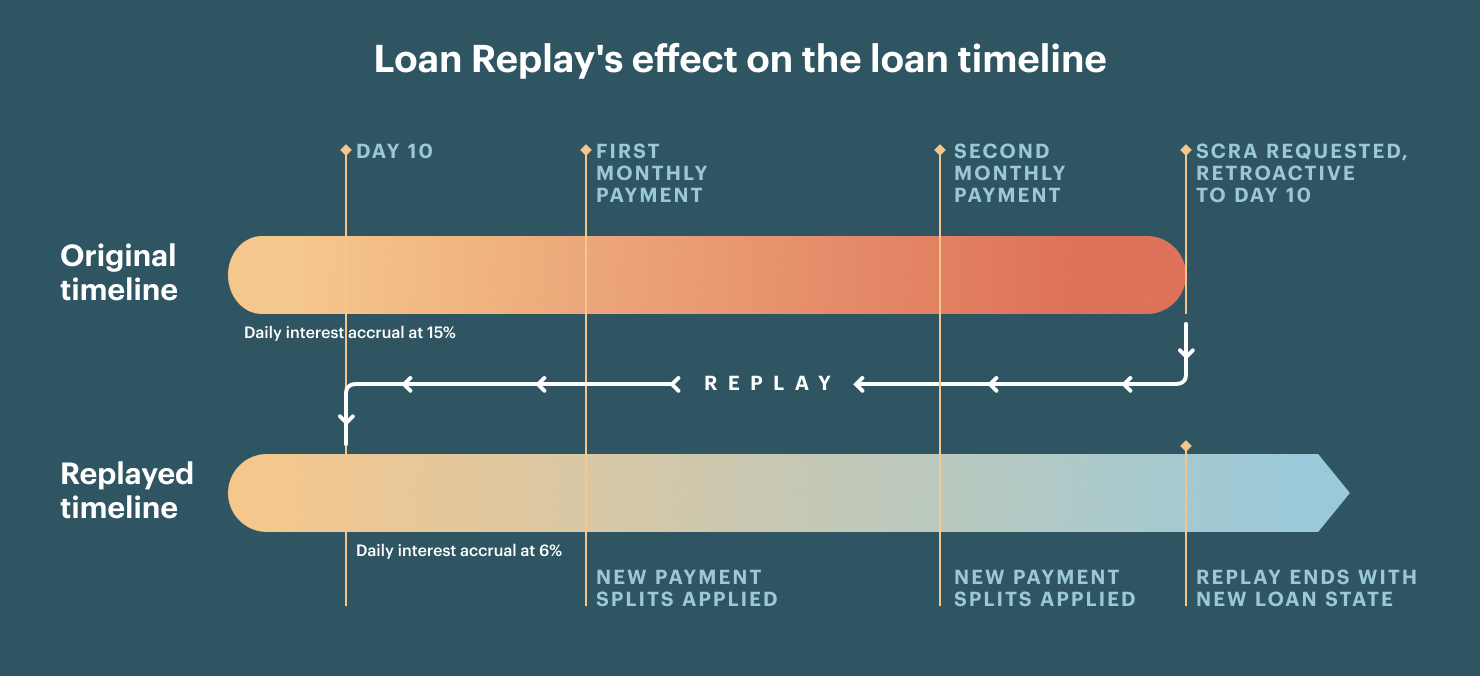
The breadth of loan data needing to be adjusted means that rewriting loan histories requires the right design and abstractions, and having a built-in layer of abstraction to handle retroactive changes is the only feasible approach. Because of our team’s combined experience in the real world of lending, we know that the need to edit past loan events is inevitable. So we’ve designed a system that makes these changes as painless and automated as possible.