READ THE FULL ARTICLE ON FINTECH NEXUS
According to Cornerstone’s 2023 What’s Going On in Banking report, 94% of banks have already embarked on a digital transformation strategy—or plan to do so by the end of 2023. This is a pretty convincing data point, and it leaves little doubt that financial institutions (FIs) are doing everything they can to modernize. And yet very few FIs are near the end of their modernization journey, which means significant opportunities remain.
For FIs, modernization can take many forms. One of the most obvious is the adoption of emerging technologies like cloud computing, APIs, machine learning and blockchain. At a more granular level, FIs are focused on modernizing around various themes like digital onboarding, digital lending initiatives and fraud management.
From our conversations with FIs at Peach Finance, we’re most familiar with initiatives related to modernizing core lending infrastructure—that is, loan management and servicing software. Because of the inherent complexity of lending software, modernization can feel risky due to the possibility of service interruptions, loss of data integrity and compliance violations. With potential downsides like these, it can feel like there’s never really a good time to take the plunge into lending modernization. But the longer FIs wait, the further behind they find themselves in terms of their flexibility, customer experience and support for novel product constructs.
So the question becomes, When is the least bad time to modernize? Generally speaking, FIs have more to lose when the economy is booming and credit is flowing. During these times, the risks of modernization loom larger and it can be harder to justify taking your foot off the gas to make platform improvements. So it’s times of economic uncertainty—such as we find ourselves in now—that may be the best opportunity for FIs to invest in modern lending infrastructure that positions them for future growth.
There are a few key areas of lending infrastructure where FIs should consider accelerating their modernization efforts.
1. Loan management system configurability
The loan management system (LMS) is the heartbeat of lending programs in the sense that it determines lenders’ flexibility to launch new products, accommodate evolving regulations and make product configuration changes on the fly. LMS modernization can go in a couple of different directions...(article continued on Fintech Nexus)
lender’s priority list. But that doesn’t mean compliance is straightforward, even for lenders with the most earnest intentions. Often, legacy infrastructure is the culprit, making it difficult for lenders to take the actions clearly outlined in the law. Even regulations that haven’t changed for some time—like the—still present significant challenges for many lenders.
The SCRA grants active-duty service members the ability to request certain protections during the period of their deployment, enabling them to devote their energy to serving the country. These protections include a reduction in interest rate to a maximum of six percent on any pre-service loans. While the SCRA in its current version has been law since 2003, the number of recent enforcement actions indicates just how difficult it is for many lenders to comply with the SCRA’s interest rate protections.
Blunt tools in the absence of a scalpel
For example, in October of 2022 the Department of Justice (DOJ) announced that the financial leasing arm of GM agreed to pay over $3.5 million to resolve allegations in relation to
Peach’s approach to SCRA
At Peach, we brought real-life lending experience to the design of our platform. So from day one, we recognized the importance of being able to make retroactive changes to loans. (There are numerous applications beyond SCRA, including our Supported Portfolio Migration.) In the case of SCRA, Peach has long enabled lenders to retroactively change interest rates and waive past fees—as separate, manual actions.
Peach’s approach to SCRA
This was functional, but the ideal way to implement SCRA is to make these changes simultaneously. We now support this capability by leveraging the power of Peach's Loan Replay™ engine, which can make changes to the ledger at any time, and then recalculate a loan’s history in light of those changes. The new combined functionality is as user-friendly for your agents as processing a payment.
Peach’s approach to SCRA
Specifically, the new SCRA feature allows your agents to perform the following adjustments simultaneously on a loan of an active-duty service member:
- Lower interest rates to 6% (and lower the recurring payment during the active-duty period to account for the interest rate reduction)
- Waive fees, if necessary
- Enact these changes retroactively, if necessary, and replay the loan history with the rate and fee adjustments
- Preview the intended changes
“We launched our first product on Peach in six weeks. Eighteen months later.”
John Smith, CMO
Our SCRA functionality is available via API as well as through our white-label agent tool. The white-label agent interface can be seen here:
Peach’s approach to SCRA
Our SCRA functionality is available via API as well as through our white-label agent tool. The white-label agent interface can be seen here:
For those working directly with the API, this can be as simple as sending the following request body to the SCRA endpoint:
You’ll receive a response with either the actual post-SCRA adjusted payment plan or a preview of it. Below is a comparison of a payment plan prior to the SCRA adjustment, and the expected payments after the SCRA adjustment. The SCRA period is in effect for the first two months, and thus you will see the interest rates lowered to 6% in the response body (and the recurring amount due lowered by the amount of the interest rate reduction for the two relevant months). The origination fee has also been canceled.
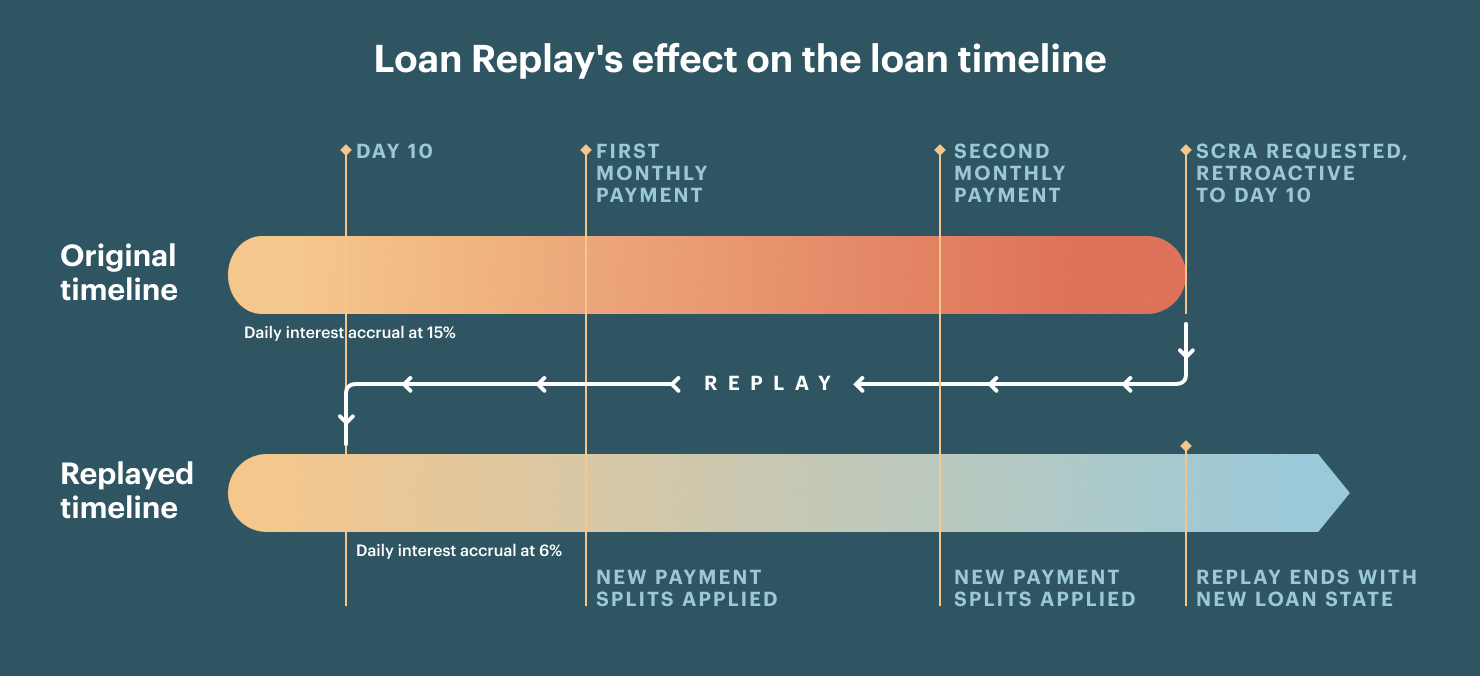
The breadth of loan data needing to be adjusted means that rewriting loan histories requires the right design and abstractions, and having a built-in layer of abstraction to handle retroactive changes is the only feasible approach. Because of our team’s combined experience in the real world of lending, we know that the need to edit past loan events is inevitable. So we’ve designed a system that makes these changes as painless and automated as possible.