Ever had an agent go “oops”? Or gotten a call from someone who is panicked about a missed payment? How about a customer’s purchase dispute getting resolved in their favor? All of these can happen, and when they inevitably do, can your system handle retroactive reconciliation in an automated way?
Unfortunately, many companies face significant back and front office challenges with their existing systems. It’s no easy feat for operations, finance or engineering teams to go back in time to update and reconcile account changes. Changes could mean a variety of things, such as the need to update an interest rate (e.g. SCRA, promotion terms, offers, etc.), or back-date payment dates, or defer a payment, or many more necessary actions. The challenge is making such changes while the loan management system automatically recalculates and adjusts to reflect the new due balance, due dates, payment splits or payment schedules.
Human error, new government regulations, hardship support, or complex refinancing necessitate that systems have the flexibility to change past events—be it a day past or years ago. All of these scenarios push the capabilities of systems to be fault tolerant—and when systems can't keep up, it leads to lost revenue and damaged reputations. Servicing systems must be robust enough to handle real-world scenarios like misplaced payments, regulatory compliance, and offering customer support in a reliable and automated way.
Ultimately, customer experience suffers when inflexible systems cannot meet real-life expectations. Studies show that even one negative experience—like a missed payment fee when the check was lost in the mail, or an agent entering in the wrong payment amount during a phone call—can drive customers away. Systems that cannot flex around real-life scenarios aren’t just putting current revenue at risk, but future revenue, too. Here are some key stats to consider for how impacting customer experience can change revenue growth opportunities:
- According to one of the most well-quoted surveys from American Express, service is the competitive advantage for companies looking to succeed with consumers. ¹
- A Forrester Research study revealed that 63% of customers would abandon a company after a single negative experience. ²
- A PWC study found that 92% of people will leave a company after just two or three bad interactions. ³
- Companies invest time and energy into great customer experiences — and yet studies like these show that it only takes a couple of interactions to potentially negate it all. Having options to change past events helps protect the customer's present relationship, and future cross-sell opportunities, with your company.
Of course, such flexible options must still protect your company’s interests, lower risks, and avoid service delays due to manual calculations or agent escalations. A modern servicing platform that’s considered this need can save your developers and engineers hours in development, testing, and remediation over time.
That’s why Peach built Loan Replay™—a process that lets you service accounts retroactively without the need for manual recalculations or delays in real-time problem solving. We understand that sometimes changes need to be made, but that change doesn’t mean erasing audit history. We’ve built in processes to change past events, save the historical information, and reflect the changes as the present state of the account.
Related: Learn how Peach’s loan management software supports automated retroactive reconciliation and accurate loan servicing.
Let Peach show you how we can help your system become fault tolerant and lower risk with our Adaptive Core™ and Loan Replay capabilities – contact us today.
lender’s priority list. But that doesn’t mean compliance is straightforward, even for lenders with the most earnest intentions. Often, legacy infrastructure is the culprit, making it difficult for lenders to take the actions clearly outlined in the law. Even regulations that haven’t changed for some time—like the—still present significant challenges for many lenders.
The SCRA grants active-duty service members the ability to request certain protections during the period of their deployment, enabling them to devote their energy to serving the country. These protections include a reduction in interest rate to a maximum of six percent on any pre-service loans. While the SCRA in its current version has been law since 2003, the number of recent enforcement actions indicates just how difficult it is for many lenders to comply with the SCRA’s interest rate protections.
Blunt tools in the absence of a scalpel
For example, in October of 2022 the Department of Justice (DOJ) announced that the financial leasing arm of GM agreed to pay over $3.5 million to resolve allegations in relation to
Peach’s approach to SCRA
At Peach, we brought real-life lending experience to the design of our platform. So from day one, we recognized the importance of being able to make retroactive changes to loans. (There are numerous applications beyond SCRA, including our Supported Portfolio Migration.) In the case of SCRA, Peach has long enabled lenders to retroactively change interest rates and waive past fees—as separate, manual actions.
Peach’s approach to SCRA
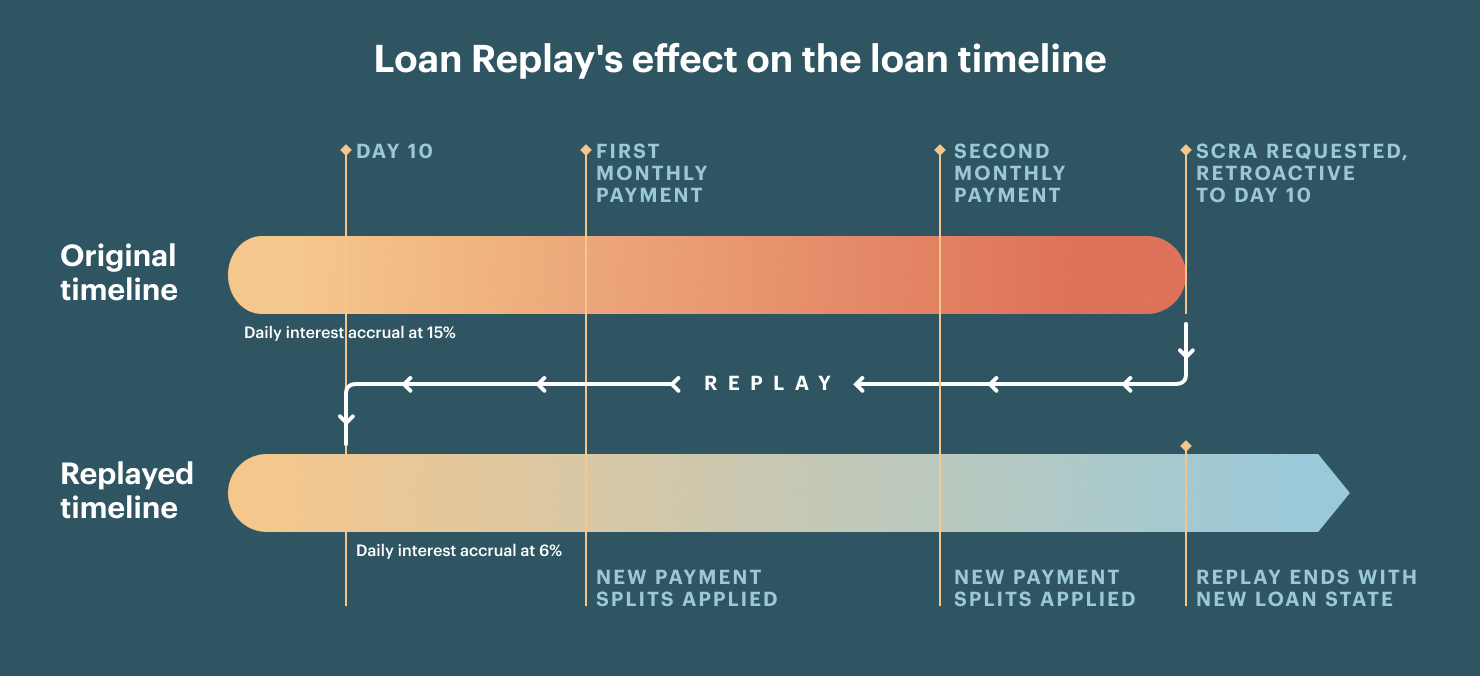
This was functional, but the ideal way to implement SCRA is to make these changes simultaneously. We now support this capability by leveraging the power of Peach's Loan Replay™ engine, which can make changes to the ledger at any time, and then recalculate a loan’s history in light of those changes. The new combined functionality is as user-friendly for your agents as processing a payment.
Peach’s approach to SCRA
Specifically, the new SCRA feature allows your agents to perform the following adjustments simultaneously on a loan of an active-duty service member:
- Lower interest rates to 6% (and lower the recurring payment during the active-duty period to account for the interest rate reduction)
- Waive fees, if necessary
- Enact these changes retroactively, if necessary, and replay the loan history with the rate and fee adjustments
- Preview the intended changes
“We launched our first product on Peach in six weeks. Eighteen months later.”
John Smith, CMO
Our SCRA functionality is available via API as well as through our white-label agent tool. The white-label agent interface can be seen here:
Peach’s approach to SCRA
Our SCRA functionality is available via API as well as through our white-label agent tool. The white-label agent interface can be seen here:
For those working directly with the API, this can be as simple as sending the following request body to the SCRA endpoint:
You’ll receive a response with either the actual post-SCRA adjusted payment plan or a preview of it. Below is a comparison of a payment plan prior to the SCRA adjustment, and the expected payments after the SCRA adjustment. The SCRA period is in effect for the first two months, and thus you will see the interest rates lowered to 6% in the response body (and the recurring amount due lowered by the amount of the interest rate reduction for the two relevant months). The origination fee has also been canceled.
The breadth of loan data needing to be adjusted means that rewriting loan histories requires the right design and abstractions, and having a built-in layer of abstraction to handle retroactive changes is the only feasible approach. Because of our team’s combined experience in the real world of lending, we know that the need to edit past loan events is inevitable. So we’ve designed a system that makes these changes as painless and automated as possible.