The CFPB’s final rules on debt collection issued in October and December 2020 have left creditors and servicers wondering what to do with them. These rules were the result of a 7-year long process and represent the first major rulemaking under the Fair Debt Collection Practices Act (FDCPA) since the law’s inception over 40 years ago. Even with the rules finalized, as described in greater detail below, incoming CFPB leadership has questioned whether the final rules need to be further refined.
By definition, creditors and first-party servicers are excluded from coverage because they are not “debt collectors” under the FDCPA. But even then, creditors and servicers comply with many FDCPA requirements in large part due to longstanding CFPB guidance stating that entities that are not debt collectors could still violate consumer protection laws by engaging in conduct prohibited by the FDCPA. The CFPB’s powers to enforce such violations would not come through the FDCPA itself, but through the CFPB’s broad powers to prohibit unfair, deceptive, or abusive acts or practices (UDAAPs).
One of the notable requirements under the final rules effectively proposes 2 distinct limits on how often debt collectors can call consumers. Subject to limited exceptions, the final rules create a presumption that a debt collector violates the FDCPA if it (a) calls a person more than 7 times within 7 consecutive days; or (b) calls a person within 7 days of having a phone conversation with that person. These limits apply at the per-debt level, with the exception of student loans which may be aggregated by account number.
In the 1000+ pages of the rules’ text, the CFPB expressly refused to apply the new rules to creditors and first-party servicers or take a position on whether any conduct under the rules could give rise to a UDAAP. However, much could change between now and the rules’ effective date of November 30, 2021. The CFPB Director who issued the final rules, Kathy Kraninger, stepped down from her post at the request of the Biden administration in January and is expected to be succeeded by FTC Commissioner Rohit Chopra. On several occasions, FTC Commissioner Chopra has publicly expressed his views that the final rules don’t do enough to protect consumers from abusive debt collection practices. In particular, he has opined that the new phone call frequency limits “seem excessive” and has admonished the CFPB for failing to follow through with its plans to regulate first-party debt collection practices. Earlier this month, Acting CFPB Director Dave Uejio directed CFPB staff to explore options for preserving the status quo with respect to the debt collection rules, sending a strong signal that the final rules could be delayed until the CFPB implements more consumer-friendly requirements with FTC Commissioner Chopra at the helm.
With these developments, the risk is apparent that the CFPB under a new presidential administration will eventually apply at least some aspects of the final rules to creditors and first-party servicers. Prudent creditors and first-party servicers will need to assess the potential impact the final rules could have on their operations and whether, and the extent to which, they might proactively comply with some of the new requirements, at least as we understand them today.
At a time when applicable regulatory requirements appear uncertain and subject to swift amendment, more creditors and servicers are turning to Peach. Peach has developed a suite of services to help creditors and servicers achieve compliance with the complex web of requirements that apply to the servicing and collection of consumer purpose credit. For instance, Peach’s Compliance Guard - Rules module checks outbound servicing and collections-related communications against federal, state, and local laws that apply to creditors and servicers. The Compliance Guard - Rules module automates compliance for requirements under the FDCPA (including unusual time and place restrictions and limitations on third-party contacts) and already incorporates existing call frequency limits in jurisdictions that require them, such as Massachusetts and New York City. As part of the onboarding process, Peach presents creditors and servicers with its catalogue of pre-programmed business and legal rules, which in coordination with Peach, can be tailored to meet a company’s operational needs and risk tolerance. Once in action, Compliance Guard - Rules smartly selects applicable rules by loan type, licensure, servicer or creditor’s charter, and borrower’s state of residency. If the Compliance Guard - Rules module determines that a proposed communication would violate a legal or business requirement, it will recommend blocking the communication attempt.
If you’d like to learn more about how Peach can help creditors and servicers automate compliance, while providing a best-in-class servicing experience, email us at info@peachfinance.com.
lender’s priority list. But that doesn’t mean compliance is straightforward, even for lenders with the most earnest intentions. Often, legacy infrastructure is the culprit, making it difficult for lenders to take the actions clearly outlined in the law. Even regulations that haven’t changed for some time—like the—still present significant challenges for many lenders.
The SCRA grants active-duty service members the ability to request certain protections during the period of their deployment, enabling them to devote their energy to serving the country. These protections include a reduction in interest rate to a maximum of six percent on any pre-service loans. While the SCRA in its current version has been law since 2003, the number of recent enforcement actions indicates just how difficult it is for many lenders to comply with the SCRA’s interest rate protections.
Blunt tools in the absence of a scalpel
For example, in October of 2022 the Department of Justice (DOJ) announced that the financial leasing arm of GM agreed to pay over $3.5 million to resolve allegations in relation to
Peach’s approach to SCRA
At Peach, we brought real-life lending experience to the design of our platform. So from day one, we recognized the importance of being able to make retroactive changes to loans. (There are numerous applications beyond SCRA, including our Supported Portfolio Migration.) In the case of SCRA, Peach has long enabled lenders to retroactively change interest rates and waive past fees—as separate, manual actions.
Peach’s approach to SCRA
This was functional, but the ideal way to implement SCRA is to make these changes simultaneously. We now support this capability by leveraging the power of Peach's Loan Replay™ engine, which can make changes to the ledger at any time, and then recalculate a loan’s history in light of those changes. The new combined functionality is as user-friendly for your agents as processing a payment.
Peach’s approach to SCRA
Specifically, the new SCRA feature allows your agents to perform the following adjustments simultaneously on a loan of an active-duty service member:
- Lower interest rates to 6% (and lower the recurring payment during the active-duty period to account for the interest rate reduction)
- Waive fees, if necessary
- Enact these changes retroactively, if necessary, and replay the loan history with the rate and fee adjustments
- Preview the intended changes
“We launched our first product on Peach in six weeks. Eighteen months later.”
John Smith, CMO
Our SCRA functionality is available via API as well as through our white-label agent tool. The white-label agent interface can be seen here:
Peach’s approach to SCRA
Our SCRA functionality is available via API as well as through our white-label agent tool. The white-label agent interface can be seen here:
For those working directly with the API, this can be as simple as sending the following request body to the SCRA endpoint:
You’ll receive a response with either the actual post-SCRA adjusted payment plan or a preview of it. Below is a comparison of a payment plan prior to the SCRA adjustment, and the expected payments after the SCRA adjustment. The SCRA period is in effect for the first two months, and thus you will see the interest rates lowered to 6% in the response body (and the recurring amount due lowered by the amount of the interest rate reduction for the two relevant months). The origination fee has also been canceled.
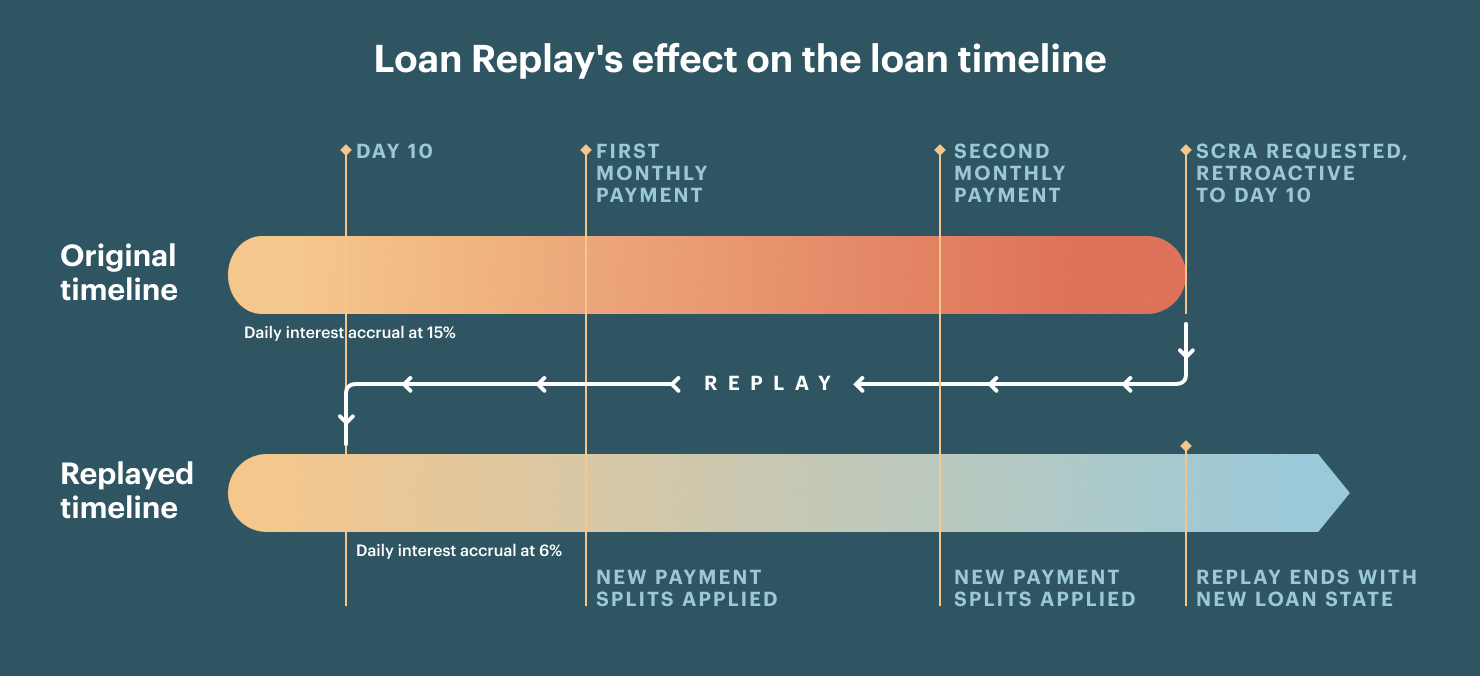
The breadth of loan data needing to be adjusted means that rewriting loan histories requires the right design and abstractions, and having a built-in layer of abstraction to handle retroactive changes is the only feasible approach. Because of our team’s combined experience in the real world of lending, we know that the need to edit past loan events is inevitable. So we’ve designed a system that makes these changes as painless and automated as possible.