Line of credit (LOC) products offer a wide range of options to lenders looking to diversify their portfolio. And while each line of credit offering comes with its own unique challenges and opportunities, we’ve built a servicing solution that is flexible enough to adapt to support multiple products side-by-side. With Peach, lenders can customize and iterate upon critical aspects of their product logic to deliver an offering that meets ever-changing market needs.
How does Peach support LOCs?
- Flexible product and draw type(s): Peach supports both revolving and non-revolving LOCs across a range of constructs like personal lines, business lines, and credit cards. Draws can be set up for different purposes, like cash advances, balance transfers, BNPL Pay over Time, or regular purchases - each with their own terms. Draw flexibility lets lenders design flexible credit programs and repayment schedules to differentiate their product and meet borrower’s financial needs.
- Line of credit structure settings: A line of credit in Peach is designed to support multiple draws (sub-lines) with independent interest rates, fee structures, minimum payment calculations, amortization schedules, and credit limits. Each draw can have its own defined credit limit, interest rate, and amortization schedule. Lenders can also set a draw's credit limit as a percentage of the overall line of credit. Peach will ensure that across multiple draws the total overall LOC credit limit is not exceeded.
- Product Configuration: Peach Loan Types govern the loan behavior, such as the grace period policy, minimum payment amounts, open-to-buy logic, utilization calculation, payment waterfall, and statement generation. Peach takes the lender’s product structure, terms, fees, etc. and configures the product’s granular details during implementation. All product nuances are handled with configuration – not customization.
- Product Configuration – Fees: Peach supports a multitude of fee structures, such as annual fees, purchase fees, draw fees, and late fees. Once configured, fees are automatically triggered upon an event, such as N days past due, foreign transaction purchase, etc., and are then calculated and applied to the line. Fees are configurable by state to meet local regulatory requirements based on the borrower’s residence.
- Event-driven system of record – real-time decisioning: Peach offers real-time ledgering, authorization, and logic management for real-time decisions like card swipe authorization at point of sale and repayment processing. We provide webhooks with message-oriented events related to status, payments, balances, purchases, disputes, and more for real-time, event-driven integration with your other business systems.
- System of record – payments: Our ledgers track granular balances at the line and draw level for accurate interest accruals, statementing, payment application, etc. in an auditable and explainable way. Product configurations include payment waterfall logic that defines balance repayment order at both the individual draw level and across multiple draws on the line. We also support dynamic repayment processing with hold day logic, and Loan Replay for retroactive adjustments.
Managing lines of credit requires flexibility. Borrowers need changes, regulations shift, and unforeseen circumstances arise. Our system provides native, scalable logic – not customizations – to give lenders the ability to make on-demand modifications with automatic downstream processes for notifying the borrower, making past or future schedule adjustments, etc. Retroactive changes like purchase disputes, failed payments, chargebacks, etc. are executed automatically with our Loan Replay functionality. Peach replays each day of the loan’s history from the date of the applied change, reapplying the splits between transaction principal, interest, and fees; reaccruing daily interest on the updated principal balance; and recording the net adjustment to the line as part of the upcoming statement. This eliminates the need for manual engagement or external logic to reconcile adjustments, and enables lenders to remain flexible to servicing needs.
Peach empowers lenders to fully customize their line of credit products from a single, unified system. The configurations mentioned in this article are just a few of what Peach makes available to lenders – there are so many more supported within our 250+ options. Lenders can launch a single line of credit and quickly iterate to service additional options concurrently within the same system. In addition, lenders can continue to diversify their portfolio offerings on Peach by launching any number of new credit products. Dive into how to set up Line of Credit management within Peach in our technical guide.
Build once into Peach’s API-first infrastructure and scale in any direction.
Contact us today to learn more.
lender’s priority list. But that doesn’t mean compliance is straightforward, even for lenders with the most earnest intentions. Often, legacy infrastructure is the culprit, making it difficult for lenders to take the actions clearly outlined in the law. Even regulations that haven’t changed for some time—like the—still present significant challenges for many lenders.
The SCRA grants active-duty service members the ability to request certain protections during the period of their deployment, enabling them to devote their energy to serving the country. These protections include a reduction in interest rate to a maximum of six percent on any pre-service loans. While the SCRA in its current version has been law since 2003, the number of recent enforcement actions indicates just how difficult it is for many lenders to comply with the SCRA’s interest rate protections.
Blunt tools in the absence of a scalpel
For example, in October of 2022 the Department of Justice (DOJ) announced that the financial leasing arm of GM agreed to pay over $3.5 million to resolve allegations in relation to
Peach’s approach to SCRA
At Peach, we brought real-life lending experience to the design of our platform. So from day one, we recognized the importance of being able to make retroactive changes to loans. (There are numerous applications beyond SCRA, including our Supported Portfolio Migration.) In the case of SCRA, Peach has long enabled lenders to retroactively change interest rates and waive past fees—as separate, manual actions.
Peach’s approach to SCRA
This was functional, but the ideal way to implement SCRA is to make these changes simultaneously. We now support this capability by leveraging the power of Peach's Loan Replay™ engine, which can make changes to the ledger at any time, and then recalculate a loan’s history in light of those changes. The new combined functionality is as user-friendly for your agents as processing a payment.
Peach’s approach to SCRA
Specifically, the new SCRA feature allows your agents to perform the following adjustments simultaneously on a loan of an active-duty service member:
- Lower interest rates to 6% (and lower the recurring payment during the active-duty period to account for the interest rate reduction)
- Waive fees, if necessary
- Enact these changes retroactively, if necessary, and replay the loan history with the rate and fee adjustments
- Preview the intended changes
“We launched our first product on Peach in six weeks. Eighteen months later.”
John Smith, CMO
Our SCRA functionality is available via API as well as through our white-label agent tool. The white-label agent interface can be seen here:
Peach’s approach to SCRA
Our SCRA functionality is available via API as well as through our white-label agent tool. The white-label agent interface can be seen here:
For those working directly with the API, this can be as simple as sending the following request body to the SCRA endpoint:
You’ll receive a response with either the actual post-SCRA adjusted payment plan or a preview of it. Below is a comparison of a payment plan prior to the SCRA adjustment, and the expected payments after the SCRA adjustment. The SCRA period is in effect for the first two months, and thus you will see the interest rates lowered to 6% in the response body (and the recurring amount due lowered by the amount of the interest rate reduction for the two relevant months). The origination fee has also been canceled.
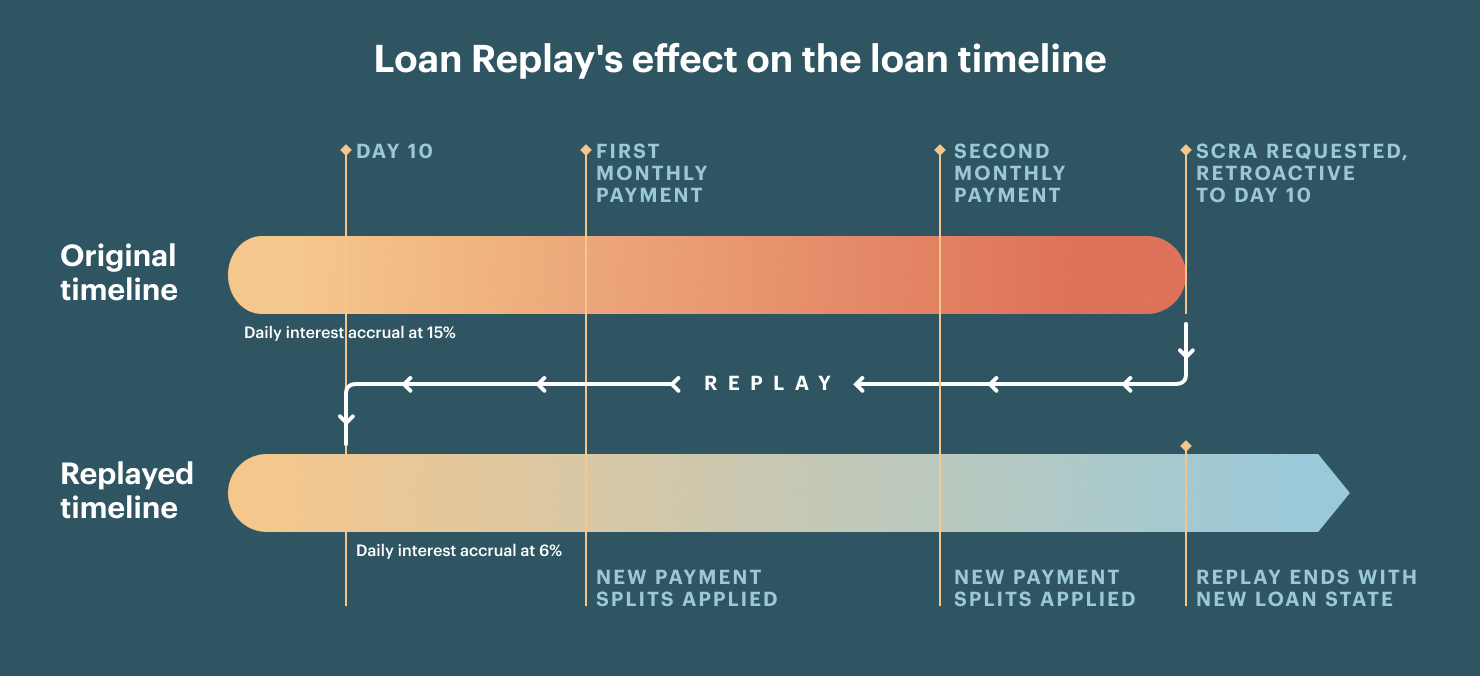
The breadth of loan data needing to be adjusted means that rewriting loan histories requires the right design and abstractions, and having a built-in layer of abstraction to handle retroactive changes is the only feasible approach. Because of our team’s combined experience in the real world of lending, we know that the need to edit past loan events is inevitable. So we’ve designed a system that makes these changes as painless and automated as possible.